
Social Parental Monitoring: Beyond Static Ratings in the IPTV Era
3376_A social approach to parental monitoring over DVB-IPTV digest of technical papers.
This paper introduces a social-based parental monitoring system for DVB-IPTV that utilizes collaborative tagging and trust-based social networks to predict content appropriateness. By combining professional metadata from broadcasters with real-time "folksonomy" tags from parents, the system calculates a Blocking Index to automate content filtering in Internet Protocol television environments.
TL;DR
The traditional model of TV ratings is broken—it's too static and doesn't reflect individual parental values. This paper presents a Collaborative Parental Monitoring System for DVB-IPTV that uses social networks and tag-based similarity to predict what content should be blocked, effectively allowing parents to "delegate" moderation to a trusted community.
The Problem: The Inefficiency of Top-Down Ratings
For decades, we relied on "TV Parental Guidelines" (e.g., PG-13, TV-MA). However, these systems suffer from professional bias and a lack of granularity. In the modern DVB-IPTV landscape, where content flows like the Internet, a centralized authority cannot keep up.
The authors argue that parents don't just want a "Safety Mode"—they want a system that reflects their specific sensibilities. The challenge is: how do you automate this without making every parent watch every show first?
Methodology: Collaborative Tagging and Trust Metrics
The core of the system is the Folksonomy—a collaborative vocabulary created by both the IPTV provider (standard metadata) and the parents (tags like "scary," "inappropriate language," or "educational").
1. Representing Content via Tag Clouds
Every program is assigned a Content Reference Identifier (CRID). The system flattens structured metadata into a "Tag Cloud" (TC). Similarity between two programs is determined using Cosine Similarity, measuring how closely the tag vectors of two different shows align.
2. Measuring User Similarity
The system assumes that if Parent A and Parent B have blocked the same types of programs in the past, their future judgments will likely align.
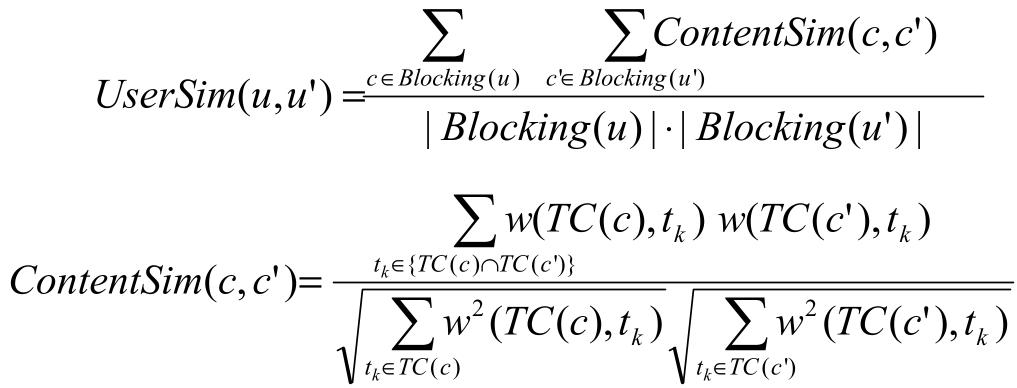
3. The Trusty Collaborative Blocking Index (BI)
The final decision to block is not just a democratic vote. It is a weighted average where the weight is determined by:
- UserSim: How similar is this parent's history to mine?
- Trust: Have I explicitly stated that I trust this parent's judgment?
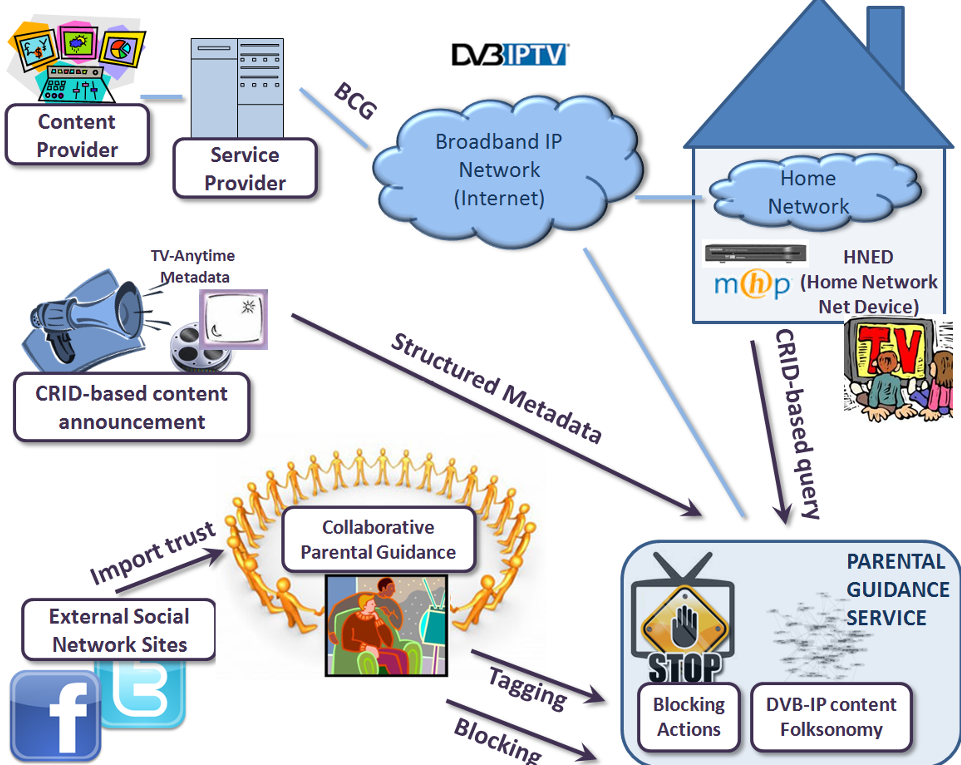 Figure 1: The architecture bridging the Broadcaster (BCG), the Social Network, and the Home Network Device.
Critical Insight: The "Social" Inductive Bias
What makes this work intriguing is the move away from pure AI content analysis (which often fails at cultural context) toward Social Intelligence. By leveraging "Social Knowledge," the system bypasses the "cold start" problem of new content—if a trusted parent in the network tags a new show as potentially harmful, the effect ripples through the network immediately.
Experimental Conclusion & Future Outlook
The prototype proves that social tagging can supplement the Broadcaster Content Guide (BCG) to create a more dynamic filtering environment. However, the authors admit a significant limitation: the current model treats the "Home" as a single unit. In reality, a block that applies to a 5-year-old shouldn't necessarily apply to a 15-year-old in the same house.
Future Work will likely need to focus on multi-user profiles within a single IPTV terminal and the integration of more sophisticated natural language processing (NLP) to resolve ambiguities in user tags.
Takeaways
- Decentralization: Content moderation is moving from central boards to community-driven trust networks.
- Hybrid Metadata: Combining "expert" metadata with "amateur" social tags creates a more robust content profile.
- Trust as Currency: In automated systems, explicit trust relations significantly improve the precision of collaborative filtering.