
Social-P2P: Mimicking Human Intuition to Solve the P2P Resource Discovery Problem
Social Peer-to-Peer for Resource Discovery
The paper introduces Social-P2P, a decentralized resource discovery algorithm that mimics human social interactions and "small-world" phenomena. By leveraging a local knowledge index and semantic interest-area routing, it achieves SOTA performance in unstructured P2P search, significantly outperforming random and basic semantic methods like NeuroGrid.
TL;DR
Social-P2P is a bio-inspired routing algorithm that treats P2P nodes like human acquaintances in a social network. By learning from previous search results and organizing nodes into "spontaneous communities" based on shared interests, it achieves highly efficient resource discovery without the massive overhead of structured DHTs or explicit community management.
Background: Within the landscape of distributed systems, this work sits at the intersection of Social Network Theory (Small-World Phenomenon) and Unstructured P2P Search. It moves away from rigid mathematical structures (like Chord) toward a more fluid, adaptive architecture.
Problem & Motivation: The "Blind Flooding" Dilemma
In unstructured P2P networks, nodes often don't know who has what. This leads to two extremes:
- Blind Flooding: Sending queries to everyone, which kills bandwidth.
- Strict Indexing: Maintaining complex distributed hash tables (DHTs) that break under "churn" (when nodes join and leave frequently).
The authors observed that humans don't have this problem. If you need a rare book, you don't ask every person on earth; you ask a friend who likes literature. Even if they don't have the book, they likely know someone who does. The goal of Social-P2P is to bring this semantic intuition to computer nodes.
Methodology: The Three Phases of Social Search
The core innovation is a three-tiered routing strategy that simulates how we recall information:
- Direct Association: First, checking if any previously contacted node has exactly what is needed.
- Semantic Interest-Area Correlation: If no direct match exists, the node calculates which neighbors are "experts" in the general category (e.g., "Remote Sensing"). It uses a correlation degree formula: where nodes with higher overlap in a specific interest area are prioritized.
- Random Fallback: If the local knowledge index is empty (new nodes), it defaults to random forwarding.
Spontaneous Topology Evolution
Unlike other systems that force nodes into groups, Social-P2P allows connections to evolve. When a search succeeds, a direct link is established. Over time, nodes with similar interests become "highly clustered," creating a Small-World Network naturally.
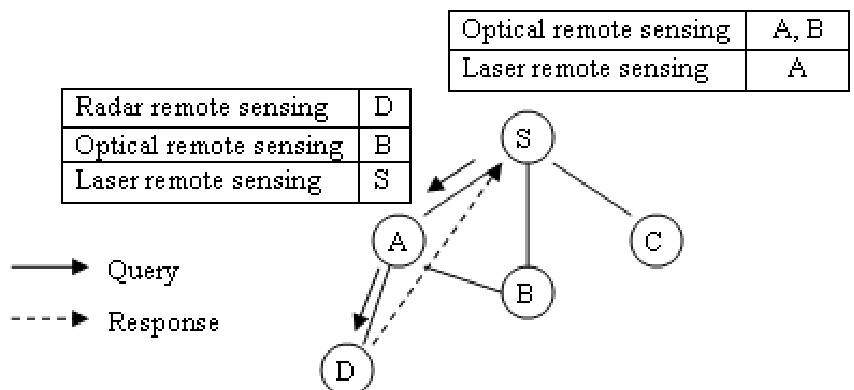 Figure: How a query travels from Node S to Node D by navigating through 'interest-area' experts like Node A.
Experiments & Results: Efficiency Gains
The authors compared Social-P2P against RAN (Random) and NEURO (Basic Semantic Routing).
- Recall & Success: Social-P2P targeted requested files much faster than NEURO. This is because Social-P2P doesn't just look for keywords; it understands "Interest Areas."
- The Power of Small-World: The network's clustering coefficient increased dramatically compared to a random graph, while the "distance" between nodes shrank.
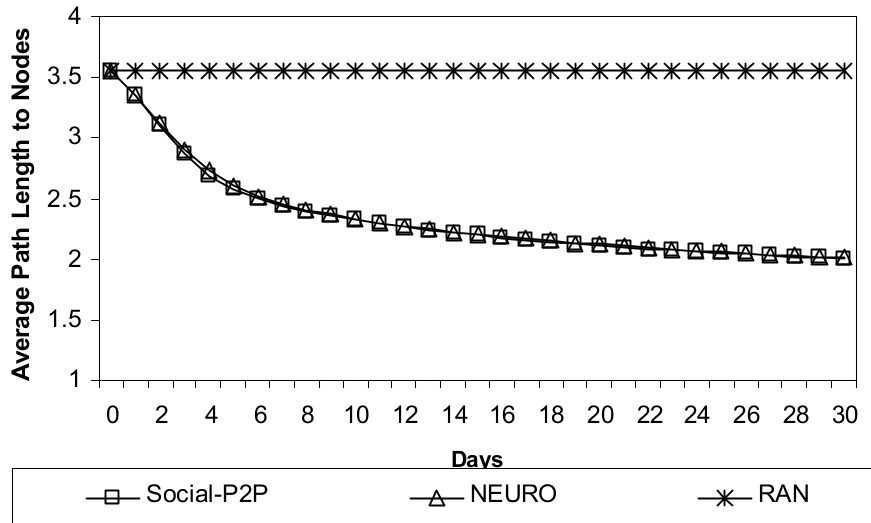 Figure: Social-P2P (top line) consistently achieves higher recall than competing methods over time.
Critical Analysis & Conclusion
Takeaway
The genius of Social-P2P lies in its zero-overhead community management. By letting the network organize itself through "daily searches," it bypasses the complexity of traditional clustering algorithms.
Limitations
- Cold Start: For very rare topics or brand-new nodes, the system still relies on random chance initially.
- Privacy: Nodes must store associations of what others possess, which might raise privacy concerns in sensitive environments.
Future Outlook
As we move toward more decentralized "Edge AI" and "DePIN" (Decentralized Physical Infrastructure Networks), algorithms like Social-P2P offer a blueprint for how millions of diverse devices can find and share resources without needing a central "brain."