
Beyond the Popularity Trap: Discovering the "Unknown but Interesting" via Social Penetration
Unknown but interesting recommendation using social penetration
The paper proposes SPUBI (Social Penetration for Unknown But Interesting items), a recommendation algorithm designed to discover "surprise" content in social networks. By leveraging a novel "Social Penetration" score inspired by physical sound attenuation (Stokes' law), it balances item popularity, user familiarity, and content categories to provide non-obvious yet relevant suggestions.
TL;DR
Standard recommendation algorithms often bore users by suggesting what they already know. This paper introduces SPUBI, an algorithm that uses the physics of sound attenuation to find hidden gems in your social feed—items that are relevant to your interests but far enough outside your immediate circle to be genuinely "new."
Background Positioning: This work bridges the gap between Collaborative Filtering and Social Network Analysis by introducing a "Discovery" layer that prioritizes serendipity over mere similarity.
The "Popularity" Paradox
In modern social networks, we face a stagnation problem. If an item is too popular, you’ve likely seen it already. If an item is recommended by a close friend, it’s probably already in your "knowledge range."
The authors identify a critical motivation: How do we recommend items that are near the border of a user's understanding range—far enough to be unknown, but close enough to be interesting?
Methodology: The Physics of Social Discovery
The core innovation is the application of Stokes’ Law of Sound Attenuation to social data.
1. The Sound of Information
In physics, sound intensity diminishes with distance and the medium it travels through. The authors map this to social networks:
- Intensity (): Represented by Ensemble Popularity Score (EPS).
- Distance (): Represented by Inverse Familiarity Score (IFS) (how rarely you talk to the person who posted it).
- Attenuation Coefficient (): Represented by Inverse Preference Category Score (IPCS) (how much you dislike the category).
This logic ensures that if you are highly interested in a category ( is low), information about it can "travel further" to you from distant acquaintances.
2. Weighted User Actions
Unlike models that treat "Likes" and "Comments" equally, SPUBI calculates a specific Worth Value (WV) for every user based on their individual interaction patterns. This personalizes the Interest Score segment of the recommendation.
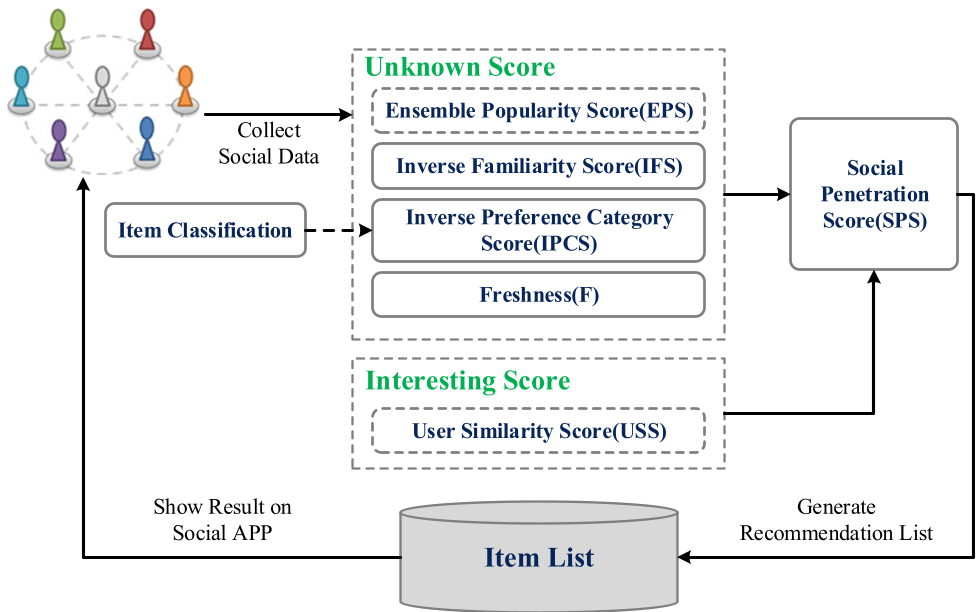 Fig 1: The SPUBI System Architecture, integrating social data collection with the sound-attenuation-based discovery engine.
Experiments: Breaking the Bubble
The authors tested SPUBI against five competitors:
- RN/PN: Recent and Popular News (Traditional).
- TANGENT: A surprise-based graph algorithm.
- UBI/WUBI: Previous iterations of the "Unknown but Interesting" logic.
Key Findings:
- Precision Boost: SPUBI achieved a significant lead in the Top-5 items, where users are most likely to engage.
- Freshness Matters: By including an exponential time-decay function, the model avoided recommending "stale" unknown items, which was a common failure point for older discovery algorithms.
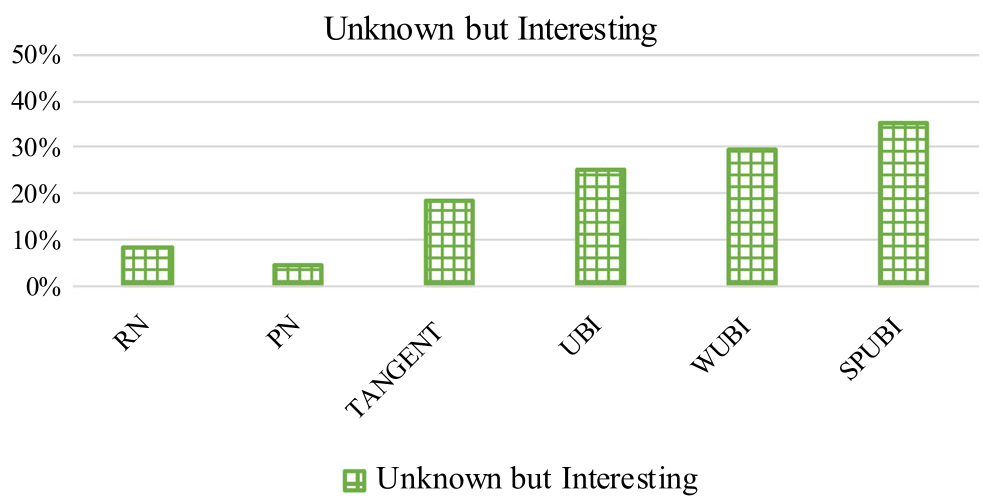 Fig 2: Comparison of precision for "Unknown but Interesting" recommendations across different algorithms.
Critical Insight: Why it Works
The "Social Penetration" metaphor is powerful because it acknowledges that our interest acts as a medium. If I am a "Tech Enthusiast," my "penetration range" for tech news is huge—I want to see tech posts even from people I barely know. However, for "Cooking," my range might be tiny—I only want to see recipes from my inner circle. This dynamic "Discovery Border" is what makes SPUBI feel more human than a standard matrix factorization model.
Conclusion & Limitations
Takeaway: SPUBI effectively solves the "Filter Bubble" by mathematically modeling the distance between familiarity and interest.
Limitations: The reliance on Wikipedia for category mapping (Word Segmentation) might be slow for real-time trending topics and may struggle with slang or multi-lingual nuances in modern social media (like TikTok or X). Future work could likely replace the mmseg4 segmentation with LLM-based embedding clusters for even higher precision.