
Social Plugins: The Bridge Between Community and Commerce
The effect of integrating social plugins into e-commerce website: a study on online consumer behaviour
This paper investigates the impact of integrating Facebook social plugins (e.g., "Like" buttons, comment boxes) into a dedicated e-commerce website. Using an empirical study on a gift shop platform, it measures changes in perceived trust, word-of-mouth (WOM), and purchase intention, finding that while social integration significantly boosts purchase intention (p < 0.05), its effects on trust and WOM are statistically marginal.
TL;DR
Is a Facebook page enough for your business? This paper argues "No," but suggests that bringing Facebook into your website is the secret sauce. By integrating social plugins like "Like" buttons and comment boxes, businesses can significantly boost Purchase Intention, even if it doesn't immediately transform their brand's overall trust rating.
The "SNS-Only" Trap
Many startups opt for a Facebook-only storefront to save costs. The authors identify three critical risks in this strategy:
- Data Dispossession: You don't own your customer profiles; the platform does.
- System Fragility: If the SNS goes down or mistakenly transfers your page to a rival (as happened in a cited case with Merck KGaA), your business vanishes.
- Credibility Gap: A lack of a dedicated domain signals a lack of serious investment, which can alienate skeptical shoppers.
Methodology: The ToHerHeart.com Experiment
The researchers used a real-world online gift shop, ToHerHeart.com, to test how social plugins affect the consumer psyche. They focused on three hypotheses:
- H1 (Trust): Does seeing "Likes" make the site feel safer?
- H2 (WOM): Does the ease of sharing increase viral potential?
- H3 (Purchase): Does the social presence drive the final click to buy?
 Figure 1: Examples of the social plugins integrated into the study environment.
Key Findings: Conversion over Conviction
The study utilized a 5-point Likert scale and a t-test to analyze the results from two participant groups (pre- and post-integration).
The Lead Stat: Purchase Intention Works
The most striking result was that Purchase Intention increased significantly (p = 0.02). Seeing social activity creates a sense of "human warmth" and social presence that mitigates the coldness of a digital storefront, making users more likely to commit to a transaction.
The Trust Paradox
Interestingly, while users were more likely to buy, their Perceived Trust and Word-of-Mouth intentions only saw marginal, non-significant increases. This suggests that social plugins act more as a "nudge" in the final stages of the funnel rather than a foundational brand-building tool.
| Variable | p-value | Supported? |
|---|---|---|
| Perceived Trust | 0.72 | No |
| Word of Mouth | 0.26 | No |
| Purchase Intention | 0.02 | Yes |
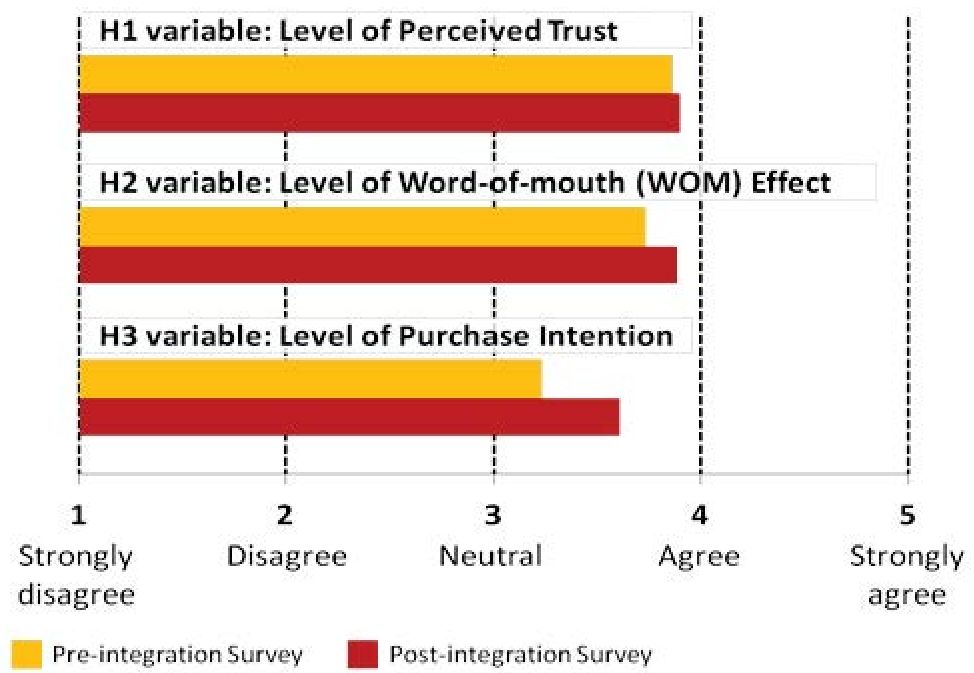 Figure 2: The statistical delta between pre-integration and post-integration scores.
Deep Insight & Conclusion
The "Chained Trust Effect"—the idea that a friend's interaction validates a site—is a powerful psychological lever. However, the study implies that familiarity is just as important. By using Facebook's UI elements, the website leverages the user's existing comfort with those platforms to reduce cognitive friction.
Takeaway for Businesses: Don't abandon your own platform for social media. Instead, "hollow out" the social media platform and bring its most interactive components into your own domain. It is the most effective way to maintain ownership while capitalizing on social proof to drive sales.
Future Outlook: As we move toward more fragmented social ecosystems (TikTok, LinkedIn, etc.), the next challenge will be determining which specific "flavor" of social plugin resonates with different product niches. A "Like" might work for a gift shop, but professional services may require different social signals.