
Social Power Dynamics: How Hierarchies Stabilize in a Noisy World
Social Power Dynamics over Switching and Stochastic Influence Networks
This paper extends the DeGroot-Friedkin (DF) model to analyze social power evolution over switching and stochastic influence networks. It introduces novel discrete and continuous-time frameworks while proving convergence under environment noise and memory-based interaction mechanisms.
TL;DR
How does a stable "pecking order" emerge in a group when our daily interactions are random and noisy? This paper extends the DeGroot-Friedkin (DF) model to prove that even if social networks switch constantly or are plagued by environment noise, social power (influence centrality) still converges to a steady state—provided that individuals have a "memory" of their past status.
Background: The Evolution of Self-Appraisal
In social psychology, the reflected appraisal mechanism suggests that our self-worth is a mirror of how much influence we perceive we have over others. The original DF model combined this with the DeGroot opinion model:
- People discuss an issue and reach a consensus.
- Those whose opinions carried more weight (higher "Social Power") increase their self-appraisal for the next issue.
- Those ignored by the group lose self-confidence.
However, the classic model assumed the "Influence Network" (who listens to whom) stays the same forever. This paper shatters that assumption by introducing Switching and Stochastic Networks.
Problem: The Volatility of Social Influence
Real-world interactions are rarely static. You might listen to Colleague A on technical issues but ignore them on political ones. Previous models struggled with:
- Temporal Switching: The network structure changes issue-by-issue.
- Environment Noise: External factors that distort how social power is perceived.
- The Memory Gap: Humans don't just remember the last interaction; they remember a lifetime of them.
Methodology: Taming Randomness with Math
The authors propose a sophisticated update to the DF model using Stochastic Approximation. The core idea is the introduction of a Memory Mechanism:
 Figure 1: The conceptual flow of the DeGroot-Friedkin model across issues.
The "Tapering Step-Size" Insight
The researchers used a "tapering step-size" (). As time goes on, the weight of a single new interaction slightly decreases compared to the accumulated "mountain" of past experiences. Mathematically, this mirrors how a mature social group becomes resistant to a single outlier event.
Continuous-Time vs. Discrete-Time
A major contribution is the derivation of a Continuous-Time DF Model. By viewing social power as a fluid, evolving ODE (Ordinary Differential Equation), they proved that the system naturally "drains" toward a unique equilibrium point (), provided the network is not a "Star Graph" (where one person is a total autocrat).
Key Results & Evidence
The paper provides rigid proofs for different network topologies:
- Star Networks: Social power inevitably collapses into Autocracy. The center node gains all power at a rate of .
- Non-Star Networks: Social power reaches a Democratic Equilibrium. The convergence is incredibly fast—exponential ().
- Noisy Environments: Even with heavy stochastic noise, the "Self-Appraisal Memory" acts as a low-pass filter, allowing the group to reach the same power distribution it would have in a perfect, noise-free world.
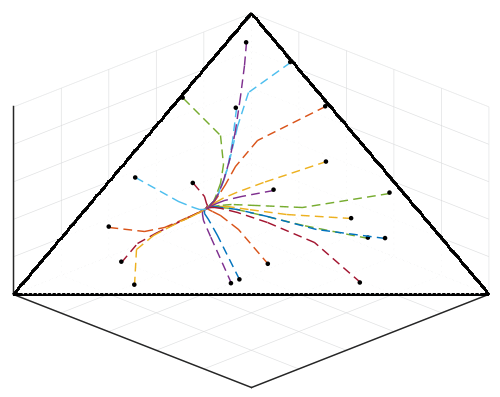 Figure 2: Trajectories of social power converging despite stochastic influence matrices.
Critical Insight: Why Does Memory Matter?
The most profound takeaway is that Memory is the Stabilizer of Society. Without memory, a switching network causes social power to fluctuate wildly—nobody knows who the leader is. With memory, the "law of large numbers" takes over. The random fluctuations of daily life cancel each other out, leaving only the "true" underlying influence structure.
Conclusion & Future Outlook
This work moves social network theory away from "toy models" and toward the messy reality of human interaction. By proving that social power is asymptotically stable under noise, it provides a mathematical explanation for the resilience of social hierarchies.
Future Directions:
- How do Stubborn Agents (people who never change their mind) disrupt this convergence?
- Can this be applied to Reducible Networks where the group splits into two echo chambers?
Paper Reference: Chen, G., Duan, X., Friedkin, N. E., & Bullo, F. (2019). Social Power Dynamics Over Switching and Stochastic Influence Networks. IEEE Transactions on Automatic Control.