
Social Priors: Leveraging Collective Human Signals to Revolutionize Search Relevance
Social priors to estimate relevance of a resource
The paper introduces a social-aware ranking approach that quantifies Web resource importance through external social signals (likes, shares, comments). By modeling collective user interactions as "social priors"—specifically Popularity, Reputation, and Freshness—the authors integrate these into a Language Model (LM) framework to enhance Information Retrieval (IR) performance.
TL;DR
This research moves beyond simple keyword matching by treating social media interactions—likes, shares, and comments—as "social priors." By categorizing these signals into Popularity, Reputation, and Freshness, the authors demonstrate a massive 50% boost in Mean Average Precision (MAP) when integrated into a standard probabilistic Language Model.
Background & Motivation: Why Keywords are No Longer Enough
Classic Information Retrieval (IR) models like BM25 or PageRank view the web as a graveyard of text and static links. However, the modern web is alive. When a user "Likes" a movie on IMDb or "Tweets" a link, they are providing an explicit or implicit vote of confidence.
The authors argue that these "interaction traces" are high-quality indicators of a resource's a priori relevance—meaning its importance regardless of the specific query. The challenge lies in translating chaotic social noise into structured mathematical properties that a search engine can understand.
Methodology: Formalizing Social Properties
The core of the paper is the transformation of raw counts into three distinct Social Properties:
- Popularity (): Measured by the volume of propagation (Shares, Comments). It represents how "known" a resource is.
- Reputation (): Measured by positive endorsements (Likes, +1s, Bookmarks). This represents the "quality" or "trust" assigned by the community.
- Freshness (): Computed using a Gaussian Kernel to decay the value of older social actions, ensuring that "trending" topics are promoted over stale ones.
Architecture: Integrating Priors into Language Models
The authors use a Bayesian approach to update the score of a document for a query :
Here, is not uniform but is the product of the specific social properties derived from the interactions.
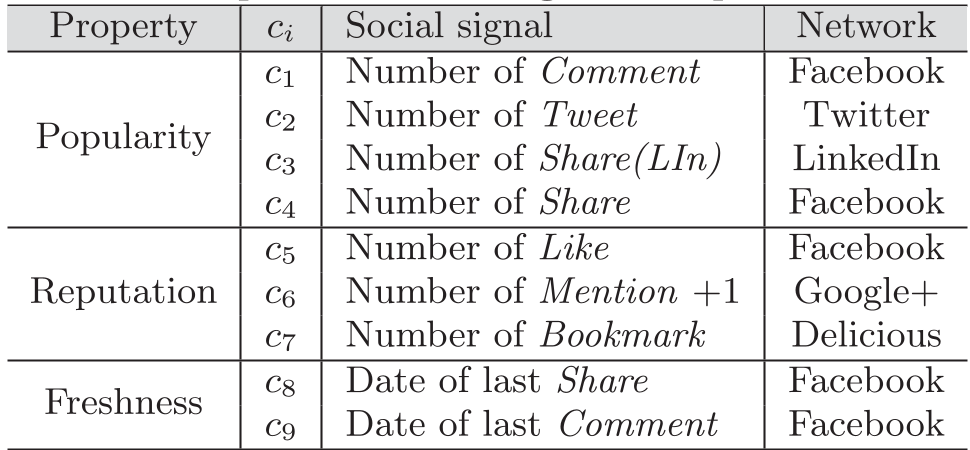 Figure: Categorization of incoming social signals into Reputation, Popularity, and Freshness.
Experimental Insights: What Signals Matter Most?
The study utilized the IMDb dataset, pulling signals from Facebook, Twitter, LinkedIn, Google+, and Delicious.
1. The Power of Combination
While individual signals (like Facebook Shares) improved results, the combination of properties yielded the highest gains. The "All Properties" model significantly outperformed the "All Criteria" baseline, suggesting that grouping signals by their semantic meaning (e.g., all "positive" signals together) provides better regularized information than treating every button-click as a separate feature.
2. Reputation > Popularity
One of the most profound findings: Reputation signals (Likes) were more correlated with true relevance than Popularity signals (Comments). This is intuitive; a comment can be negative or spam, but a "Like" or "+1" is generally an explicit endorsement of value.
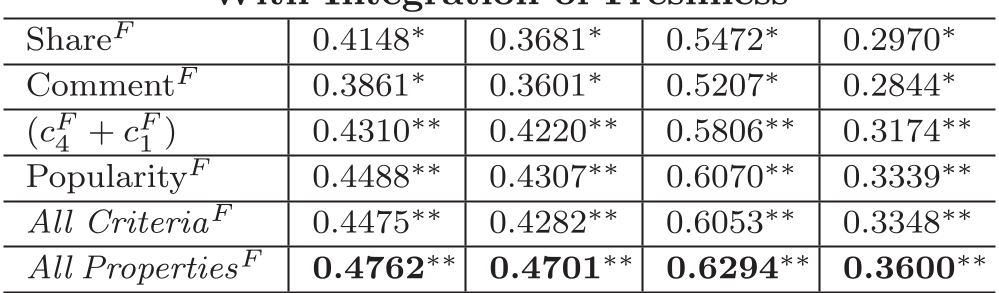 Table: Comparison of MAP and nDCG shows a clear trend—integrating Freshness (F) always leads to superior performance.
Critical Analysis & Conclusion
This work provides a robust theoretical framework for "Social IR." By using Language Model smoothing (Dirichlet), the authors elegantly handle the "zero-probability" problem for resources that have no social footprints.
Limitations:
- Data Silos: The study relies on external APIs (Facebook, Twitter), which are increasingly restricted, making this data harder to crawl.
- Spam Susceptibility: Social signals can be gamed (bot farms). The paper does not explicitly account for "adversarial social SEO."
Future Outlook: As we move into an era of LLM-driven search, "Social Priors" could serve as a vital filter for RAG (Retrieval-Augmented Generation) systems to ensure the context retrieved is not just relevant in text, but trusted by the human community.
Takeaway
If you want to build a modern search engine, don't just look at what the page says—look at how the world reacts to it. Positive engagement is the most reliable "Inductive Bias" for human relevance.