
Decoding the Professional Graph: A Taxonomy of Social Professional Networks
Social professional networks: A survey and taxonomy
This paper provides a comprehensive survey and taxonomy of Social Professional Networks (SPN), distinguishing them from general social networks. It categorizes existing research into two main streams—Issues (data acquisition/storage) and Tasks (analysis/application)—and establishes a hierarchy for SPN types like code repositories, academic networks, and business platforms.
TL;DR
This survey serves as a fundamental blueprint for understanding Social Professional Networks (SPN). Unlike general social media, SPNs like GitHub, LinkedIn, and ResearchGate are driven by productivity, expertise, and career-oriented interactions. The paper introduces a rigorous taxonomy, categorizing nodes and edges not just as "friends," but as collaborators, advisors, and competitors, while providing a deep dive into the algorithms—Clustering, Recommendation, and Ranking—that power these platforms.
Contextualizing the Professional "Link"
In the digital age, a "link" on Facebook is often a social acquaintance. On GitHub, it signifies a code commit or a pull request; on LinkedIn, it represents a professional endorsement; and in academic networks, it denotes co-authorship. The authors argue that these professional interactions require a specialized analytical lens. They position the SPN as a subset of social networks where utility outweighs entertainment.
Problem & Motivation
The core challenge identified is the "Information Overload" specific to professional domains. Finding a relevant collaborator or the right expert is significantly more complex than suggesting a casual friend. Prior work often struggled with:
- Heterogeneity: Nodes representing different entities (people, papers, code, companies) in the same graph.
- Veracity: Distinguishing between actual professional skill and mere "social popularity" or "emotional noise."
- Dynamic Evolution: Professional networks change as careers evolve, making static graph analysis obsolete.
Methodology: The Taxonomy of SPN
The paper organizes the domain into a hierarchical structure shown below:
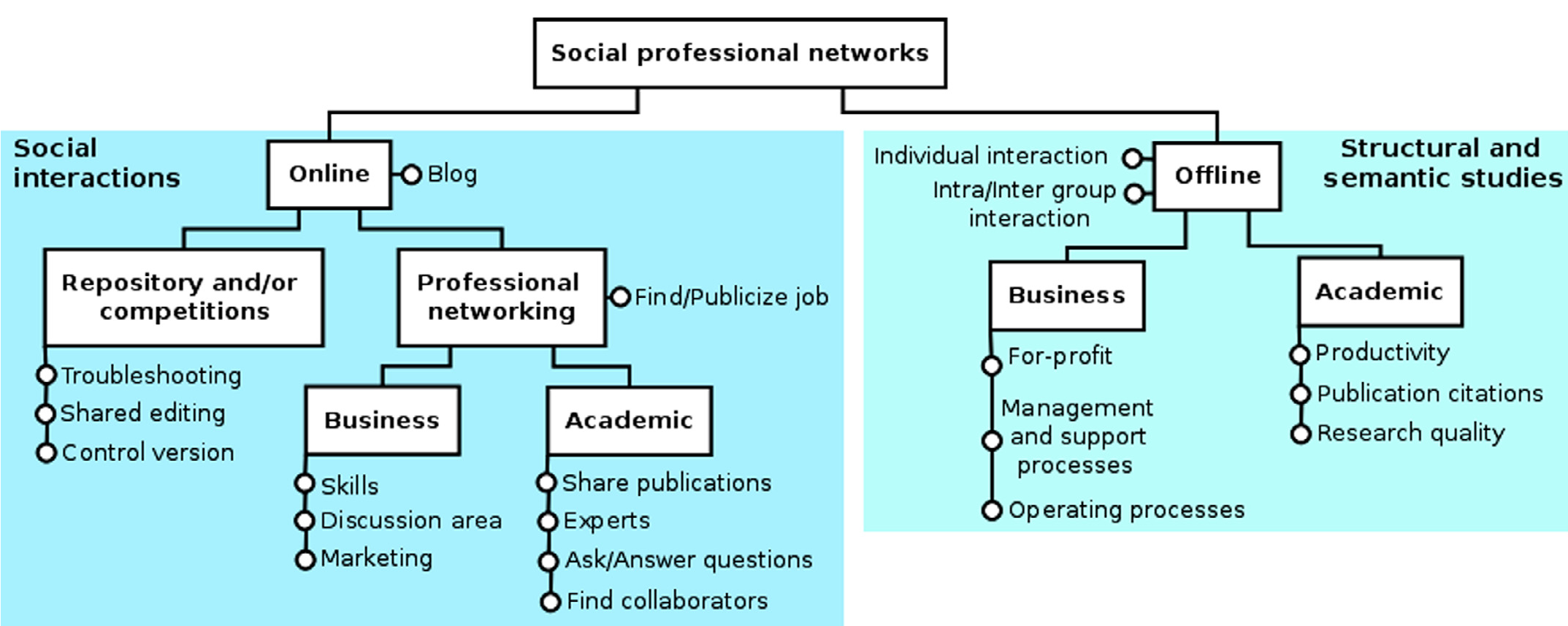
The Three Pillars of Analysis
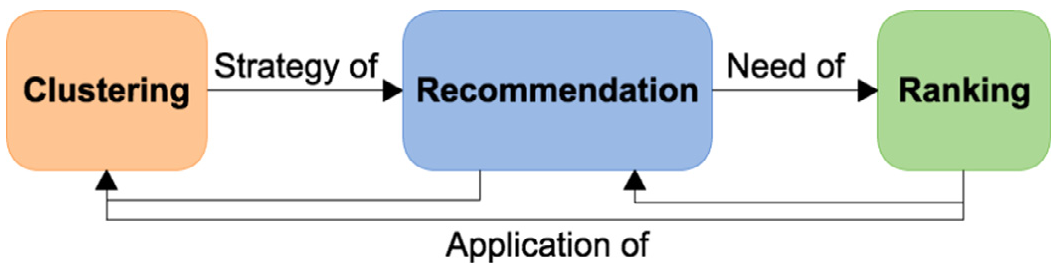
The authors break down the technical workflow into three interdependent stages:
- Clustering: Grouping users based on shared expertise or geographic industrial agglomeration. The paper discusses techniques such as Hierarchical Clustering (for organizational structures) and Overlapping Community Detection (since a developer can belong to multiple tech stacks).
- Recommendation: Moving beyond simple content-based filtering to Hybrid Systems that combine structural topology (who you know) with semantics (what you write/code).
- Ranking: The "Order of Importance." Algorithms like
RankClusare highlighted for their ability to integrate clustering with ranking, ensuring that the most influential entities within a specific cluster are surfaced first.
Metrics and Evaluation
The paper provides a masterclass in evaluation metrics. It moves beyond simple "Accuracy" (Precision/Recall) to internal graph metrics like Modularity (Q), BetaCV, and Silhouette Width. For professional networks, the authors emphasize that Purity and F-Measure are vital to ensure that detected communities actually represent distinct professional fields.
| Metric | Core Physical Intuition |
|---|---|
| Modularity | Measures how much denser the connections are within groups compared to a random network. |
| C-Index | Evaluates if a clustering puts the "closest" neighbors in the same group. |
| V-Measure | An entropy-based measure checking for homogeneity and completeness in cluster assignments. |
Deep Insights & Future Directions
The paper concludes with a forward-looking perspective on three critical areas:
- Semantic Enrichment: The need to utilize Natural Language Processing (NLP) to extract deeper meaning from professional interactions.
- Temporal Dynamics: Professional networks are not snapshots; they are movies. Following the "reachability" over time is key to predicting career moves.
- Expertise Veracity: A major open problem is "capturing the truth"—how do we distinguish between an actual expert and an "influencer" with no technical depth?
Conclusion
This survey is more than a list of papers; it's a structural guide for anyone building professional recommendation engines or analyzing career paths. It reminds us that in the professional world, the quality of a connection is defined by the expertise it flows and the productivity it facilitates.
Senior Editor's Note: While published in 2016, the fundamental taxonomy presented here remains the bedrock for modern Graph Neural Network (GNN) applications in professional platforms.