
Social Protocols: Orchestrating Agility in Virtual Teams
Social Protocols for Agile Virtual Teams
The paper introduces an extended concept of "Social Protocols" to enhance the agility of virtual teams (VTs). It combines social network modeling with flexible workflow systems to create a framework where human-centric interactions can rapidly adapt to internal and external changes.
TL;DR
In a world of remote work and global collaboration, "agility" is often hindered by rigid software systems. This paper proposes Social Protocols, a framework that fuses social network graphs with workflow models. By using a three-layered approach (Abstract, Implemented, Instantiated) and Meta-Processes, it allows virtual teams to rewrite their "rules of engagement" on the fly when things go wrong—such as a developer going offline or a tool failing.
The Problem: Why Virtual Teams Are "Fragile"
Current workflow management systems (WfMS) are built on the assumption of stability. They define a sequence of tasks (A -> B -> C) and stick to them. However, human-to-human (H2H) interaction is chaotic.
- The Social Void: Most systems ignore roles and relationships (e.g., who knows whom, who can substitute for whom).
- Runtime Paradox: Once a workflow starts, it is notoriously hard to change without breaking the system.
- The "How" vs. "Who": We often have tools for tasks and tools for social networking (like LinkedIn), but they rarely talk to each other to solve a project bottleneck.
Methodology: The Three-Layered Social Protocol
The core innovation lies in the architectural separation of concerns, mirrored after Object-Oriented Programming (OOP):
- Abstract Social Protocol (The Interface): Defines the logical flow (e.g., a "Brainstorming" pattern) without naming specific people or software.
- Implemented Social Protocol (The Class): Links the abstract steps to specific tools (e.g., "Post Ideas" becomes "Create a thread on Forum X").
- Social Process (The Object/Instance): Assigns real individuals to roles (e.g., "John is the Chairman").
Bridging Social and Task Networks
The methodology uses a directed graph to model both Social Networks (Interdependencies among resources) and Interaction Protocols (Petri-net based activity sequences).
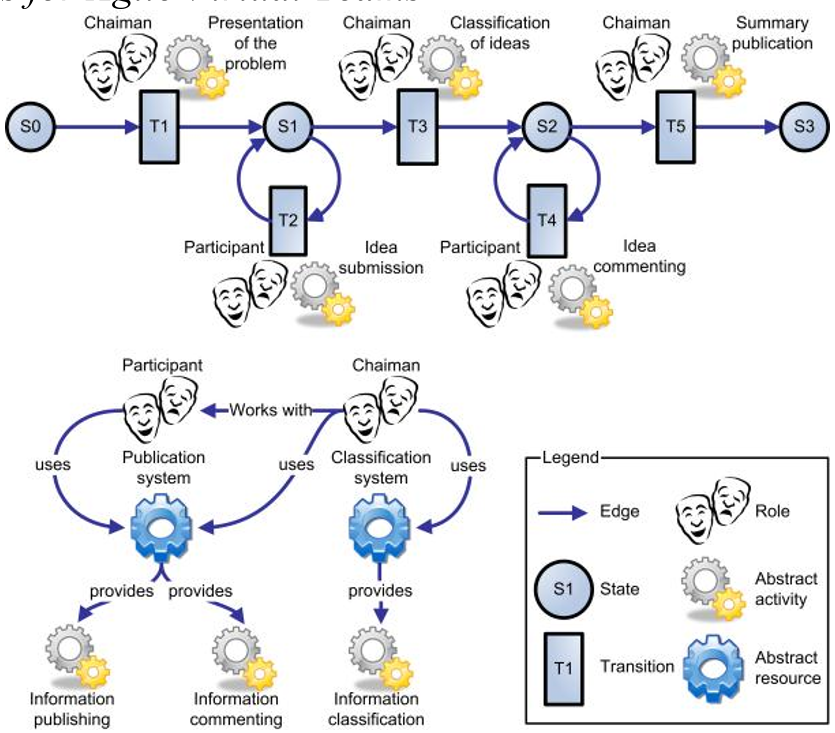 Figure 1: The interplay between abstract activities and social resource mappings.
Agility through Meta-Processes
What happens when the plan fails? The paper introduces Meta-Processes. If a team realizes their current workflow is no longer fit for purpose (e.g., a machine breakdown), they trigger a Meta-Process. This is essentially a "protocol to change the protocol." It allows the team to negotiate a new structure, update the mappings, and resume the instance without starting from scratch.
Critical Analysis & Takeaways
This paper moves the needle from "Software-defined collaboration" to "Socially-aware orchestration."
- Strengths: The analogy to OOP (Interfaces/Classes/Objects) makes the complex transition from abstract logic to real-world execution highly intuitive for computer scientists.
- Limitations: While the theoretical framework is robust, the paper notes that a prototype is still under implementation. The real-world friction of humans "negotiating protocols" during a crisis might be higher than the model suggests.
Future Outlook: The integration of information systems (Web Services) into the social graph is a precursor to modern Agentic Workflows, where AI agents and humans share the same "social" environment. For researchers in CSCW, this work provides a vital blueprint for building systems that don't just manage tasks, but manage the social resilience of the teams performing them.
Conclusion
Agile Virtual Team Agility (VTA) requires more than just chat apps; it requires a formal yet flexible way to model the "who" and the "how." By treating social interactions as first-class citizens in workflow design, Social Protocols offer a path toward truly resilient digital organizations.