
Beyond the Bill: Synchronizing Society with the Green Energy Grid
18375_Social, Psychological and Technological Determinants of Energy Use.
This paper explores the integration of social psychology and institutional governance to transform energy consumption. It proposes the "UseGreenEnergy.Today" framework, which leverages smart meter data and social norms to synchronize individual demand with renewable energy supply peaks.
TL;DR
Saving energy isn't just about lower prices; it's about changing human habits. This paper argues that technology (smart meters) must be paired with social psychology (norms and peer influence) and governance (the "Commons" approach) to solve the misalignment between green energy supply and consumer demand.
The "Invisible" Energy Crisis
For decades, the energy industry has operated on a simple, supply-side logic: price goes up, demand should go down. However, the authors argue this is a fundamental misunderstanding of human behavior. Most households receive feedback once a month via an abstract bill. By the time you see the cost, you've forgotten which light was left on. This creates a "disconnect" where the environmental and financial consequences of our choices are invisible.
Furthermore, the transition to renewable energy introduces a new headache: synchronization. Solar peaks at noon, but demand peaks in the evening. Solving this requires more than just efficient appliances; it requires a techno-social synchronization of human activity.
Social Obstacles: Why We Hesitate
The paper identifies several psychological roadblocks that prevent us from going green:
- Omission Bias: People feel less guilty about doing nothing (inaction) than making a proactive choice that might be "wrong" (like buying an appliance that gets upgraded a month later).
- The Sucker Effect: No one wants to be the only person making a sacrifice while neighbors continue to waste energy.
- Single-Action Bias: The tendency to do one small thing (like buying a hybrid car) and feel "absolved," leading to more energy use in other areas (the licensing effect).
Methodology: The "UseGreenEnergy.Today" Framework
The core of the methodology is shifting energy usage from a private financial burden to a social common pool resource.
1. Immediate Feedback & Mental Models
By handing smart meter data back to the user via smartphones, individuals can see the immediate "spike" when a kettle is turned on. This allows them to build a mental model of their home, understanding the physical reality behind the abstract numbers.
2. Gamification and Social Norms
The "UseGreenEnergy.Today" project introduces a "Green Percentage" metric. Instead of comparing total volume (which is unfair to compare a mansion to an apartment), users compare how well they align their usage with "peak green" times.
- Green Leaves: Points awarded for timing usage correctly, which can be turned into coupons or charity donations.
- Injunctive Norms: Using social approval (e.g., "Most of your neighbors are using green energy now") to drive behavior.
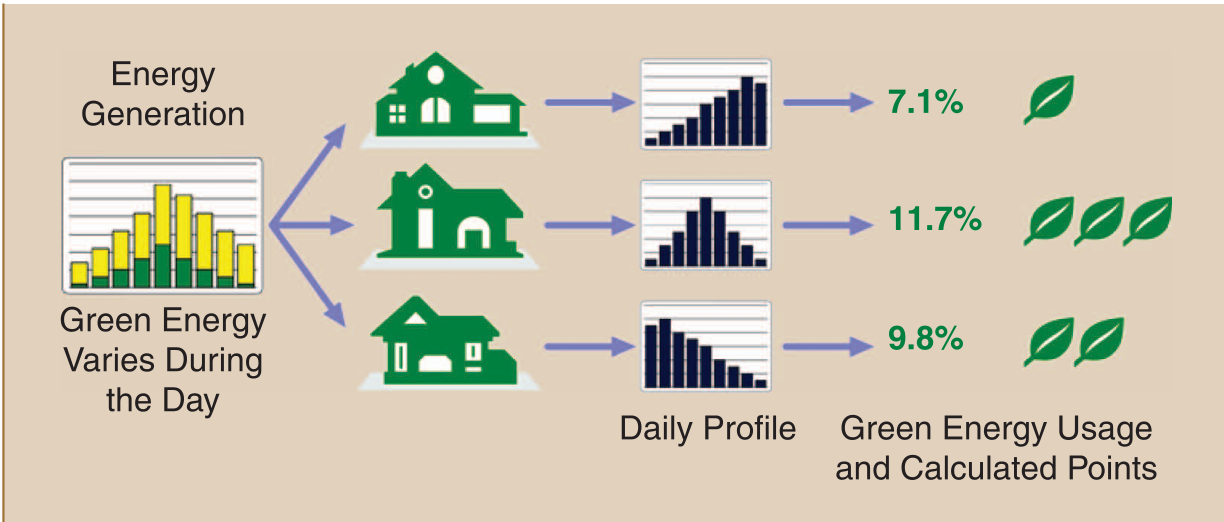 Fig 1: The architecture of the UseGreenEnergy.Today platform, connecting grid status to social incentives.
Collective Action: Energy as a "Commons"
Drawing on Nobel Laureate Elinor Ostrom, the authors claim that energy should be managed like a shared forest or water basin. A "Community of Prosumers" (those who produce and consume) is more resilient than isolated individuals. When groups make collective decisions, they tend to be less self-centered and share knowledge more effectively.
Critical Insight & Future Outlook
The most striking takeaway is the "Boomerang Effect": telling someone they are below average energy use might actually encourage them to use more to be "fair." The authors mitigate this by using a "Green Leaf" system that rewards the quality (timing) of energy use rather than just the quantity.
Limitations: The paper acknowledges that while psychological factors are strong, they cannot replace the need for physical infrastructure (insulation, efficient devices). The challenge remains in how to scale these "virtual communities" from small neighborhood pilots to national grids.
Conclusion
The future of energy is not just a smarter grid, but a smarter society. By transforming energy labels from "costs" into "social contributions," we can move past the limitations of the monthly bill and enter an era of real-time, collective sustainability.