
Social Puzzles: Turning Shared Memories into Cryptographic Keys
Social Puzzles: Context-Based Access Control in Online Social Networks
The paper introduces "Social Puzzles," a novel context-based access control paradigm for Online Social Networks (OSNs). It proposes two cryptographic constructions—one based on Shamir’s Secret Sharing and another on Ciphertext-Policy Attribute-Based Encryption (CP-ABE)—to allow data access only to users who can prove knowledge of specific shared events or information, achieving both fine-grained privacy and surveillance resistance against service providers.
TL;DR
Social Puzzles introduces a paradigm shift in OSN privacy: instead of asking "Are you my friend?", the system asks "Do you know what happened at our last dinner?" By leveraging Shamir’s Secret Sharing and Ciphertext-Policy Attribute-Based Encryption (CP-ABE), the researchers have built a system where data is only accessible to those who share a specific context, all while keeping the social network provider (like Facebook) completely in the dark.
Context is the New Firewall
Standard privacy settings are static. You're either a "Friend" or you aren't. But what if you want to share a photo of a private party only with the people who were actually there? Current ACL-based systems require manual group creation, which is a usability nightmare.
More importantly, we currently trust Facebook or Twitter to enforce these rules. This means the provider has the "master key" to your life. The authors identify the insider threat (friends who shouldn't see specific posts) and service provider surveillance as the two major hurdles for modern digital privacy.
Decoding the "Social Puzzle"
The paper proposes two distinct ways to turn "context" (questions and answers about an event) into a security mechanism.
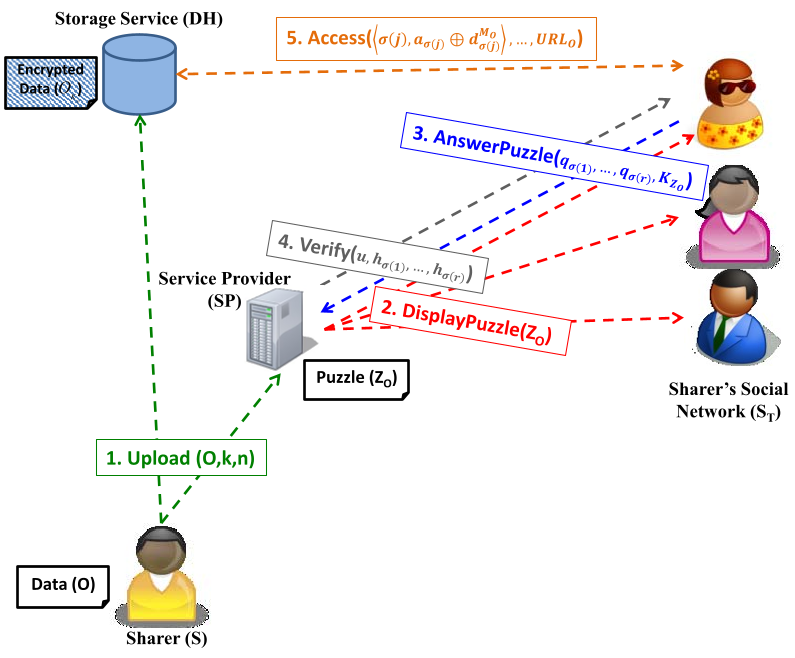
Construction 1: The Secret Sharing Approach
This construction uses Shamir’s (k, n) Secret Sharing.
- The sharer creates a secret .
- This secret is split into shares.
- Each share is "blinded" (XORed) with an answer to a context question.
- A receiver must answer at least questions correctly to unblind enough shares to reconstruct the secret and decrypt the data.
Construction 2: The ABE Approach
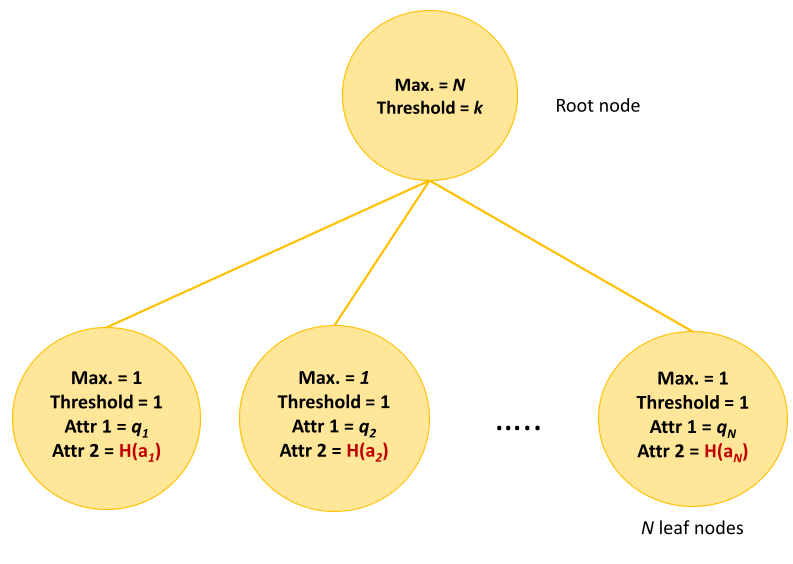
For more complex policies, they use CP-ABE. Here, the access policy is a tree. For example: "(Location=Paris AND Event=Commencement) OR (Invited=Yes)". The innovative "tweak" here is the Perturbed Access Tree. The answers are hashed before being embedded in the tree, ensuring that even if the storage provider sees the policy, they don't know the actual answers required to unlock it.
Performance: Can It Run on a Tablet?
One of the paper's strengths is its empirical validation. They tested a JavaScript-based version (Construction 1) against a Linux-based CP-ABE version (Construction 2).
- Construction 1 (I1) is a clear winner for mobile. Because it's pure JavaScript, it runs in any browser with negligible lag (<10ms processing).
- Construction 2 (I2) provides stronger mathematical guarantees and more flexible policies but suffers from larger file sizes (~600KB overhead) and higher latency due to the complexity of bilinear pairings.
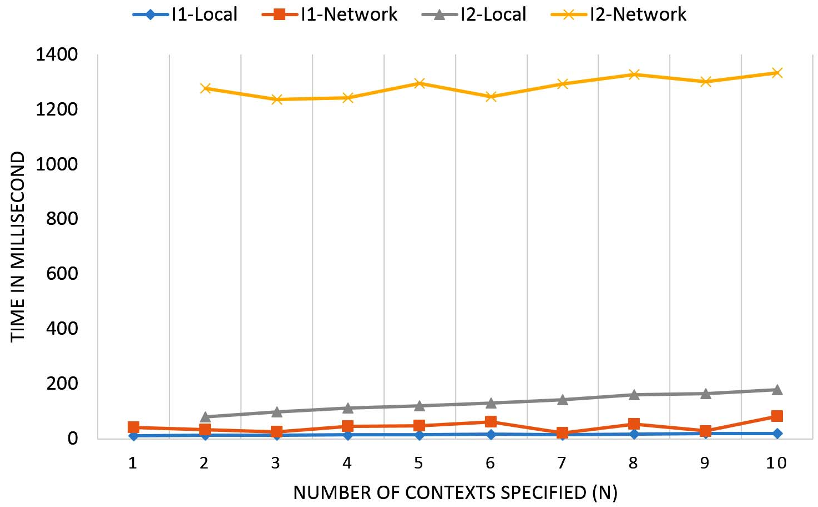 The chart shows that while Construction 2 (I2) is heavier, Construction 1 (I1) is nearly "free" in terms of user experience lag.
Expert Insight: Why This Matters
The "Social Puzzles" work is a precursor to what we now see in decentralized identity (DID) and Zero-Knowledge proofs. By decoupling authentication (proving who you are) from authorization (proving you have the right context), it allows for a "Surveillance-Resistant" social web.
Limitations & Future Work
The primary weakness identified is collusion. If a malicious service provider teams up with a "friend" who has partial knowledge, they can eventually brute-force the remaining context. Future iterations could benefit from Rate-Limiting puzzle attempts or integrating Multi-Party Computation (MPC) to ensure no single entity ever sees the full "unblinded" response.
Final Takeaway
This research proves that privacy doesn't have to be a trade-off with usability. By turning our natural social interactions into cryptographic inputs, we can build social networks that are personal, secure, and—most importantly—private from the platforms themselves.