
SocialQ&A: Leveraging Social Trust to Solve the Q&A "Altruism Bottleneck"
Social Q&A an Online Social Network Based Question and Answer System
This paper introduces SocialQ&A, a social network-based Question and Answer system that leverages common interests and mutual-trust relationships to route questions. It achieves SOTA-like performance in answer quality and reduced wait times by actively forwarding queries to capable and willing friends rather than relying on global altruism.
TL;DR
SocialQ&A is a next-generation Q&A framework that treats social networks as a "routing layer" for knowledge. By matching questions to friends who are both expert enough to answer and socially close enough to care, it reduces unanswered questions and slashes wait times to under 10 minutes for half of all queries.
The Problem: The Failure of Digital Altruism
In massive Q&A hubs like Yahoo! Answers or Quora, the signal-to-noise ratio is abysmal. Experts are overwhelmed by irrelevant questions, and askers are often met with silence. Statistics cited in the paper are grim: only ~17.6% of questions on Yahoo! Answers are resolved satisfactorily.
The core issue? Social Distance. There is no inherent motivation for a stranger to answer you quickly. SocialQ&A transforms this by utilizing the two pillars of social networks:
- Common Interest: Friends often share professional or hobbyist domains.
- Mutual Trust: We are exponentially more likely to help a friend (or a friend-of-a-friend) than a random avatar.
Methodology: The "Capability-Willingness" Formula
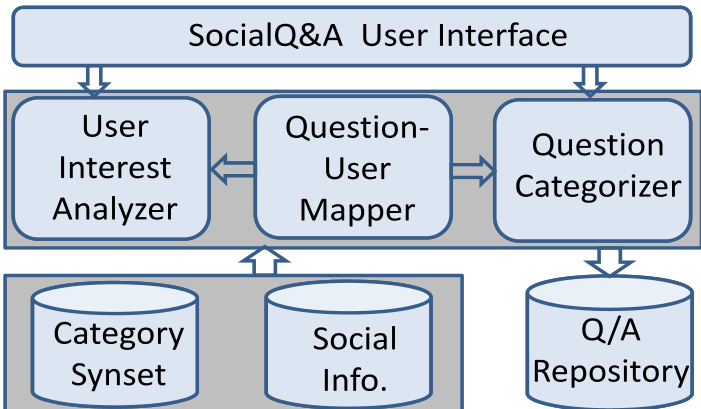
The heart of SocialQ&A lies in how it selects an answerer. Instead of broadcasting to everyone (flooding) or no one (static search), it uses a Question-User Mapper.
1. Architectural Overview
The system analyzes user profiles and previous Q&A history to build a dynamic interest vector. When a question is posed, the Question Categorizer uses WordNet-based synsets to map it to the same vector space.
2. The Ranking Metric
The system calculates a score for each potential friend :
- (Interest Similarity): Does the friend know the topic?
- (Social Closeness): Based on interaction frequency and common friends, will they actually reply?
3. Privacy-Preserving Knowledge Sharing
To solve the privacy dilemma (sharing friend lists and interests with the system), SocialQ&A introduces Bloom Filter-based exchange. Friends only exchange "hashed summaries" of their interests. To mask identities for sensitive questions (e.g., politics/health), the system uses Onion Routing, ensuring no single node knows both the asker and the answerer.
Experimental Results: Precision vs. Speed
The authors tested the system on PlanetLab (global testbed) and a real-world prototype.
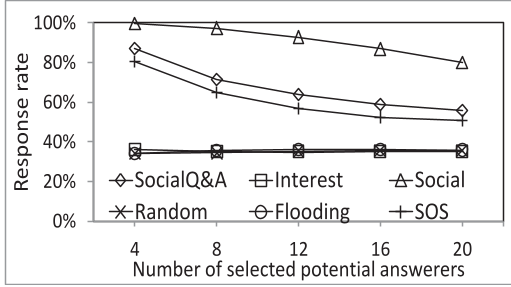
- Precision and Recall: By adjusting the parameter (weighting interest vs. social bond), SocialQ&A achieves a higher F-score than SOS or pure interest-based routing.
- Latency: In the real-world test, the system achieved a median wait time far below traditional platforms, with many factual questions answered in minutes.
Deep Insights: Accuracy vs. Privacy
The paper presents a fascinating trade-off: Bloom Filter False Positives. By increasing the false positive rate of the Bloom Filter, users gain more privacy (it's harder for a malicious user to guess their exact friends), but routing accuracy takes a slight hit (~8% reduction in F-score). This is a "knob" that any future social-technical system must learn to tune.
Conclusion and Future Work
SocialQ&A proves that the "Social Graph" is not just for scrolling—it is a highly efficient indexing structure for human knowledge. While the current prototype relies on manual category synsets, the authors suggest that integrating Topic Modeling and Word Embeddings (precursors to modern LLMs) will allow the system to handle redundant and complex questions at a global scale.
Final Takeaway: The future of Q&A isn't just "smarter" AI; it's smarter routing to the right human.