
Social Ranking: Beyond PageRank for the Spoken Web
Social ranking for spoken web search
The paper introduces "Social Ranking," a novel content prioritization framework for the "Spoken Web"—a voice-driven alternative to the World Wide Web tailored for low-literacy users in developing regions. By leveraging social signals like user relationships and community trust rather than traditional hyperlink-based PageRank, it provides high-relevance audio search results over mobile phone interfaces.
TL;DR
In the developing world, the "Spoken Web" allows illiterate or low-literacy users to create and browse audio content via basic mobile phones. Since there are no "hyperlinks" between audio files, traditional PageRank fails. This paper proposes a Social Ranking algorithm that uses real-world relationships and community trust—mined from browsing logs—to ensure that search results are socially relevant to the listener.
Background: The Web of Speech
For billions of people in rural, developing regions, the Internet isn't a screen; it's a voice on a phone. The Spoken Web enables users to host "VoiceSites." However, searching audio is a nightmare. Because audio is sequential, a user can't "skim" 10 results in seconds. If the first two results aren't perfect, the user hangs up.
The authors argue that in these close-knit communities, who said something is often more important than what was said.
The Problem: Why Links Don't Work
The World Wide Web's success was built on in-links (PageRank). But in a VoiceSite ecosystem:
- No Link Structure: Audio files don't naturally link to one another.
- Local Relevance: A farmer in Gujarat cares more about a neighbor's agricultural tip than a generic expert from a city.
- Sequential Constraint: The "Top 10" UI of Google is a "Top 1" or "Top 2" UI in speech.
Methodology: Quantifying Human Relationships
The authors break down "Social Rank" (S) into two key components: Relationship () and Trust ().
1. The Relationship Function ()
This measures how close the searcher (query-creator) is to the person who recorded the audio (content-creator). It combines:
- Following Score (): Does the searcher frequently listen to this specific creator?
- Similarity Score (): Do the searcher and the creator listen to the same types of content?
2. The Community Trust Factor ()
Independently of the searcher, how much does the whole community listen to this creator? This identifies "local celebrities" or "trusted experts."
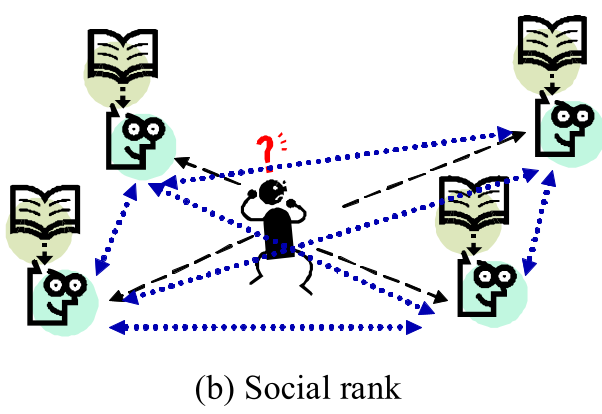 Figure 1: Comparison between traditional PageRank (link-based) and Social Rank (relationship-based).
The Final Formula
The ranking is a weighted sum: This allows the system to balance "Personalized Interest" (what I like) with "General Authority" (what everyone trusts).
Experimental Validation: Field Study in Gujarat
The researchers tested their algorithm on 4,827 audio documents from a live VoiceSite used by 250 grain farmers in India. They interviewed 15 farmers to map their "real-world" social networks and then checked if the algorithm could recreate that map using only log data.
Key Findings:
- Accuracy: In most cases, the algorithm’s "Top 5" relationships matched the people the farmers specifically named in person.
- Authority Identification: The trust score () successfully identified the regional experts that the community relied upon.
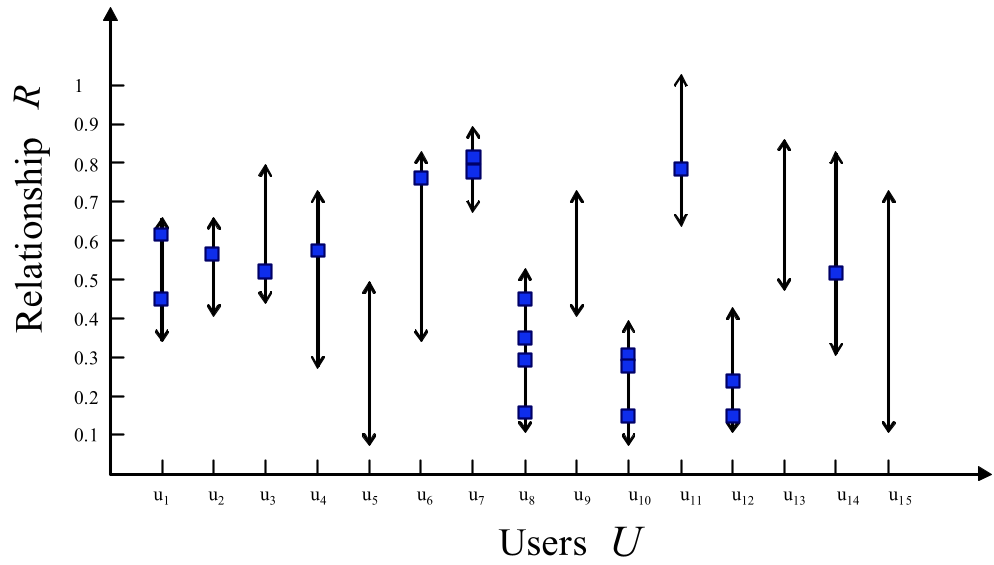 Figure 2: The R-score (lines) effectively captures the actual people (dots) farmers identified as important.
Future Outlook and Limitations
While the social ranking shows immense potential for localized, illiterate communities, the authors note a few hurdles:
- Cold Start: If a user is new and hasn't listened to anything, is hard to calculate.
- Scalability: While it works for a community of 250, how does social trust scale to millions?
- Evaluation: The authors admit they still need to compare this against a traditional baseline in a controlled A/B search task.
Conclusion
This work highlights a critical shift in Information Retrieval (IR): as we move toward "Web 2.0" and "Spoken Web" environments, Social Context becomes the new PageRank. For developers building for the "Next Billion Users," the lesson is clear: mine the social interactions, not just the keywords.