
Beyond Hyperlinks: Personalizing the Web via Social Ranking and Maximum Flow
2389_Social ranking techniques for the web.
This paper introduces Social Ranking techniques that leverage social media shared URLs and network structures (Google Buzz and Twitter) to rank web content. It extends traditional algorithms into PageRank on Social Network (PRSN) and HITS on Social Network (HSN), while proposing a novel personalized ranking method based on Maximum Flow.
TL;DR
While established algorithms like PageRank judge a website's importance by its links, they ignore the vast amount of human-curated data on social media. This paper proposes Social Ranking, a framework that uses URLs shared on platforms like Twitter and Google Buzz to re-rank the web. By introducing a Maximum Flow approach, the authors demonstrate how to tailor search results to an individual's specific social circle, effectively moving from a "global web" to a "personalized web."
The Core Insight: Humans as the New Hyperlinks
For decades, the Web was viewed as a static graph of pages. If Page A linked to Page B, it was an "endorsement." However, in the age of social media, the most valuable endorsements happen when a person shares a URL with their followers.
The authors argue that social media acts as a "tunneling" mechanism for information. The distance between people (often cited as the "Six Degrees of Separation") is much shorter than the average distance between web pages (estimated at 19 hops). By leveraging these shorter, human-centric paths, we can rank information based on who shared it and how close they are to you.
Methodology: Extending PR and HITS to the Social Sphere
The paper adapts two classic algorithms and introduces one novel personalized approach:
- PRSN (PageRank on Social Network): Nodes are users, and edges are social ties. Influence flows through the social graph; if a highly influential user shares a URL, that URL inherits a portion of their "social authority."
- HSN (HITS on Social Network): Treats users as "Hubs" and shared URLs as "Authorities." It ignores the social graph structure and focuses strictly on the bipartite relationship of "who shared what."
- Maximum Flow (Personalized Ranking): This is the crown jewel of the paper. For a specific user , a dedicated flow network is built. It measures the "capacity" of information to reach the user through their direct and indirect social ties.
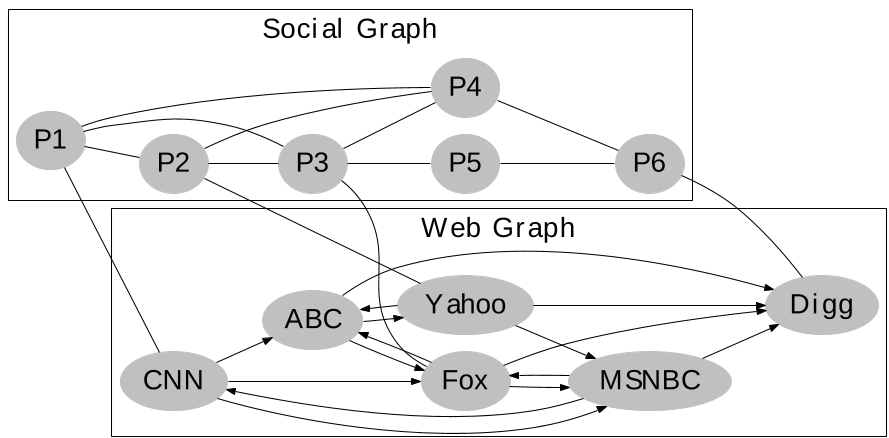 Fig 1: The dual-layer approach—The top box represents the social network (People), and the bottom box represents the web network (Pages).
The Maximum Flow Intuition
The Maximum Flow algorithm treats information like water flowing through pipes. The "source" is the user performing the search, and the "sink" represents the URLs. If many of your friends (and their friends) share a specific link, the "capacity" to that URL increases, pushing it higher in your personalized ranking.
Experimental Results: Consistency vs. Personalization
The researchers conducted experiments on 2,000 random and popular URLs from Google Buzz and Twitter.
- Agreement on Popularity: For "viral" content, PageRank and HITS largely agreed. In Google Buzz, the average difference in position was only ~3 slots.
- The Divergence of the Individual: When using Maximum Flow, the rankings became highly subjective. Users with different social circles saw vastly different "Top" results for the same set of URLs.
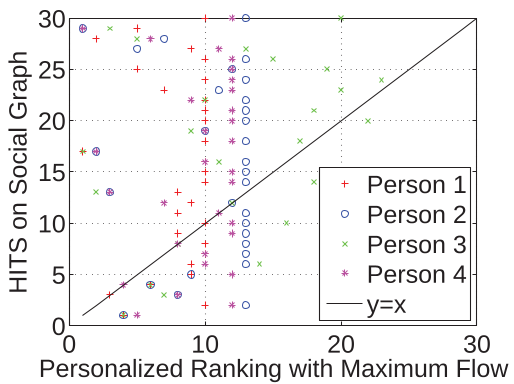 Fig 2: Correlation between PRSN and HSN. Popular URLs (left) show tighter alignment, while random URLs (right) show significant dispersion.
Key Quantitative Takeaway:
| Network | URL Type | Avg. Rank Difference (PRSN vs HSN) |
|---|---|---|
| Google Buzz | Popular | 2.9 positions |
| Google Buzz | Random | 9.6 positions |
| Popular | 5.9 positions | |
| Random | 7.2 positions |
Critical Analysis & Future Outlook
Strengths: The paper successfully demonstrates that social graphs can be used to navigate the "Deep Web" where traditional PageRank might struggle due to a lack of incoming hyperlinks. The Maximum Flow approach is mathematically sound and yields intuitive personalization.
Limitations:
- Scalability: Constructing a personalized flow graph for every user in real-time is computationally expensive compared to a global index.
- The "Celebrity Effect": In platforms like Twitter, high-outdegree nodes (celebrities) can skew the social ranking, potentially drowning out close personal ties—a phenomenon the authors noted in their data analysis.
The Takeaway for Modern AI: In today’s era of RAG (Retrieval-Augmented Generation) and AI agents, this paper reminds us that "authority" isn't just about how many people link to a site—it's about the proximity of the source to the end-user. Future social search engines will likely combine these flow-based metrics with semantic understanding to provide even more nuanced results.
Conclusion
Social ranking transforms the web from a cold library of hyperlinked documents into a living network of human endorsements. By mathematically modeling how information "tunnels" through our social connections, we can move closer to a search experience that understands not just what is important, but who it is important to.