
FFDR: Achieving Stability in Social Recommendations via Dynamic Profile Fusion
Social Recommendation Algorithm Dynamically Adaptable to User Profiling for SNS
The paper introduces Fusion Feature based Dynamic Recommendation (FFDR), a social recommendation algorithm that dynamically switches between Content-Based Filtering, Collaborative Filtering, and Influence Ranking. By evaluating "user feature richness" and "user relation richness," the system adapts to varying data densities in Social Network Services (SNS) like Weibo.
TL;DR
Social Network Services (SNS) present a unique challenge for recommendation engines: data is often sparse, and users vary from "lurkers" with empty profiles to "super-nodes" with massive networks. This paper proposes FFDR (Fusion Feature based Dynamic Recommendation), an adaptive algorithm that calculates the "richness" of a user's profile and social ties to decide whether to use Content-Based matching, Collaborative Filtering, or Influence Ranking (PageRank).
The "Data Dilemma" in Modern Social Networks
Most recommendation systems rely on a specific type of signal. If you use Content-Based Filtering, you need a detailed user profile (age, location, interests). If you use Collaborative Filtering (CF), you need a history of ratings.
In platforms like Weibo or Twitter, both signals are often missing:
- Sparsity: Users rarely fill out every profile field.
- No Ratings: Unlike Amazon, social networks lack a 1-5 star rating system for friends.
- The Cold Start: New users have neither content nor connections.
The authors' insight is simple yet powerful: Don't force one algorithm on every user. Instead, measure the metadata available for each user and pivot the strategy accordingly.
Methodology: Quantifying "Richness"
The core of the FFDR algorithm lies in two new definitions:
- User Feature Richness (): A weighted sum of existing profile attributes (sex, region, education). If a user has a complete profile, is high.
- User Relationship Richness (): Measured by the number of following/followers relative to a threshold (set to ).
The Selection Logic
The algorithm employs a Selection Function to determine the execution path:
- High , Low : Use Feature Matching (Homophily-based).
- Low , High : Use Collaborative Filtering (treating 'following' as a 'rating' of 1).
- Both High: Fuse the results of both using a MAX/MEAN ranking rule.
- Both Low: Fall back to PageRank to recommend influential "vouched" users (solving the cold-start problem).
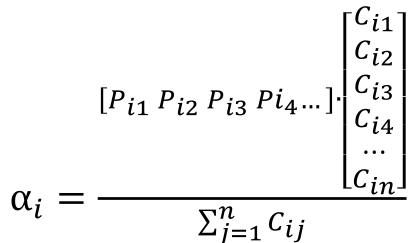 The mathematical basis for calculating User Feature Richness.
Experiments & Results
Testing on a real-world Sina Weibo dataset (5,562 users), the authors validated their hypothesis: feature matching performance correlates positively with profile richness, and CF performance improves with network density.
Performance vs. Stability
The FFDR algorithm was compared against Feature Matching (FM), Collaborative Filtering (CF), and PageRank (PR).
- Accuracy: FFDR reached the highest Average Hit Rate (AHR).
- Stability: Standard Deviation (SDHR) was the lowest for FFDR, meaning it provides consistent quality across different user types, unlike FM or CF which fluctuate wildly depending on data availability.
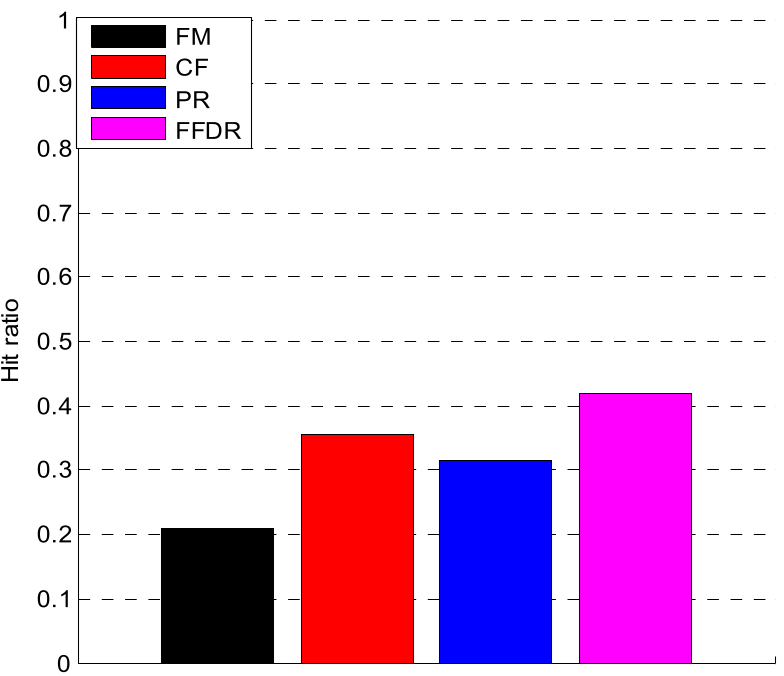 Figure 5: FFDR (green bar) shows a significant lead in hit rate over traditional baselines.
Deep Insight: Why It Works
The brilliance of this approach isn't in a new mathematical operator, but in the meta-logical layer. By acknowledging that "User A" and "User B" provide different types of data, the system avoids the "garbage in, garbage out" trap of applying CF to a user with no friends or Content-Matching to a user with no bio.
Limitations & Future Work
While effective, the weighting factors for profile features in this study were determined manually. Future iterations could benefit from Automated Machine Learning (AutoML) to learn attribute weights. Furthermore, moving from simple PageRank to Graph Convolutional Networks (GCNs) for the "low-richness" users could further enhance recommendation depth.
Conclusion
FFDR proves that robustness in recommendation systems comes from adaptability. By treating user profiling as a dynamic variable rather than a static input, we can bridge the gap between niche personalized suggestions and broad influence-based hits.