
SocialMF: Bridging the Gap Between Social Trust and Matrix Factorization
Social recommendation algorithm based on stochastic gradient matrix decomposition in social network
This paper introduces SocialMF, a social recommendation algorithm that utilizes Stochastic Gradient Descent (SGD) for matrix decomposition. By merging social network graphs and user-item rating matrices into a unified low-rank factorization framework, it achieves superior prediction accuracy and effectively addresses the data sparsity problem in e-commerce systems.
TL;DR
Recommending the right product is no longer just about analyzing what a user bought in the past; it's about who they trust. SocialMF is a social recommendation framework that integrates social network topology directly into the Matrix Factorization (MF) process using Stochastic Gradient Descent. By treating social relations as auxiliary constraints, it drastically reduces prediction error (RMSE) and solves the infamous "Cold-Start" problem.
Problem & Motivation: The Isolation of Traditional Recommenders
In the real world, our purchasing decisions are rarely made in a vacuum. If you need a new camera, you ask a friend. However, traditional Collaborative Filtering (CF) algorithms often treat users as independent rows in a sparse matrix.
The authors identify two critical flaws in prior SOTA:
- The Cold-Start Vacuum: New users with zero or few ratings cannot be modeled accurately.
- Ignoring Trust Propagation: While some models used direct social links, they failed to account for the recursive nature of trust—the idea that your "friends of friends" also shape the latent preferences of your immediate circle.
Methodology: Fusing Social Graphs with Rating Matrices
The core innovation lies in the construction of a merged matrix. Instead of factorizing the user-item matrix in isolation, the authors append the social network matrix to it.
1. The Unified Objective Function
The algorithm seeks to minimize the reconstruction error of the merged matrix while applying quadratic regularization to prevent overfitting: Where and are the latent feature matrices for users and items/social-connections.
2. Stochastic Gradient Descent (SGD) Optimization
To handle large-scale datasets like Epinions (50k+ users), the authors use SGD to iteratively update the latent vectors and . This allows the model to learn the "potential factors" (latent features) that characterize both a user's social position and their product preferences simultaneously.
 Figure 1: Conceptual representation of the user-item rating matrix interaction.
Experiments & Results: Proving the Social Advantage
The authors tested SocialMF against three major baselines: PearsonCF (Memory-based), BasicMF (Model-based), and TrustWalker (Random walk-based).
SOTA Comparison
On both the Epinions and Flixster datasets, SocialMF achieved the lowest RMSE. The results indicate that the latent factors captured by social regularization provide a much more accurate "fingerprint" of user behavior than ratings alone.
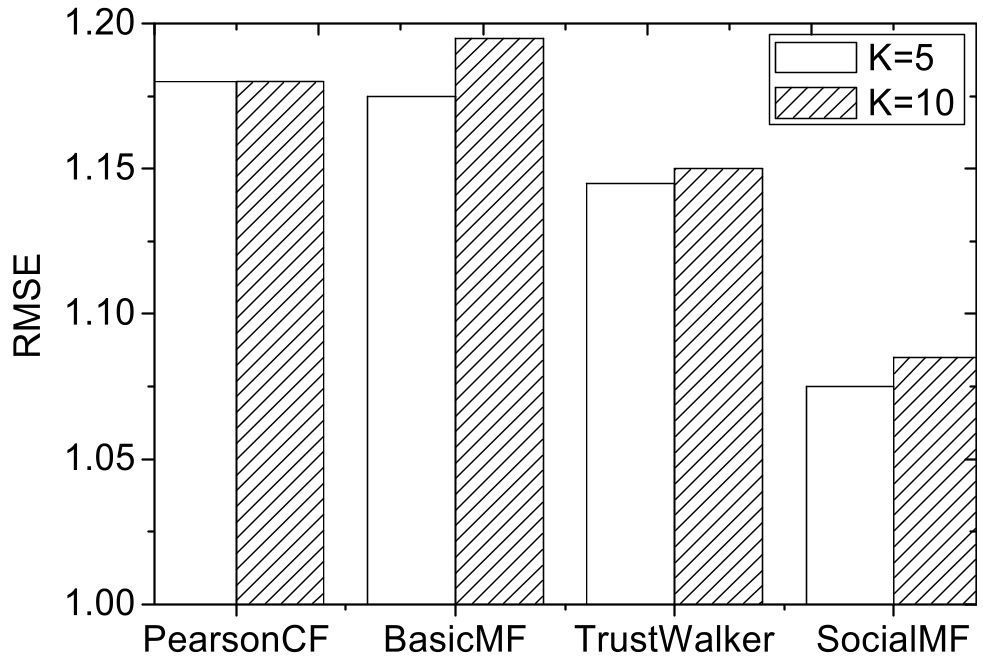 Figure 2: Prediction error (RMSE) comparison on the Epinions dataset showing SocialMF outperforming others.
Solving the Cold-Start Problem
One of the most impressive findings is shown in the "Cold Start" analysis. For users with very few social connections or ratings, SocialMF maintains a lower error rate because it can "borrow" latent features from the broader social network graph.
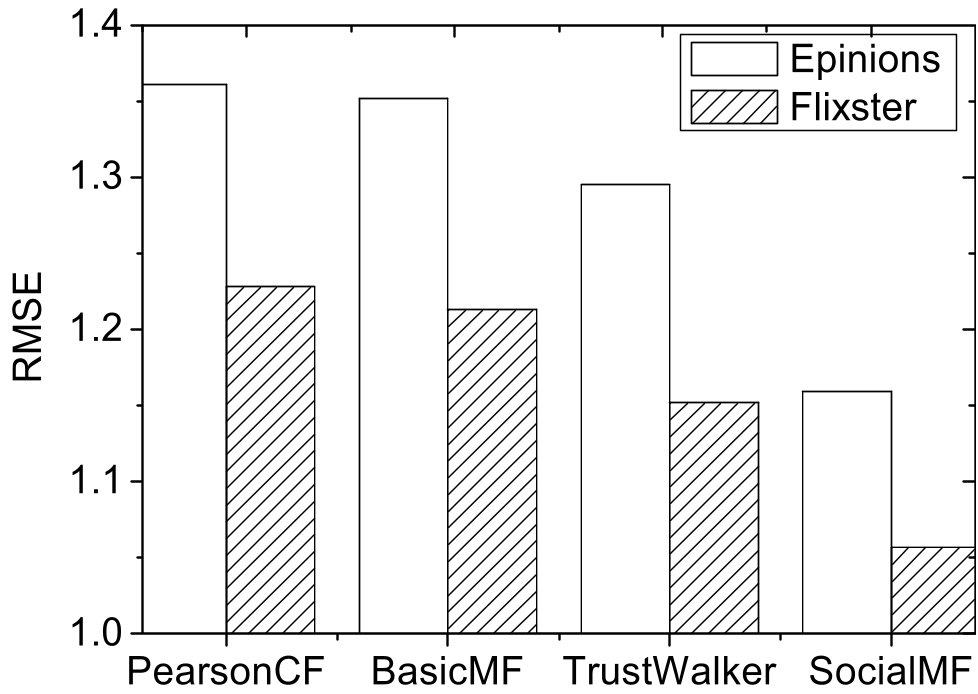 Figure 3: Performance stability for users with limited initial data (Cold Start Nodes).
Critical Insight & Conclusion
SocialMF demonstrates that Trust is a Latent Feature. By mathematically aligning a user's latent vector with their neighbors' vectors, we simulate the sociological phenomenon of Homophily (birds of a feather flock together).
Takeaway: While newer deep learning models (like Graph Neural Networks) are now the standard, this paper provides the foundational "Matrix" logic for social regularization that remains highly relevant for lightweight, interpretable recommendation systems. Its ability to solve the cold-start issue through recursive trust propagation is a blueprint for any platform where social interaction and commerce coexist.