
MCCRF: Revolutionizing Social Recommendation via Multi-scale Continuous CRFs
11968_A social recommendation framework based on multi-scale continuous conditional random fields.
This paper introduces Multi-scale Continuous Conditional Random Fields (MCCRF), a social recommendation framework that extends standard CCRF to handle multiple users simultaneously. By utilizing Markov property and MCMC-based optimization, it achieves SOTA performance on MovieLens and Epinions datasets, effectively modeling complex relational dependencies in sparse social networks.
TL;DR
Social recommendation systems often fail when data is sparse because they treat every prediction as an isolated event. This paper breaks that isolation by introducing Multi-scale Continuous Conditional Random Fields (MCCRF). By modeling the entire recommendation space as a joint probabilistic graph, MCCRF allows predictions for different users and items to "collaborate," achieving superior accuracy on real-world datasets like Epinions and MovieLens.
The "Independence" Trap in Traditional CF
Most Collaborative Filtering (CF) algorithms suffer from two fatal flaws:
- Prediction Independence: If User A and User B are similar, their predicted ratings for a new item should influence each other. Traditional models only look at existing ratings, missing this "prediction-to-prediction" dependency.
- Feature Integration Complexity: Social networks offer a goldmine of data—trust links, item genres, user demographics. Linearly combining these usually leads to a combinatorial explosion during weight optimization.
The authors' insight is simple yet powerful: Use the Markov property. By treating recommendations as a labeling problem in a continuous space, we can model dependencies globally.
Methodology: The Multi-scale Probabilistic Graph
The core of the paper is the extension of Continuous Conditional Random Fields (CCRF) from a single scale (one user) to a multi-scale architecture (all users).
1. The Architecture
MCCRF defines a joint probability distribution over all predictions .
- State Features: Local info (e.g., average rating of a genre).
- Intra-layer Edges: Dependencies between different items for the same user (Item Similarity).
- Inter-layer Edges: Dependencies between different users for the same item (Trust or User Similarity).
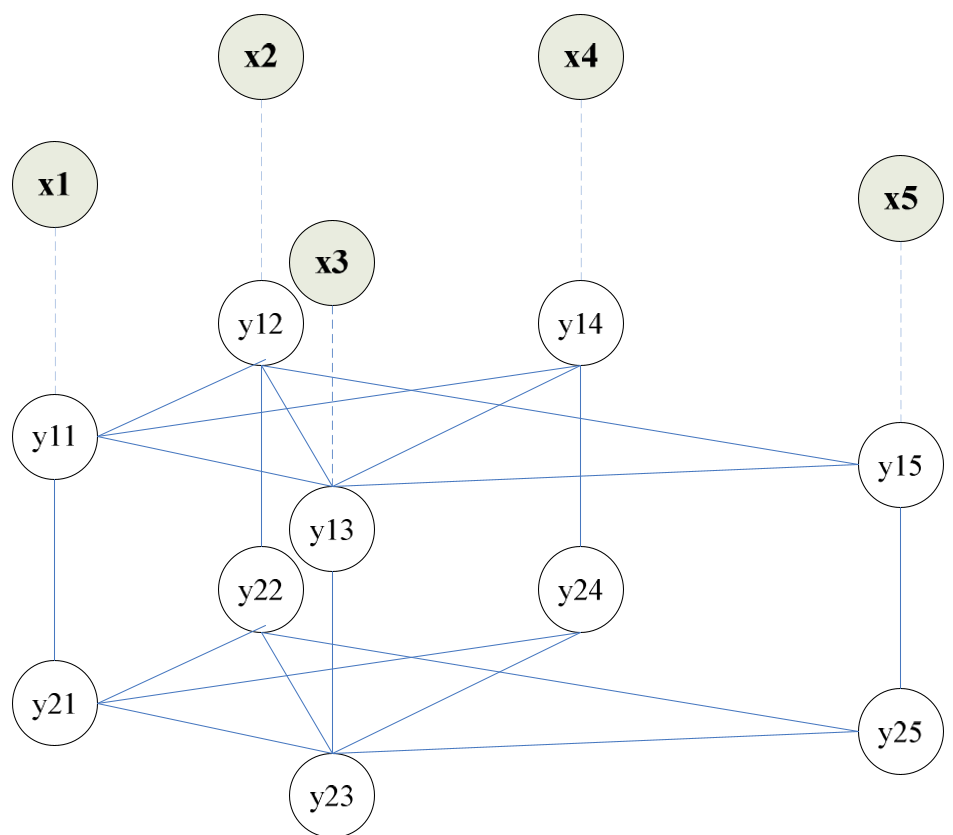 In this graph, each layer represents a user. Actual lines represent dependencies where predictions "help" each other.
2. Learning and Inference via MCMC
Because the normalization factor in continuous CRFs is an intractable integral, the authors use Markov Chain Monte Carlo (MCMC).
- Gibbs Sampling: Used to estimate the expectations of feature functions during training.
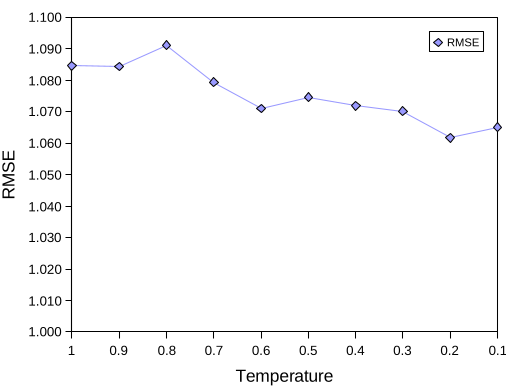
- Simulated Annealing: Used during inference to find the configuration of ratings that maximizes the joint probability as the "temperature" of the system cools.
Experimental Evidence
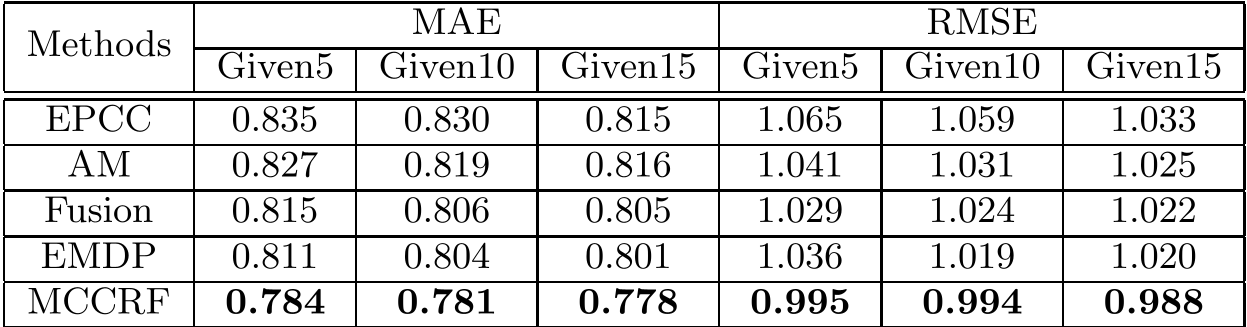
The model was tested against industry standards like Aspect Model (AM) and Similarity Fusion.
Overall Performance
As shown in the table below, MCCRF consistently achieves the lowest MAE and RMSE across all test cases (Given 5, 10, 15 ratings).
Why It Works: The Power of Features
One of the most compelling parts of the study is the ablation study on social features. Adding Trust information (CRF-T) and Demographics (CRF-BA/BO) led to significant jumps in accuracy, proving that MCCRF is an excellent "aggregator" of diverse social signals.
Critical Insight & Conclusion
The true value of MCCRF lies in its holistic view. By moving away from "local" predictions and toward a "global" likelihood optimization, it effectively mitigates the cold-start and sparsity problems.
Limitations: While powerful, the MCMC process is computationally heavy. The authors used clustering (K-means) to make it scalable, but for real-time systems with millions of users, further optimization in sampling efficiency would be required.
Future Outlook: This framework paves the way for integrating even more complex relations, such as temporal dynamics or multi-modal content features (images/text), into the same unified probabilistic graph.