
Deciphering Social Rec: A Unified Probabilistic View of Social Terms
Social Recommendation Terms: Probabilistic Explanation Optimization
The paper proposes the Unified Covariance Framework (UCF) to provide a rigorous probabilistic explanation for social recommendation models. It establishes that existing social terms in Probabilistic Matrix Factorization (PMF) are essentially modifications of the inverse covariance matrix (ICM) and mean priors, addressing the lack of theoretical clarity in prior SOTA methods like SocialMF and SoRec.
TL;DR
Why does adding social links to a recommendation model actually work? While many models (SocialMF, SoRec) show improved accuracy, they often lack a formal "why." This paper introduces the Unified Covariance Framework (UCF), proving that nearly all social recommendation "tricks" are actually specific configurations of a Covariance Matrix and Mean Priors within a multivariate Gaussian distribution.
Background: Beyond Simple Factorization
Standard Probabilistic Matrix Factorization (PMF) assumes user latent vectors are independent and identically distributed (i.i.d.) with zero-mean Gaussian priors. However, humans are social creatures—our tastes are correlated. Previous works tried to capture this by adding "Social Terms" to the loss function.
The authors classify these into two schools:
- Regularization Terms: Forcing a user's vector to be similar to their friends' (e.g., SocialMF).
- Factorization Terms: Decoupling social links into latent factors (e.g., SoRec).
The problem? These approaches are often intuitive rather than theoretical, sometimes creating a "multi-goal" conflict where the model tries too hard to reconstruct the social graph instead of predicting user ratings.
The Core Insight: The Unified Covariance Framework (UCF)
The paper’s fundamental contribution is reshaping all user latent vectors into one massive vector and defining its distribution through a consolidated Inverse Covariance Matrix (ICM).
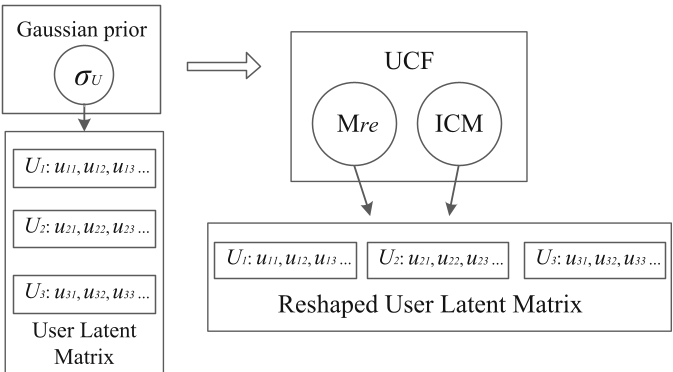
The Two Forms of ICM
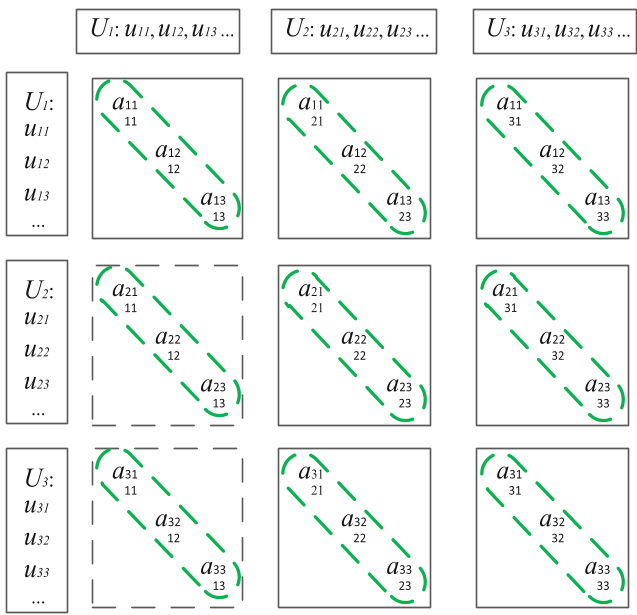
The authors identify two ways the ICM can be structured to explain existing social models:
- Each-diagonal Form (for Regularization): This models correlations between users. It proves that SocialMF and SoReg are essentially modifying the dependency premise between different user latent vectors.
- Global-diagonal Form (for Factorization): This models correlations within the elements of a single user's vector. It suggests that newborn vectors in factorization models act as indicators of personalized properties.
Methodology: How it Mathematically Aligns
The authors provide a rigorous proof (Equations 16 and 17) showing that the complex summation terms found in SocialMF or SoRec can be rewritten exactly as a UCF objective.
For example, in SocialMF, the trust-propagation term is mathematically equivalent to an ICM where non-diagonal elements represent the trust values . The accuracy improvement comes from the fact that this specific ICM structure acts as a "preconditioned" prior that guides the latent features more effectively than a standard identity matrix.
Experiments and Insights
The research findings challenge some common assumptions in the field:
- Personalization over Links: For regularization models, the accuracy boost relies heavily on personalized weights () rather than just the topology of the social network.
- Social is a Prior, not a Goal: For factorization models, the social graph is helpful only because it provides a better starting point (a prior) for the covariance of user features. If the priors are poorly designed, factorizing the social graph might actually distract the model from the rating prediction task.
Critical Analysis & Takeaways
The UCF provides a "Universal Translator" for social recommendation. Instead of inventing new, complex regularization terms, researchers can now focus on optimizing the Covariance Matrix directly.
Limitations: While the theoretical framework is elegant, the computational complexity of handling a large-scale ICM (which can be ) requires careful approximation, such as the MCMC methods mentioned by the authors.
Future Work: This framework opens the door for applying more advanced Gaussian Process kernels or structured covariance matrices from other fields of statistics directly to the social recommendation problem.