
Smart Crowdfunding: Boosting Success Rates via Phase-Based Social Recommendations
A social recommendation approach for reward-based crowdfunding campaigns
This paper proposes a Phase-based Backer Recommendation Mechanism for reward-based crowdfunding. It integrates social network data (Facebook) with crowdfunding platforms (Kickstarter, FlyingV) to identify potential investors by dynamically weighting social relationships, user preferences, and economic capacity across different project stages.
TL;DR
Crowdfunding is often an "all-or-nothing" game where the first and last weeks are critical. This paper introduces a novel recommendation engine that doesn't just look at what a user likes, but where the project is in its lifecycle. By moving from social-tie-based asks in the early days to interest-based asks in the final stretch, the system significantly improves backer engagement and project success rates.
Problem & Motivation: The Passive Waiting Trap
Despite the explosion of platforms like Kickstarter, the success rate for crowdfunding remains stubbornly below 50%. The authors identify three core bottlenecks:
- Passive Diffusion: Creators usually wait for backers to find them.
- The Trust Gap: Investing in a stranger's "idea" is high-risk; without social validation, backers shy away.
- Static Logic: Most recommenders treat a project on Day 1 the same as Day 30, ignoring the "Herd Behavior" that occurs once a project nears its goal.
The Research Insight: The profile of a backer changes over time. Early funds come from the "Inner Circle" (Social Capital), while late-stage funds come from "Strangers" (Product Interest).
Methodology: The Phase-Based Engine
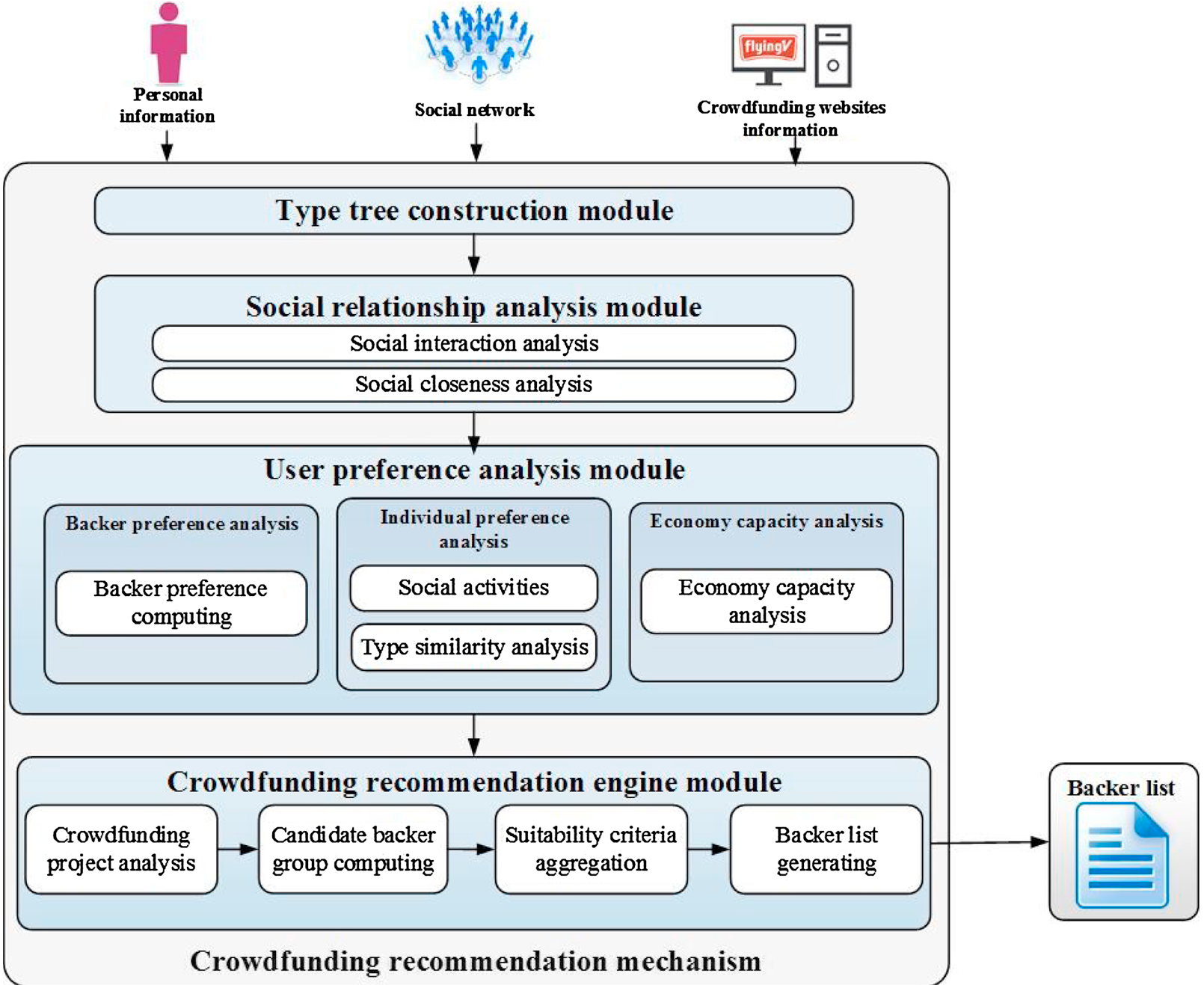
The heart of the paper is a multi-dimensional analysis module that evaluates four criteria: Social Relationship (S), Individual Preference (I), Backer Preference (B), and Economic Capacity (E).
1. The TypeTree & Preference Analysis
The authors built a "TypeTree" to bridge the gap between social media interests (e.g., Facebook "Likes") and crowdfunding categories (e.g., "Technology" or "Art"). This allows the system to solve the Cold Start problem for new backers by mining their social footprint if their crowdfunding history is empty.
2. Social Relationship Analysis
Instead of just checking if two people are "friends," the system calculates Social Closeness using:
- Interaction Intensity: Frequency of tags, comments, and mutual "likes."
- Social Path: Calculating the "hops" between a creator and a potential backer to identify strong vs. weak ties.
3. Dynamic AHP Weighting
The system uses the Analytic Hierarchy Process (AHP) to shift priorities.
- Phase 1 (Early): Weight is heavily on Social Relationship. Trust is the primary driver.
- Phase 2 (Intermediate): Weight shifts toward Individual Preference.
- Phase 3 (Late): Weight focuses on Preference and Economic Capacity. Here, the project's "herd effect" (being near the goal) reduces perceived risk for strangers.
Experiments & Results
The researchers validated the model using data from FlyingV and zeczec (Asia's leading platforms) and Facebook.
Key Findings:
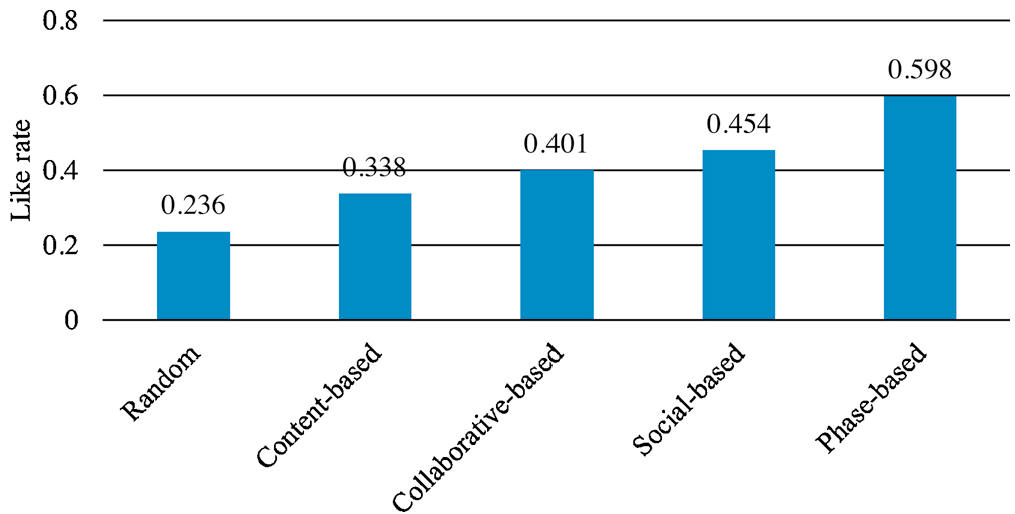
- Behavioral Engagement: The proposed model achieved a 59.8% Like Rate, nearly double that of pure content-based filtering (33.8%).
- Sharing Virality: The Share Rate reached 40.4%, proving that phase-aware recommendations feel less like "spam" and more like "opportunities" to the user.
- The "Trust" Factor: In Phase 1, social relationship was confirmed as the #1 factor for investment, whereas by Phase 3, users cared almost exclusively about the project content and their own budget.
Critical Insight & Future Outlook
This work highlights a fundamental truth in social computing: Context is temporal.
Takeaways for the Industry:
- Platform Operators: Platforms should offer creators "Smart Contact Lists" that suggest who to message at specific project milestones.
- Creators: Don't waste your social capital early by blasting strangers; save the "cold outreach" for when you have 60% of your funding secured and the "Herd Effect" kicks in.
Limitations: The study relies heavily on Facebook data. As social media fragments (to TikTok, Discord, etc.), the challenge will be maintaining a unified "TypeTree" across decentralized social graphs.
Conclusion
By treating fundraising as a dynamic journey rather than a static advertisement, the authors provide a roadmap for turning "creative ideas" into "funded realities." Their phase-based recommendation framework is a significant step toward a more efficient social economy.