
SMIN: Bridging Social Context and Item Knowledge via Self-Supervised Metagraph Networks
Social Recommendation with Self-Supervised Metagraph Informax Network
The paper introduces SMIN (Self-Supervised Metagraph Informax Network), a social recommendation framework that integrates relation heterogeneity from both user social ties and item knowledge graphs. It utilizes a metapath-guided heterogeneous GNN and a self-supervised mutual information learning paradigm to achieve state-of-the-art performance on Ciao, Epinions, and Yelp datasets.
TL;DR
Social recommendation has long relied on the "homophily" principle—that friends share interests. However, users are complex, and items are connected by more than just clicks. SMIN (Self-Supervised Metagraph Informax Network) breaks the limitations of prior work by jointly modeling heterogeneous social ties and item-side knowledge. By leveraging a sophisticated self-supervised mutual information learning paradigm, it captures both micro-level interactions and macro-level graph topology, setting new benchmarks for accuracy in sparse data environments.
The "Blind Spot" in Social Recommendation
While models like GraphRec or DiffNet have successfully used Graph Neural Networks (GNNs) to model social influence, they often treat items as isolated entities or simple ID embeddings. In reality:
- Item-Item Semantic Relatedness: Products belong to categories or share attributes that impact user preference.
- Relation Heterogeneity: A user's link to another user (social) is fundamentally different from a user's link to an item (interaction).
- Local vs. Global Context: Standard GNNs excel at gathering info from immediate neighbors but often lose sight of the global collaborative structures.
Methodology: The SMIN Architecture
SMIN addresses these challenges through a three-stage pipeline that transitions from specific meta-relations to global graph intelligence.
1. Metapath-guided Heterogeneous Encoding
The model defines specific "metapaths" to capture different semantic nuances.
- For Users: It tracks social homophily (User-User), behavior influence (User-Item-User), and knowledge-aware dependency (User-Item-Knowledge-Item-User).
- For Items: It tracks behavior-level relations (Item-User-Item) and knowledge-base links (Item-Entity-Item).
2. Cross-metapath Aggregation
Not all relations are created equal. SMIN utilizes an Attention Mechanism to automatically learn the weight of each metapath. For instance, in a dense social graph, social ties might weigh more, whereas, in a niche category, item knowledge might become the dominant signal.
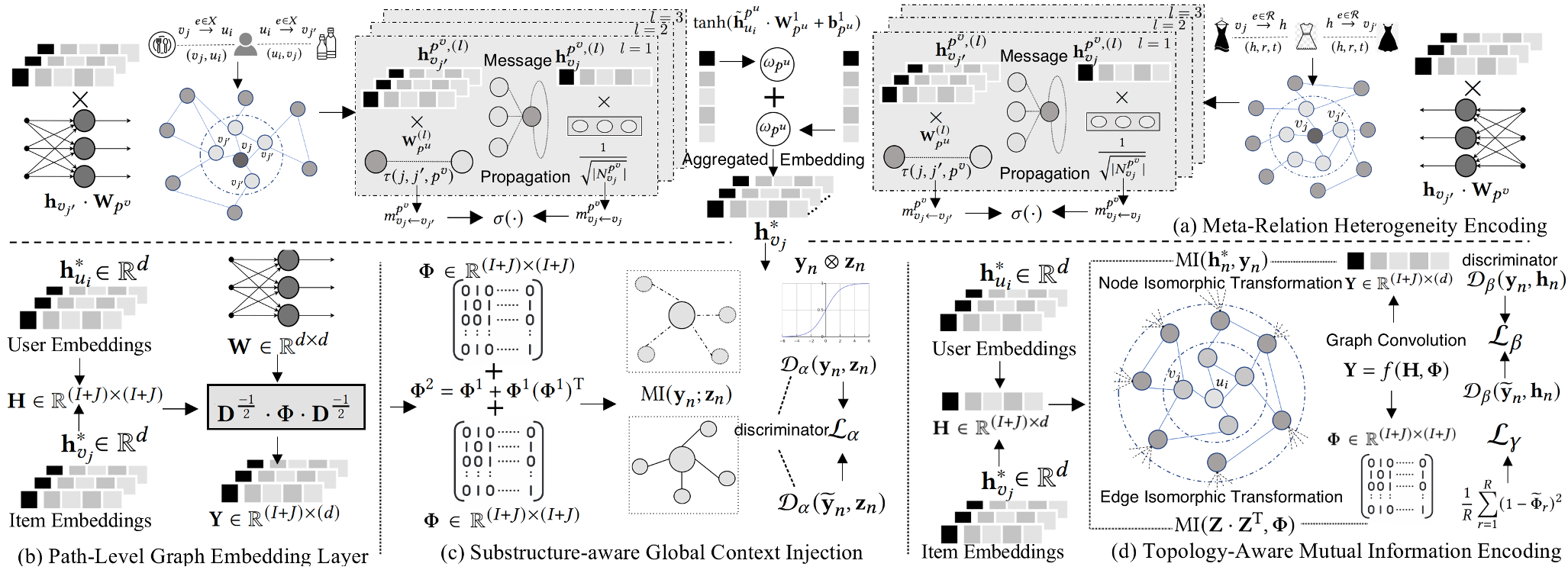 Figure: The overall framework of SMIN, showcasing the heterogeneous GNN and the mutual information learning components.
3. Self-Supervised Mutual Information (MI) Learning
This is the "Secret Sauce" of SMIN. Instead of just relying on the recommendation loss (BPR), the model sets up auxiliary self-supervised tasks:
- Global Context Injection: It maximizes the MI between local node embeddings and a substructure-aware global summary.
- Topology-Aware Encoding: It ensures the learned embeddings preserve the isomorphic transformation properties of the graph, effectively "regularizing" the latent space to respect the graph's actual shape.
Experimental Results
The authors tested SMIN on three massive datasets: Ciao, Epinions, and Yelp.
| Dataset | Metric | NGCF+ | KGAT | SMIN (Ours) | Improvement |
|---|---|---|---|---|---|
| Ciao | HR@10 | 0.6945 | 0.6601 | 0.7108 | Significant |
| Epinions | NDCG@10 | 0.5945 | 0.5578 | 0.6137 | Significant |
Deep Insights from Ablation
- Meta-Relations Matter: Removing the "knowledge-aware item dependency" (
SMIN-IKI) caused a notable performance drop, proving that item-side knowledge is just as vital as social-side links. - Self-Supervision is Key: Without the MI learning components (
SMIN-s), the model lost its ability to effectively capture high-order connectivity, falling closer to standard GNN baselines.
 Figure: Performance comparison across different hyperparameter settings and metapath configurations.
Why It Works: A Professional Take
SMIN succeeds because it treats recommendation as a multi-view alignment problem. By using self-supervised learning to align local features with global topology, it forces the model to learn representations that are robust to noise and data sparsity. The inclusion of metapaths provides the "inductive bias" needed to separate different types of influence, preventing the "over-smoothing" problem often found in deep GNNs.
Conclusion & Limitations
SMIN is a powerful evolution for social recommender systems, effectively bridging the gap between social graphs and knowledge graphs. Limitations: The model relies on the manual definition of metapaths, which requires domain expertise. Future research could explore automated metapath discovery or Reinforcement Learning to dynamicize the neighborhood selection process.
In the era of privacy-preserving AI, where social links might be harder to obtain, SMIN’s ability to "transfer" knowledge from the item domain provides a strategic advantage for platforms with rich product data but sparse social networks.