
TTR: Revolutionizing Social Recommendation via Tag-Trust Fusion and Latent Space Alignment
Research of social recommendation based on social tag and trust relation
This paper introduces TTR (Tag-based and Trust-based Recommendation), a social recommendation framework that integrates item social tags and user trust relations using Probabilistic Matrix Factorization (PMF). By sharing latent feature spaces across different data dimensions, the model achieves state-of-the-art accuracy on Epinions and MovieLens datasets.
TL;DR
The paper introduces TTR (Tag-based and Trust-based Recommendation), a novel framework designed to tackle the chronic "Cold Start" and data sparsity issues in recommendation systems. By leveraging Probabilistic Matrix Factorization (PMF) to fuse social trust networks and item-label tags into a shared latent space, the authors significantly enhance prediction accuracy, particularly for active users with minimal rating history.
Background & Motivation: Beyond Simple Ratings
Traditional Collaborative Filtering (CF) relies heavily on the user-item rating matrix. However, in real-world social networks, we have access to much richer context. The authors identify two major gaps in existing SOTA (State Of The Art) methods:
- Context Ignorance: Many models ignore social tags, which are high-dimensional reflections of user preferences and item characteristics.
- Trust Oversimplification: Most models treat trust as a binary relation (friend or not), ignoring the nuance between a "close friend" (Trustworthiness) and a "domain expert" (Competence).
Methodology: The Core of TTR
The TTR framework operates on the principle of Shared Latent Spaces. It decomposes three distinct matrices simultaneously:
- The User-Item Rating Matrix (): Captures explicit preferences.
- The User-Trust Matrix (): Refined by a new trust calculation algorithm.
- The Item-Tag Matrix (): Captures the "topic" of the resource.
1. Refined Trust Calculation
Instead of using raw social links, the authors calculate a final trust value based on:
- Competence: How "correct" a friend's past ratings were relative to the system average.
- Trustworthiness: A structural metric based on the in-degree of a user in the social graph.
2. Probabilistic Matrix Factorization (PMF)
The model constraints the user potential space and item potential space using Gaussian priors.
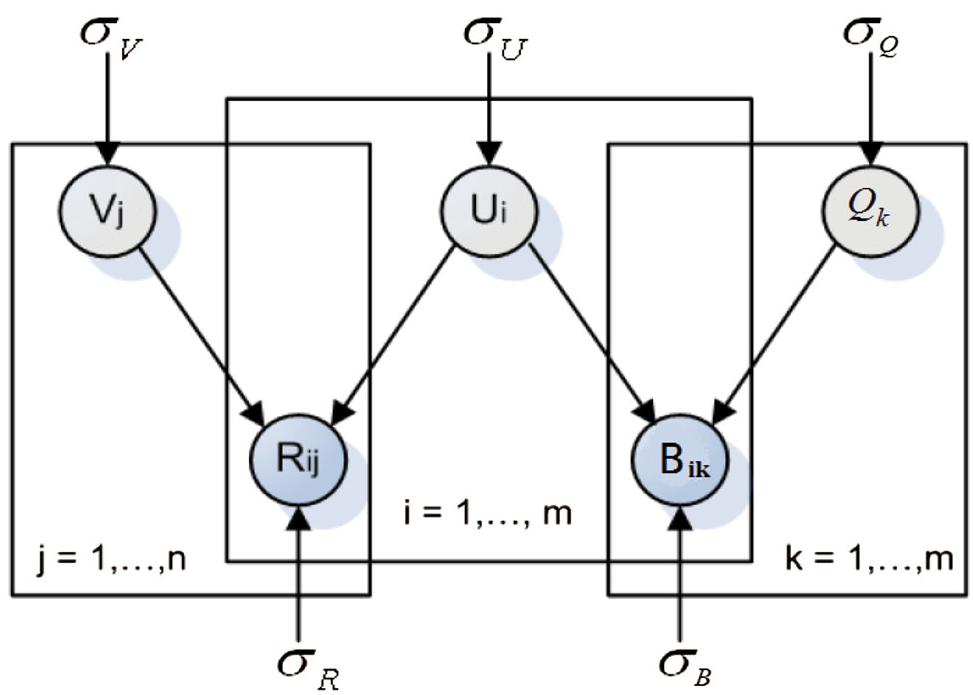 Figure 1: The Graphical Model representing how trust relations and ratings share the user latent space.
The objective function minimizes the sum-of-squared-errors across ratings and tags, weighted by a regularization parameter , which balances the influence of tag information.
Experiments: Proving the Value
The authors tested TTR against heavyweights like PMF, SVD, and SocialMF using the Epinions and MovieLens datasets.
Key Performance Metrics
Experimental data showed that TTR consistently achieved the lowest Mean Absolute Error (MAE) and Root Mean Square Error (RMSE).
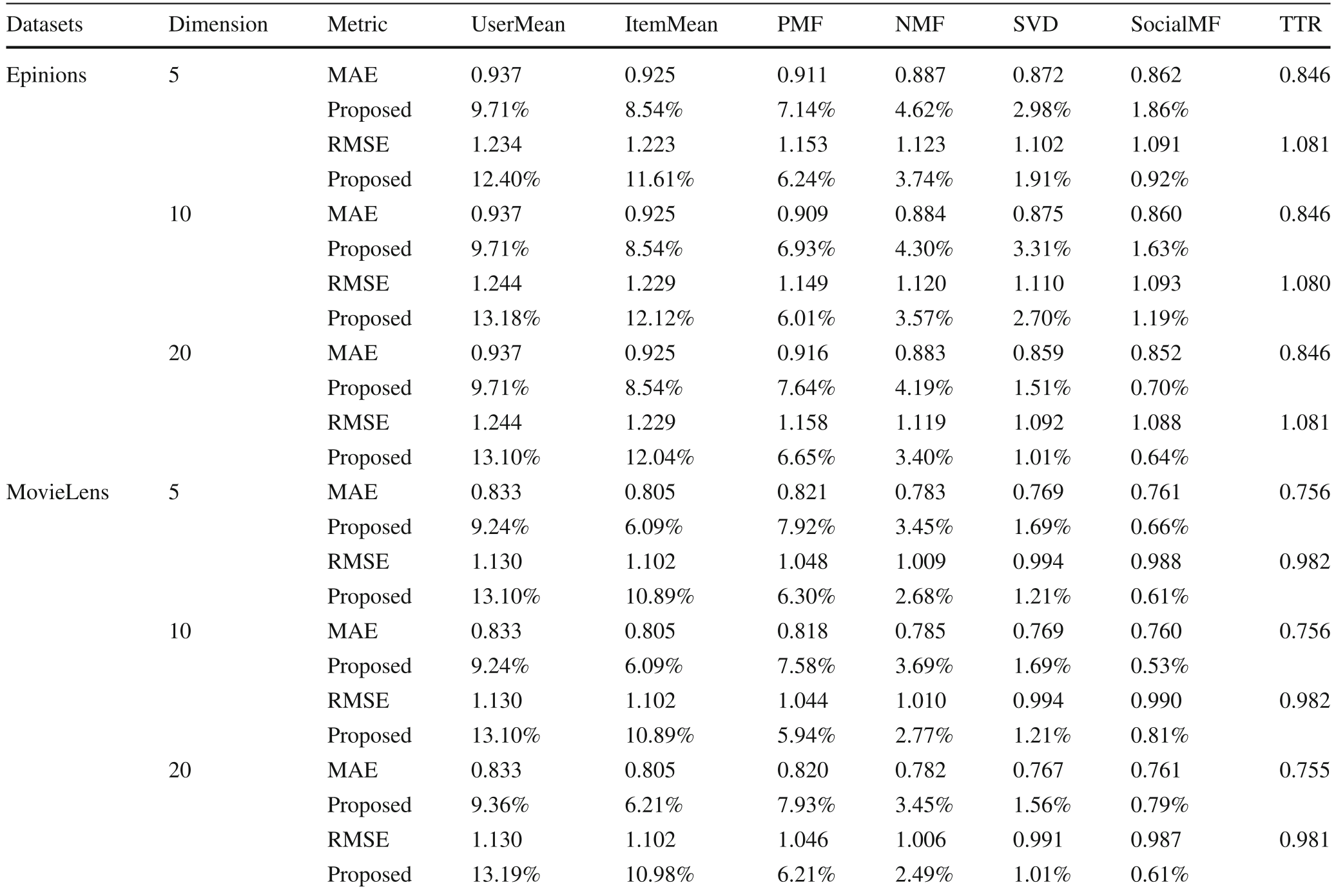 Table 1: Comparative analysis showing TTR's superiority across different dimensions and datasets.
The Cold Start Resilience
One of the most impressive findings was TTR's performance when training data was reduced to only 10%. While traditional PMF accuracy plummeted, TTR maintained robust performance because the Social Tags and Trust Relations acted as an "anchor," providing necessary information even when ratings were missing.
Deep Insight: Why It Works
The brilliance of TTR lies in its Inductive Bias. By forcing the item embeddings to not only reconstruct ratings but also align with social labels, the model learns a more "semantic" representation of items. Similarly, by weighting trust through competence, the model filters out "social noise" (friends with irrelevant tastes), focusing on influential peers who actually drive user behavior.
Conclusion and Future Outlook
TTR is a strong testament to the power of multi-source data fusion in recommendation systems. While the current model uses gradient descent, which scales linearly and is efficient enough for large datasets (converging in roughly 10 seconds), future iterations could benefit from:
- Dynamic Trust: How trust evolves over time as users' interests shift.
- Deep Learning Integration: Replacing the linear PMF with Deep Neural Networks to capture non-linear interactions between tags and users.
By bridging the gap between social structures and semantic content, TTR provides a robust blueprint for the next generation of context-aware recommender systems.