
Turning Speech into Social Currency: How ARD Uses ASR for Video Recommendations
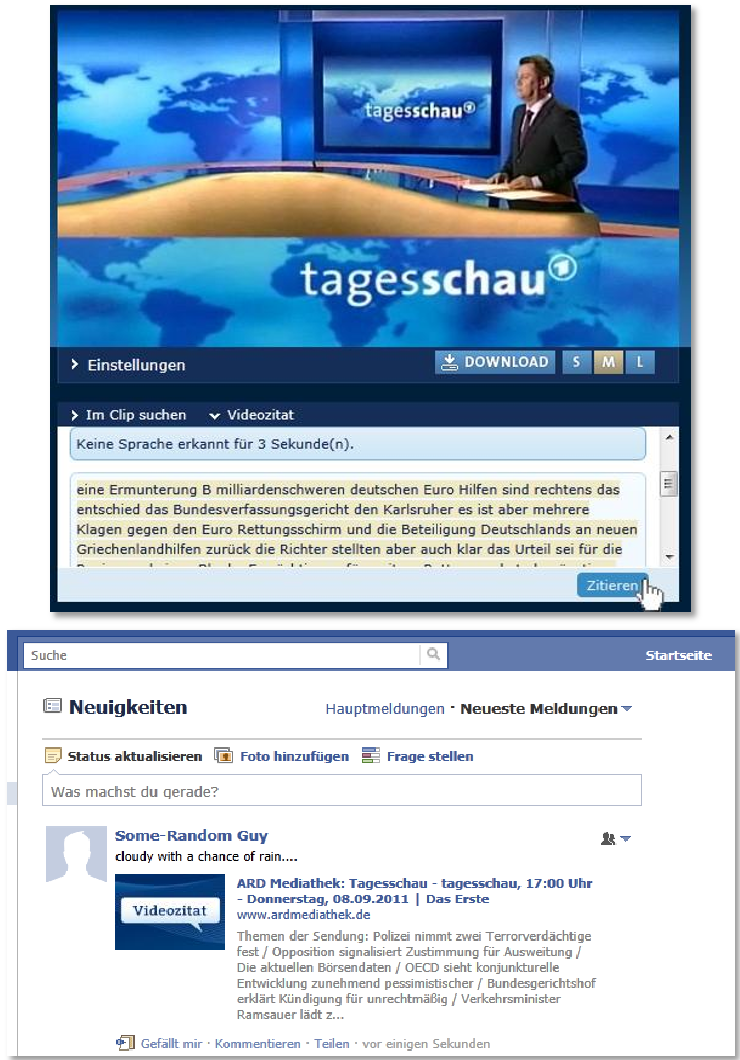
Social recommendation using speech recognition: Sharing TV scenes in social networks
This paper presents a system designed for the German broadcaster ARD that enables users to cite and share specific TV scenes on social networks using Automatic Speech Recognition (ASR) transcripts. It leverages a specialized ASR pipeline featuring acoustic and language model adaptation to ensure high-quality, searchable, and selectable text synchronized with video playback.
TL;DR
The Fraunhofer IAIS and Germany's largest broadcaster, ARD, have developed a system that turns TV broadcasts into "citable" social media snippets. By using advanced Automatic Speech Recognition (ASR) and a unique twofold adaptation strategy, they allow users to select text in a transcript and instantly share the corresponding video segment to platforms like Facebook and Twitter.
Background: The Discovery Problem
Broadcasters like ARD possess massive archives, but "hidden gems" within hours of footage are often lost because they aren't easily searchable or shareable. Existing social sharing is usually limited to a whole video or a manual timestamp. The authors realized that if users could "Copy & Paste" video as easily as text, they could drive significantly more traffic to the ARD Mediathek.
The Technical Challenge: ASR Quality
For a "Cite this" feature to work, the transcript must be readable. However, standard ASR models struggle with the diverse audio found in TV:
- Acoustic Variability: Background music, spontaneous speech, and different microphone setups.
- Linguistic Breadth: A baseline model trained on news might fail on specific sports terminology or cultural niche topics.
Methodology: The Twofold Adaptation Strategy
To bridge the gap between "raw ASR" and "user-ready text," the system employs two core adaptation layers.
1. Acoustic Model Adaptation (The "Who")
The system identifies frequent speakers (anchormen, politicians) and applies two mathematical transformations to the Triphone models:
- MLLR (Maximum Likelihood Linear Regression): A global transformation of the Gaussian mixture means.
- MAP (Maximum A-Posteriori): A local re-estimation that balances the baseline model with new adaptation data.
The combo of these two ensures that the model "tunes in" to the specific vocal characteristics of the speaker.
2. Language Model Adaptation (The "What")
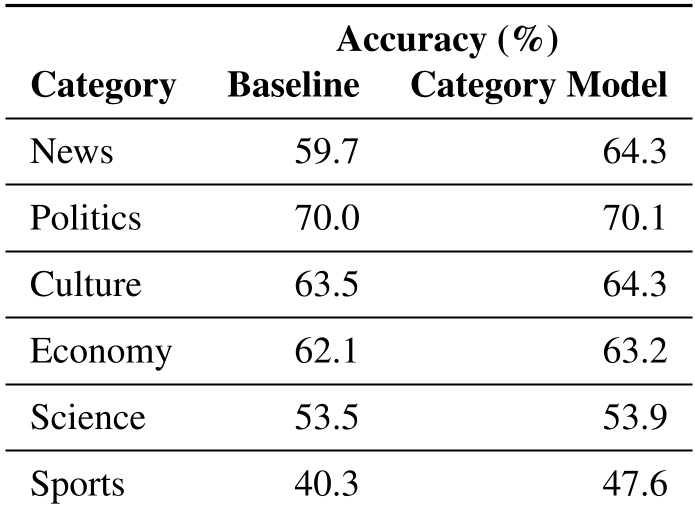
The system uses metadata to categorize videos (e.g., "Sportschau" goes to the Sports category). It then swaps or interpolates the general language model with one trained on domain-specific text (like sports newsfeeds), significantly reducing errors for niche vocabulary.
Experimental Results: Proving the Gain
The results show a dramatic improvement when these adaptations are applied.
Acoustic Gains
The jump from a 61.3% baseline accuracy to 76.3% with MLLR+MAP proves that even a few minutes of speaker-specific data can turn a mediocre transcript into a high-quality quote source.
| Approach | Accuracy (%) |
|---|---|
| Baseline | 61.3 |
| MLLR | 67.2 |
| MAP | 73.8 |
| MLLR+MAP | 76.3 |
Domain Gains
In the Sports category—often the most difficult due to fast speech and specific jargon—the accuracy jumped from 40.3% to 47.6%. While still challenging, this represents a massive reduction in relative error.
Critical Insight & Conclusion
What makes this work stand out is its focus on "Confidence-based Display." The system calculates a document-wide confidence level based on word posteriors. If the ASR quality is likely to be low, the "Social Recommendation" feature is hidden. This ensures that the user experience remains professional and the brand of the broadcaster is protected from "hallucinated" or garbled transcripts.
Future Outlook: As we move into the era of LLMs and Whisper-style models, the principles here—leveraging metadata for context and providing a seamless "text-to-video" interface—remain the gold standard for media archive accessibility.
Limitations
- The system relies on a manual mapping of categories to video series.
- While speaker adaptation is powerful, it currently only targets a pre-defined list of frequent speakers (politicians and hosts).