
HTPF: Bridging the Gap Between What We Notice and What We Like in Social Recommendation
Social recommendation based on users’ attention and preference
The paper introduces HTPF (Hierarchical Trust-based Poisson Factorization), a novel probabilistic social recommendation model that integrates both user attention and preference. By leveraging Poisson factorization and social network information, HTPF achieves state-of-the-art performance across multiple real-world datasets like Epinions and Douban.
TL;DR
Most recommendation systems assume that if you buy something, you must like it. HTPF (Hierarchical Trust-based Poisson Factorization) challenges this by introducing Attention as a distinct latent factor. By recognizing that our friends influence what we look at more than what we actually like, HTPF achieves superior accuracy by modeling the social network as a proxy for user attention.
Problem & Motivation: The Attention Gap
We live in an age of information overload. When you are presented with a long list of recommendations on a social platform, you don't evaluate every single item. Instead, your brain selectively concentrates on a small fraction—this is Attention.
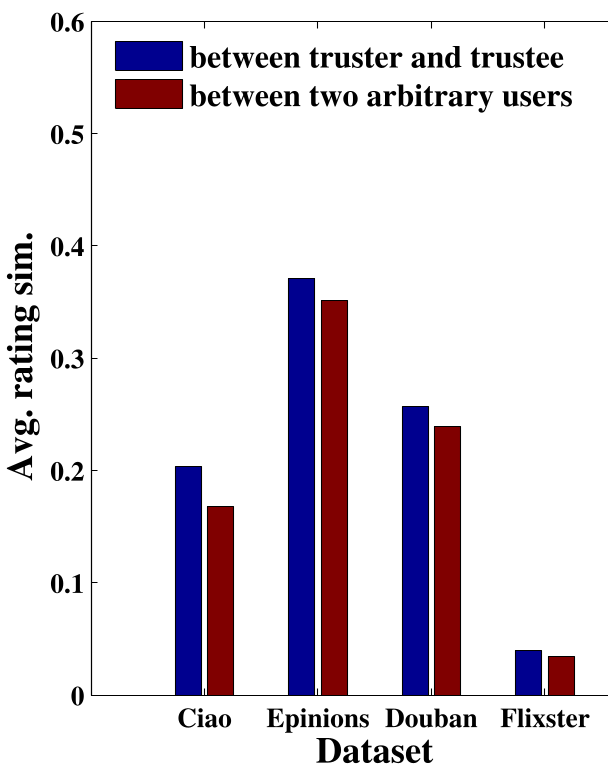
Previous social recommendation models (like Sorec or SocialMF) focused on the "social regularization" of ratings. They assumed that if User A trusts User B, their preferences (ratings) should be similar. However, the authors' empirical analysis of datasets like Epinions and Ciao reveals a different reality: Social connections influence our attention behaviors far more than our rating values. Your friends make you aware of a product, but they don't necessarily dictate whether you'll give it 5 stars.
Methodology: Decoupling Attention and Preference
The core innovation of HTPF lies in its dual-path generative process. It treats attention and preference as two separate latent variables inside a Poisson Factorization framework.
1. Socially-Driven Attention
The model uses the trust network to infer attention. If a user follows "experts" or "friends," they are likely to pay attention to the items those trustees consume. This is modeled as: Where represents the user's attention topics and represents the item's attributes.
2. Attribute-Driven Preference
Preference is modeled as the intrinsic "taste" match between a user's latent preference vector and the item's attributes :
3. The Weighted Hybrid Score
To generate the final recommendation, HTPF combines the predicted rating and the attention probability using a weight : This allows the model to balance between "what's popular in your circle" (Attention) and "what fits your historical taste" (Preference).
Experiments & Results: The Power of Social Attention
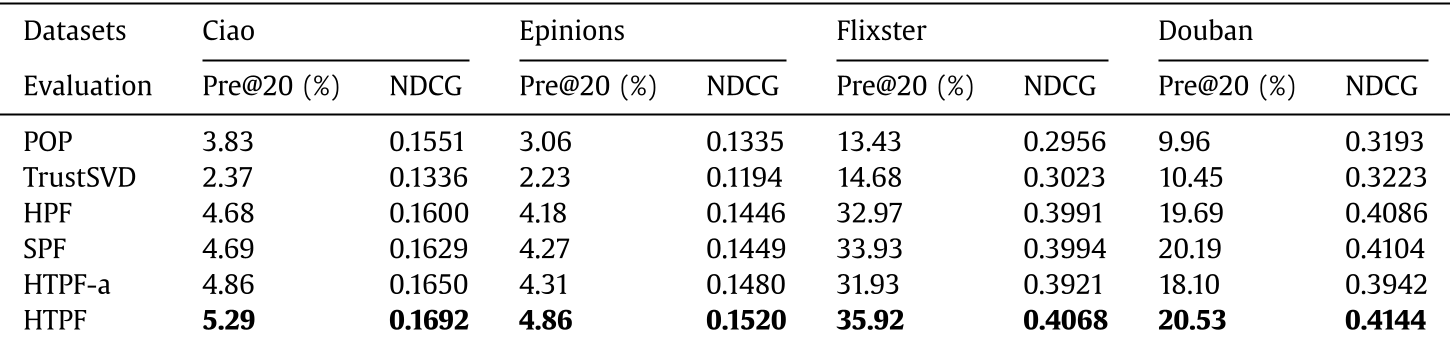
The authors tested HTPF against state-of-the-art baselines (HPF, TrustSVD, SPF) across four massive datasets.
Key Findings:
- Superiority over HPF: By adding social attention, HTPF significantly improves over the standard Hierarchical Poisson Factorization (HPF).
- The Density Effect: In the Ciao dataset (which is social-heavy/dense), a lower (0.2) was optimal. This proves that in highly social environments, attention is the dominant factor in consumption.
- Scalability: Utilizing Coordinate Ascent Variational Inference, the model remains linear relative to the number of ratings and social links, making it viable for production-scale data.
Critical Analysis & Conclusion
HTPF provides a critical psychological insight for AI engineers: Exposure Preference. By modeling the "Social Influence on Attention," the authors bridge the "trust-preference gap" that has plagued social recommendation for years.
Limitations: The model currently relies on binary attention (whether an item was rated or not). Future work could integrate more granular "implicit" data, such as dwell time or click-through logs, to further refine the attention latent space.
Takeaway: If you are building a social feed, don't just look at what people like; look at why they noticed it in the first place. The trust network is your best tool for modeling the "Noticing" phase of the user journey.