
Smart TV Navigation: Bridging Academic Content Analysis and the Living Room Experience
Social recommendation and visual analysis on the TV
This paper presents a prototype interactive TV software developed by Dublin City University and Samsung, which integrates automated visual content analysis and social networking features. The system utilizes shot boundary detection, genre-specific segmentation (news, sports, movies), and content-based recommendation to enhance the "lean-back" living room experience using only a standard remote control.
TL;DR
Researchers from Dublin City University and Samsung have developed a prototype that transforms the "passive" TV experience into an "interactive" one. By leveraging automated visual analysis, the system allows users to browse news stories, sports highlights, and social updates using nothing more than the four colored buttons on a standard TV remote.
Context: The Paradox of Choice in the DVR Era
As Digital Video Recorders (DVRs) reached capacities allowing for thousands of hours of storage, the fundamental problem shifted from "what is on" to "how do I find what I want." However, the living room is a "lean-back" environment—users are distant from the screen, easily distracted, and lack a keyboard. Traditional Information Retrieval (IR) methods fail here because they rely on active user input.
The Motivation: Intelligence without Complexity
The authors recognized that the burden of organization must shift from the user to the machine. The goal was to apply MultiMedia Information Retrieval (MMIR) tools—previously confined to high-end workstations—to a standard TV interface. The core insight was to use visual metadata to create a "chapter-like" browsing experience for all broadcast content, not just DVDs.
Methodology: Deep Content Awareness
The system bypasses complex menus in favor of a flat, color-coded architecture:
-
Genre-Specific Analysis:
- News: Automated story segmentation allows users to jump directly to specific segments (e.g., from politics to weather).
- Sports: Using SVMs and audio-visual features, the system identifies "important" events (like goals or tackles). It then generates a visual summary where the size of the keyframe correlates with the event's importance.
- Movies: Employs shot boundary detection and scene composition to mimic DVD chapter selections.
-
Social Connectivity: A dedicated button (Yellow) invokes a "Social TV" overlay, allowing users to see what buddies are watching and send instant notifications, fostering a shared viewing experience without interrupting the content.
-
Discovery via "Find Similar": Instead of searching by name, an "Orange" button triggers a similarity engine. This uses a mix of EPG text and visual content measures to suggest related shows from both the local archive and the web.
 Figure 1: The Social TV buddy list overlay.
Experimental Evidence & Results
The researchers prioritized Human Factors over raw algorithmic accuracy. By implementing a 2-level hierarchical keyframe browser (Scene -> Shot), they reduced the "cognitive load" of searching.
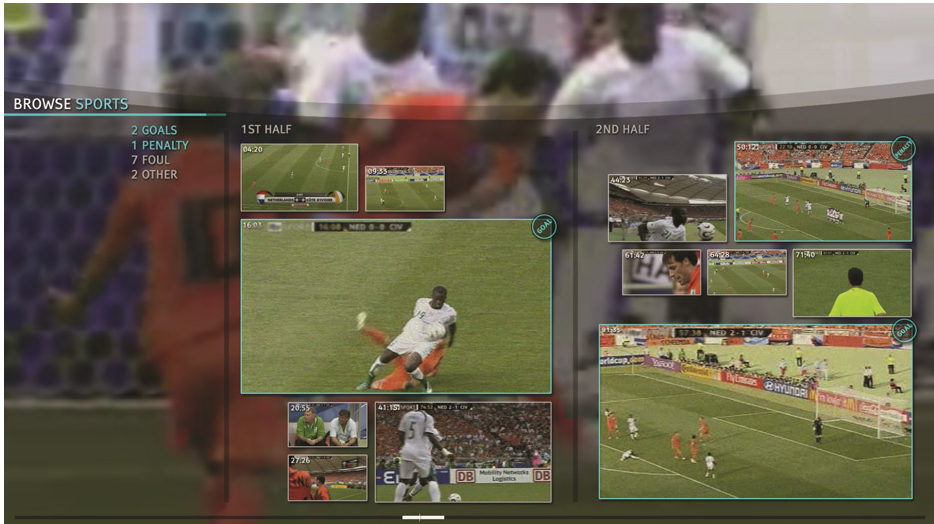 Figure 2: Event-based sports summarization where larger keyframes represent high-impact moments.
The prototype demonstrated that visual analysis could effectively "index" a TV show on the fly. Preliminary findings showed that users found the "Find Similar" feature particularly potent because it bypassed the frustration of on-screen virtual keyboards.
Critical Analysis & Future Outlook
Strengths: The transition from text-based search to visual-based browsing is highly suited for the TV form factor. The genre-specific approach acknowledges that we consume news differently than we consume soccer.
Limitations: At the time of publication (2010), the system relied on a separate PC for processing. Today, these tasks would be handled by on-chip AI accelerators within the Smart TV. Furthermore, the reliance on manual color-button mapping might become cluttered as more features are added.
Conclusion: This work laid the groundwork for the modern "Content-First" interfaces seen in Netflix and YouTube today. It proved that the future of TV isn't just about higher resolution, but about metadata-driven interaction that understands what's happening within the pixels.