
PRO-Fit: Elevating Fitness Adherence through Social Intelligence and Proactive Scheduling
Social recommendations for personalized fitness assistance
The paper introduces PRO-Fit, a personalized fitness assistant framework that combines wearable sensor data with social recommendation algorithms. Using a hybrid system of Gradient Boosted Trees for activity classification and Matrix Factorization for collaborative filtering, it provides SOTA-level personalized exercise schedules and "fitness buddy" suggestions.
TL;DR
Researchers have developed PRO-Fit (Personalized Recommender and Organizer Fitness assistant), a framework that transforms fitness tracking from a passive logbook into an active social coach. By fusing accelerometer data, personal calendars, and social network graphs, PRO-Fit doesn't just track your runs—it finds the best time for them and recommends a "fitness buddy" from your social circle to keep you accountable.
Context: Why Fitness Apps Fail
The "high maintenance" nature of current health apps is their Achilles' heel. Most require users to manually log every workout, leading to rapid burnout for busy or less self-motivated individuals. Furthermore, most apps ignore the accountability factor. Scientific phenomena like the Köhler effect suggest that people work out longer and harder when paired with others, yet few technical architectures have successfully operationalized this social dynamic into a recommendation engine.
The Methodology: Fusing Social Graphs with Latent Factors
The core of PRO-Fit is a multi-layered architecture that moves beyond simple "distance tracked" metrics.
1. Activity Classification
Instead of asking what you did, PRO-Fit uses Gradient Boosted Trees to analyze tri-axial accelerometer data. It extracts features like average resultant acceleration and "time between peaks" to distinguish between walking, running, cycling, and climbing stairs with minimal battery overhead.
2. Socially-Aware Recommendations
The system utilizes a modified Matrix Factorization approach (via Alternating Least Squares). It characterizes users and activities in a joint "latent factor space." For example, an activity might be decomposed into factors like "intensity," "speed," or "equipment needed."
The breakthrough is the Social Similarity Metric:
 Figure 1: High-level PRO-Fit architecture showing the flow from sensors to social recommendations.
The similarity between two users () isn't just based on shared preferences, but also their degree of connectivity: Where represents the distance in the social graph. Direct friends have higher influence, but "friends of friends" (2-degrees) provide the diversity needed for fresh recommendations.
Experimental Proof: Social works better
The researchers tested their intuition using the Yelp dataset (as a proxy for social preference) and the WISDM activity dataset.
Key Findings:
- The 2-Degree Sweet Spot: Experiments showed that expanding the social graph to two degrees of separation (friends of friends) resulted in the lowest RMSE (1.09) for preference prediction.
- Proactive Scheduling: In a 15-day user study, the "Session Reschedule" feature—which scans calendars to find open slots—was the most praised, with 70% of users reporting higher motivation to stick to their goals.
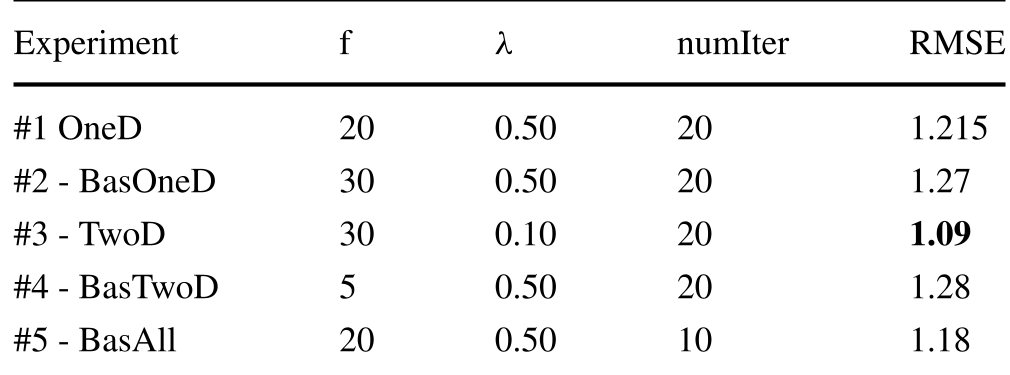 Table: Comparison of RMSE across different social separation degrees. TwoD (Experiment #3) shows the highest accuracy.
Critical Insight: The Shift from "What" to "Who"
The academic value of PRO-Fit lies in its recognition that data alone is not a motivator. While the industry has obsessed over sensor precision (GPS accuracy, HR monitor lag), this paper argues that contextual fitness (knowing a user's location, their free time at 12 PM, and who they know) is the real catalyst for behavior change.
Limitations & Future Outlook
While promising, the current framework faces a cold-start problem—new users without social connections or history still need manual initialization. Furthermore, the "tie strength" between users could be further refined by looking at interaction frequency rather than just graph distance.
Conclusion
PRO-Fit marks a transition toward Active Wellness Assistants. By integrating social signals directly into the recommendation utility matrix, it proves that "who you know" is just as important as "how fast you run" when building a sustainable healthy lifestyle.