
Beyond Symmetric Similarity: Boosting Recommendation Accuracy with Item Asymmetric Correlation (IAC)
A social recommender system using item asymmetric correlation
This paper introduces Item Asymmetric Correlation (IAC), a novel social recommendation method that leverages implicit relationships between items extracted from the user-item matrix. By integrating these asymmetric relationships as a regularization term into a Matrix Factorization (MF) framework, the system achieves SOTA performance in mitigating data sparsity and cold-start issues, particularly outperforming existing MF-based benchmarks by 11% in prediction accuracy.
TL;DR
To solve the perennial "cold start" and "data sparsity" problems in recommender systems, researchers have often looked toward social graphs (friendships). However, this paper argues that implicit item relationships are more accessible and accurate. By introducing Item Asymmetric Correlation (IAC)—which acknowledges that if you like "Item A" you might like "Item B," but the reverse isn't always true—and fusing it into Matrix Factorization, the authors achieved an 11% boost in accuracy on the Last.fm dataset.
Problem & Motivation: The "Social" Fallacy
Most social recommender systems assume that "your friends' tastes are your tastes." In reality, we follow people for many reasons: kinship, celebrity status, or shared history, none of which guarantee a shared interest in specific items. Furthermore, many e-commerce platforms simply don't have a social graph available.
The authors identify a secondary issue in traditional Item-based CF: Symmetry. Standard metrics like Cosine Similarity assume that the relationship between two items is reciprocal. In practice, correlations are often hierarchical or directional. A user purchasing a specialized "Camera Lens" is very likely to be interested in a "SD Card," but a general user buying an "SD Card" might have no interest in professional photography equipment.
Methodology: The IAC Framework
The core contribution is the Item Asymmetric Correlation (IAC), a two-step process:
1. Extracting Asymmetric Correlation
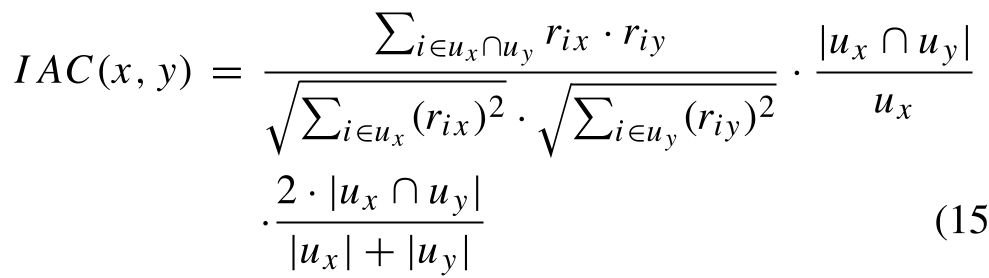
The method calculates a directed weight between items by considering the ratio of common users to the total users of each item. This ensures that the "cost" of the relationship is reflected in the weight.
2. Matrix Factorization Fusion
The calculated asymmetric matrix is injected into the standard MF objective function as a regularization term. This forces the latent factors of an item () to be close to the weighted average of its correlated items (), effectively "filling in the gaps" of missing data.

The architecture demonstrates how the User-Item matrix and the new Item Correlation matrix are processed through MF mapping models (SGD/ALS).
Experiments & Results: Dominance in Sparse Data
The authors tested the model against Basic MF, MF+M (Group Membership), and MF+IAR (Association Rules).
SOTA Comparison
As the dataset becomes sparser (moving from Train-60 to Train-90), the performance gap between IAC and other methods widens. This confirms that item-side implicit relationships are extremely robust when user-side interaction data is nearly non-existent.
SGD vs. ALS
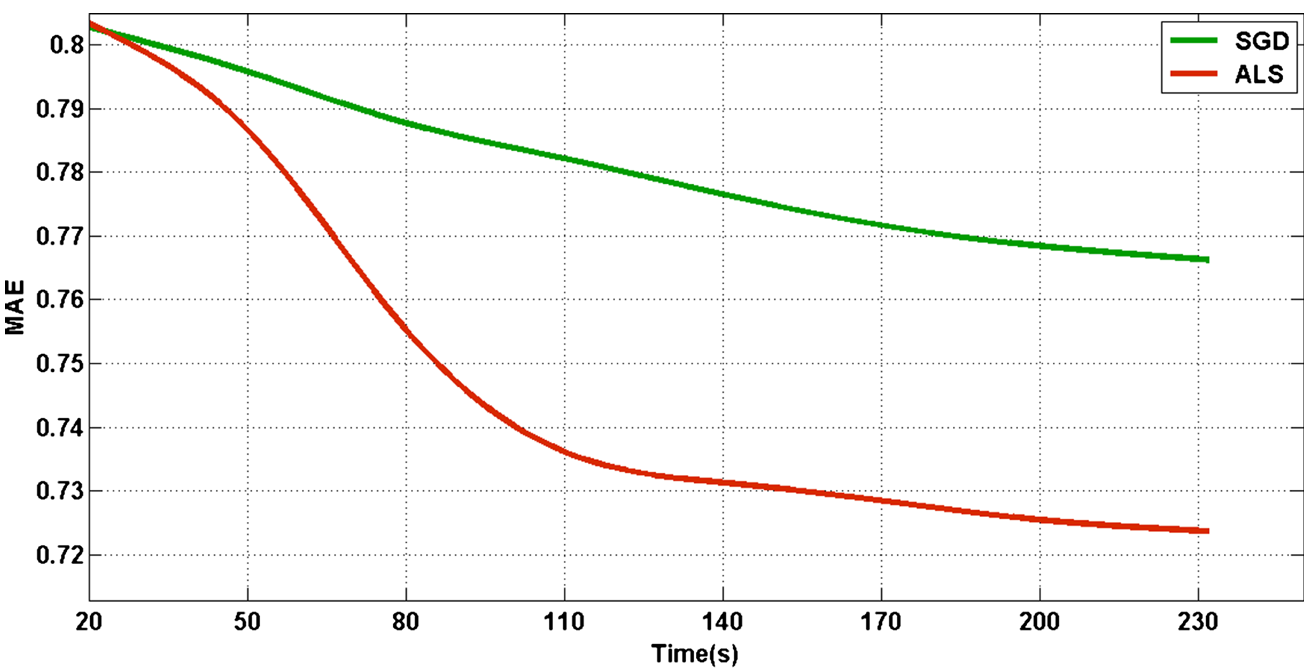
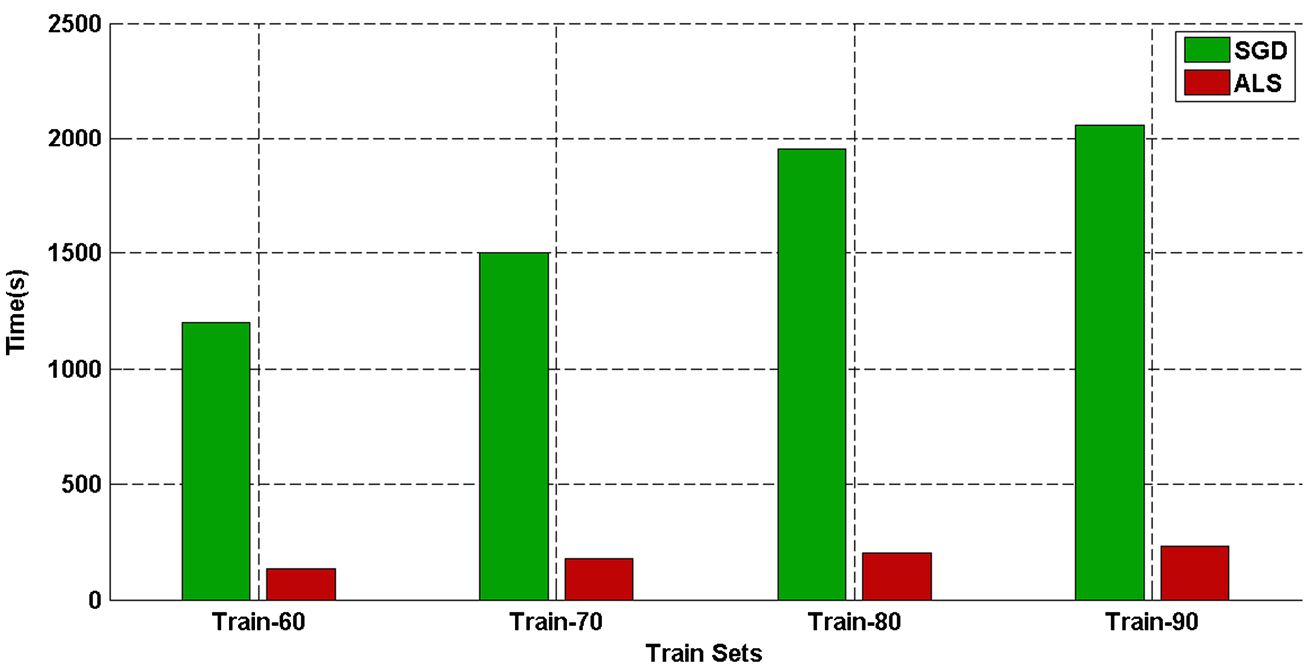
While SGD is the "industry standard" for its simplicity, the paper finds that Alternating Least Squares (ALS) is significantly more effective for this specific architecture. ALS converges faster and handles the sparsity of the IAC-regularized matrix with better stability than SGD.
Critical Insight & Conclusion
The true value of this work lies in its universality. Unlike social-based systems that require "friendship APIs," IAC works on pure interaction data. By mathematically acknowledging that item relationships are asymmetric, the model captures a deeper "manifold" of user behavior.
Limitations: The preprocessing complexity of IAC is , which may be high for massive catalogs. Future work should focus on parallelizing the correlation extraction to scale the system for real-time e-commerce environments.