
Social Recommender Systems: Beyond Collaborative Filtering to Social-Aware Intelligence
A study on features of social recommender systems
This paper provides a comprehensive survey and classification of Social Recommender Systems (SRS). It explores how integrating social network features—such as trust, tags, and groups—into traditional recommendation architectures can mitigate long-standing issues like data sparsity and cold-start problems.
TL;DR
Recommender Systems (RS) are undergoing a paradigm shift. This paper argues that the traditional "siloed" view of user preferences is obsolete. By integrating social networking features—Trust, Context, and Groups—into the recommendation loop, we can finally solve the "Cold-start" and "Data Sparsity" problems that have plagued Collaborative Filtering for decades.
The "Why": The Failure of Traditional RS
Traditional engines, like early versions of Amazon or Netflix, rely heavily on the User-Item Rating Matrix. However, two structural issues often break these models:
- Data Sparsity: A typical user only rates a tiny fraction of available items, leaving the matrix 99% empty.
- Cold-start: For a new brand-new user or item, there is zero history. How do you recommend "out of the box"?
The author's core insight is that Social Networks provide the missing link. We are more likely to buy a book recommended by a trusted friend than by a random stranger.
Methodology: The 8 Pillars of Social Recommendation
The paper classifies the evolution of Social Recommender Systems (SRS) into eight key technical features.
1. Social Regularization and Context
Context isn't just location; it's the "social, physical, mental, and emotional state" of the user. Models like SoCo use random decision trees to split the rating matrix based on context, applying Social Regularization to ensure that connected friends' preferences don't diverge too wildly in the latent space.
2. The Weight of Trust
Not all social ties are equal. SRS now distinguishes between "Direct Trust" (friends) and "Indirect Trust" (friends of friends). Algorithms like TrustMF integrate trust data directly into Matrix Factorization, allowing the system to use a "Trustee model" to explain how users follow the opinions of others.
3. Deep Learning in SRS
Modern approaches like dTrust utilize Deep Feed-forward Neural Networks to combine network topology with ratings. This allows for high-order interaction modeling that linear models miss.
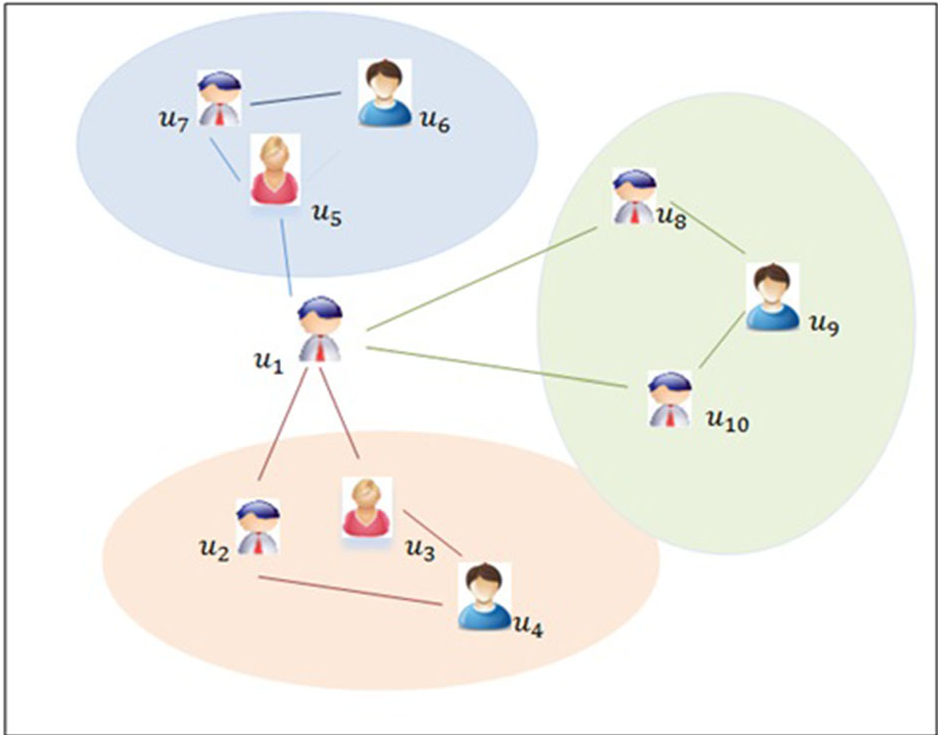 Fig 1: Illustrating how a single user maintains heterogeneous connections across different social domains (e.g., Movie recommendations vs. Professional conferences).
Comparison of State-of-the-Art (SOTA) Approaches
The paper compares several benchmark systems that have moved the needle in SRS performance.
| System | Key Parameters | Approach | Metric |
|---|---|---|---|
| SoCo | Social Regularization | Matrix Factorization | RMSE, MAE |
| dTrust | Network Topology | Deep Neural Network | RMSE, MAE |
| TT-CDR | Transitive Trust | Matrix Factorization | Recall, MAE |
| TempoRec | Time Decay | Hybrid (Topic-based) | MAP |
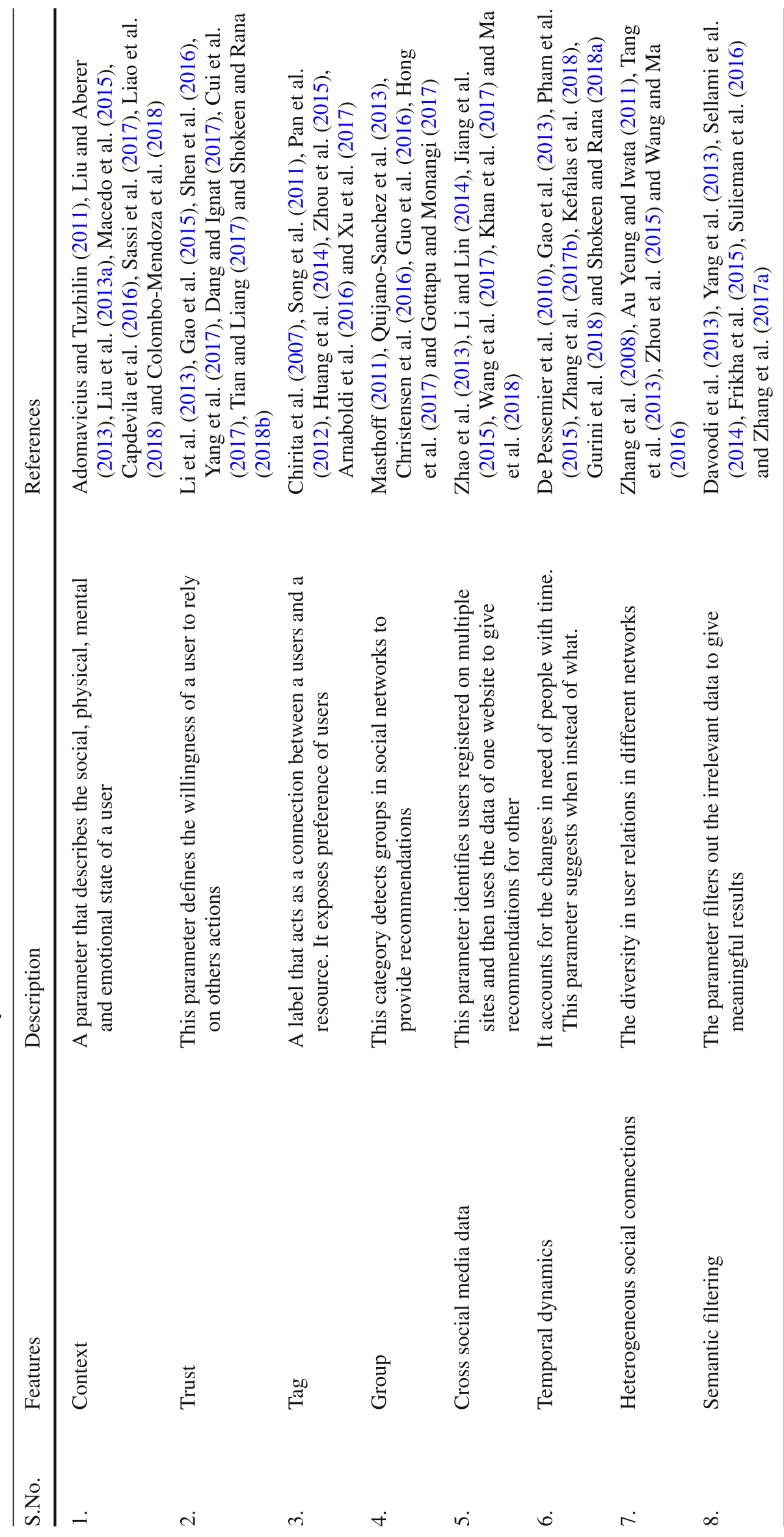 Table 1: A summary of the 8 features and the landmark research papers associated with them.
Critical Insight: The Temporal and Semantic Turn
Two features stand out as the future of the field:
- Temporal Dynamics: Preferences are non-stationary. A user interested in baby toys today will be looking for school supplies in five years. SRS must suggest when to recommend as much as what.
- Semantic Filtering: Using Ontologies (like Wikipedia or domain-specific knowledge bases) to understand the "why" behind a tag. This helps resolve "Synonymy"—where two tags mean the same thing but are spelled differently.
Conclusion and Future Outlook
While SRS significantly improves accuracy, the paper identifies several "frontiers" that remain unsolved:
- Signed Networks: Most systems only handle "likes" (positive links). Modeling "dislikes" or "distrust" (negative links) is computationally harder but essential for accuracy.
- Privacy: As we harvest more social data (tags, locations, friends), the trade-off between personalization and privacy reaches a breaking point.
- Cross-Domain Knowledge: The "Item Silk Road"—transferring your preferences from Twitter to an e-commerce platform—is the next great challenge in link prediction.
Final Takeaway: The next generation of AI recommenders won't just look at what you bought; they will understand your social graph, your current context, and your evolving trust network to provide truly "human-centric" intelligence.