
Social-movMFs: Leveraging Directional Statistics and Social Manifolds for Superior Recommendations
Social regularized von Mises–Fisher mixture model for item recommendation
The paper introduces Social-movMFs, a novel social collaborative filtering (CF) model that combines a von Mises–Fisher (vMF) mixture model with social network regularization. By modeling high-dimensional sparse user-item preference data as directional vectors on a unit-hypersphere and enforcing posterior smoothness across social connections, it achieves SOTA ranking performance on benchmark datasets like Flixster and Epinions.
TL;DR
Recommender systems often struggle with "cold start" users and extremely sparse data. While most methods rely on Gaussian assumptions, the Social-movMFs model treats user preferences as directions on a sphere. By combining von Mises–Fisher (vMF) distributions with social network regularization, this model significantly boosts ranking accuracy, achieving nearly double the performance for cold-start users in highly social environments like Flixster.
The "Gaussian Problem" in Recommendations
In Collaborative Filtering (CF), we typically measure how "close" users are. In practice, the community relies heavily on Cosine Similarity and Pearson Correlation. Probabilistically, using these measures implies that the direction of a user's preference vector matters more than its magnitude.
However, most SOTA models (like Probabilistic Matrix Factorization) assume a Gaussian distribution. This creates a mismatch: Gaussian distributions live in Euclidean space, but our data's most useful features live on the surface of a unit-hypersphere.
Methodology: The vMF Directional Intuition
The authors propose the Social-movMFs model. The core logic consists of two pillars:
- The vMF Mixture: Instead of Gaussian blobs, the model uses the von Mises–Fisher distribution, which acts like a "Gaussian on a sphere." It uses a centroid () and a concentration () parameter to model user clusters.
- Social Manifold Regularization: The model assumes that friends influence each other. It adds a penalty term (a graph harmonic function) that forces the posterior probability of a user belonging to a certain cluster to be similar to their friends' probabilities.
Scalable Learning via GEM
To handle millions of ratings, the authors derived a Generalized Expectation-Maximization (GEM) algorithm. A key innovation is the use of a Newton-Raphson step to gradually smooth user preferences based on their social graph without drifting too far from the observed rating data.

Experimental Breakthroughs
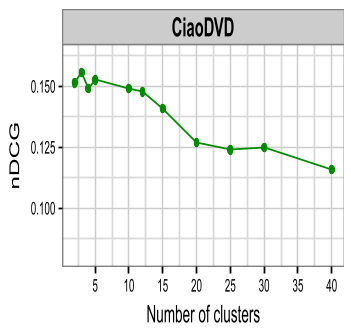
The research tested the model against heavyweights like TrustSVD, SoReg, and SocialMF across five datasets (FilmTrust, CiaoDVD, Ciao-280k, Flixster, Epinions).
Key Metrics:
- Cold Start Excellence: On Flixster, where social links are dense but ratings are sparse, the social component improved Precision@10 by a staggering 88.1% compared to a basic mixture model.
- Ranking over Rating: Unlike MF models that focus on minimizing RMSE (Root Mean Square Error), Social-movMFs optimizes for nDCG and MRR, which are more aligned with actual user satisfaction (the order of items matters).
Deep Insights: Why Does it Work?
The paper highlights a crucial "Observation": Social Information Propagation. Because the model uses a smoothing step in the GEM algorithm, social influence propagates through the network. A user with zero ratings can still receive accurate recommendations based on the cluster centroids of their friends. This "socially enabled preference learning" transforms the social graph into a dense signal that counteracts the sparsity of the rating matrix.
Critical Analysis & Conclusion
Strengths:
- Physics of Data: It respects the hyperspherical geometry inherent in recommendation similarity measures.
- Efficiency: The computational complexity scales linearly with the number of observed ratings and social links , making it viable for large-scale systems.
Limitations:
- The model assumes fixed clusters (). In dynamic real-world environments, the number of user interest groups may shift over time.
- The choice of the concentration parameter () approximation is efficient but may lose precision in very low-dimensional settings.
Future Work: The authors suggest extending this to Co-Clustering (grouping users and items simultaneously) to further combat sparsity.
Final Takeaway: If your data is high-dimensional and sparse, stop using Euclidean assumptions. The "direction" is the signal.