
Harmonizing Social Trust and P2P Streaming: An SVC-Based Approach
Social relation-aware SVC-based video streaming system over P2P network
The paper introduces a social relation-aware video streaming system that integrates Scalable Video Coding (SVC) with P2P networks. By leveraging social network data, the system implements a novel credit-based incentive mechanism where resource allocation is prioritized based on friendship closeness and historical contributions.
TL;DR
This research pioneers a social relation-aware P2P video streaming system that uses "Friendship" and "Credit" models to solve the age-old problem of free-riders. By combining Scalable Video Coding (SVC) with social network data, it allows peers to tactically trade off between watching a high-quality video now or saving social "credits" for better service in the future.
The "Free-Rider" Crisis in P2P Streaming
For years, Peer-to-Peer (P2P) networks have struggled with the Free-Rider Problem: users who download data but immediately leave the swarm or block uploads. While Bit-Torrent’s Tit-for-Tat (TfT) strategy was a breakthrough, it is often too "near-sighted." It only rewards immediate exchanges, ignoring the long-term social capital or the "friendship" that exists between human users. In the context of high-bandwidth video streaming, this lack of trust leads to network congestion and poor Quality of Experience (QoE).
Methodology: Humanizing the Network
The core innovation of this work lies in treating P2P nodes not as anonymous IP addresses, but as entities within a social graph.
1. The Social Relation-based Friendship Model
The system extracts social distances from platforms like Facebook. Peers are categorized into groups () based on their "degree of friendship."
- Closer friends (1st degree) receive a higher friendship value ().
- Strangers (higher degrees) receive lower priority.
2. Credit Model via ARMA
Instead of a simple "one-for-one" swap, the system uses an Auto-Regressive Moving Average (ARMA) model to track credits. This mathematical approach ensures that credit levels don't fluctuate wildly but reflect a peer's consistent contribution behavior over time.
3. Optimization Logic
The system must decide: How many SVC layers should I download, and which group should I upload to? The authors use a Branch-and-Bound algorithm to solve this utility maximization problem, balancing the immediate pleasure of high PSNR (video quality) against the long-term utility of accumulated social credit.
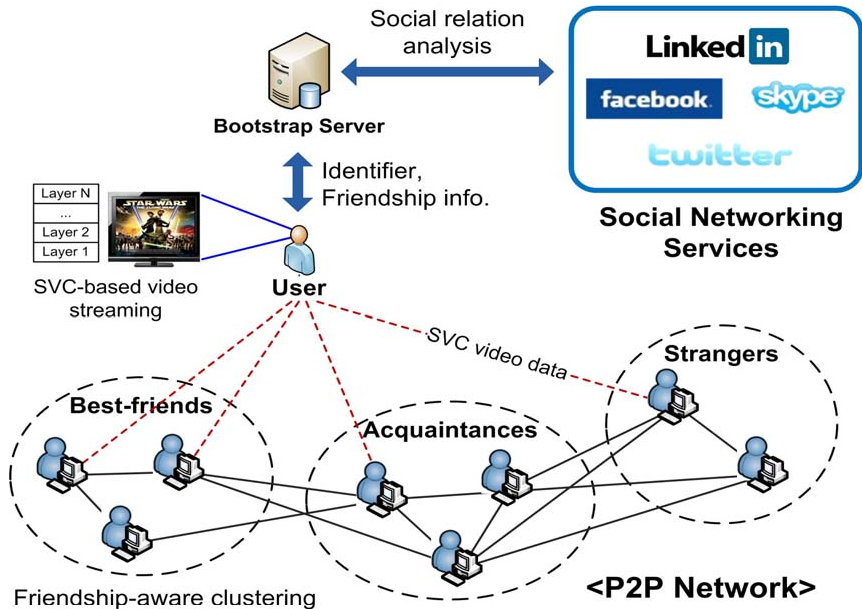 Figure 1: The hybrid decentralized architecture featuring the Bootstrap server and SNS integration.
Experiments & Results
The researchers implemented the system using the NS-2 simulator with a Facebook dataset.
- Scalability & Preference: As shown in the results, peers with a high preference for quality () achieved significantly higher PSNR by consuming their social capital, whereas "thrifty" peers saved credits.
- Defeating Free-Riders: In head-to-head comparisons, Bit-Torrent failed to stop free-riders (who attained high download rates without uploading). In contrast, the proposed system (Figure 5c) shows a clear correlation: you only get what you give.
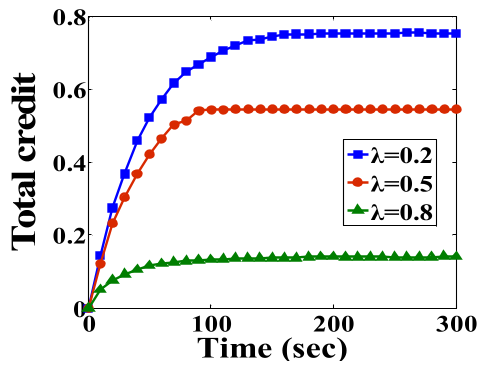 Figure 2: Performance comparison showing the proposed system (c) effectively isolating free-riders compared to Bit-Torrent (a).
Critical Insight: Why This Matters
The fundamental shift here is moving from transactional trust (I give you a block, you give me a block) to relational trust (I help you because we have a shared social history). By using SVC, the system adds a layer of flexibility—it doesn't just "cut off" a user; it gracefully degrades their video quality based on their social standing.
Limitations & Future Work
While robust, the system currently assumes a "static" friendship model derived from SNS. Future iterations could explore Dynamic Social Graphs where trust points are earned through network behavior alone, potentially removing the need for third-party SNS data and improving privacy.
Conclusion
This Social Relation-aware system proves that the efficiency of P2P networks can be significantly enhanced by mirroring the cooperative structures of human society. It offers a sustainable, fair, and high-performance framework for the next generation of Video-on-Demand (VoD) services.