
Social Relation Based Search Refinement: Let Your Friends Help You!
Social Relation Based Search Refinement: Let Your Friends Help You!
This paper introduces a Social Network Based Group Interest Model (SN-GIM) to refine Web-scale search results. By leveraging collaborative networks from the SwetoDBLP dataset, the authors create a "Group Retained Interest" mechanism that filters search results based on the collective interests of a user's social circle, effectively improving relevance in expert finding and literature search.
TL;DR
When searching the vast Web, we often struggle with vague queries and excessive results. This paper proposes a paradigm shift: Search Refinement through Social Context. By analyzing your professional network (co-authors, collaborators), the system builds a "Group Interest Model" that predicts what you are looking for based on what your circle is currently focused on. Using the DBLP dataset, the authors demonstrate that your friends' interests are a remarkably accurate proxy for your own.
Problem & Motivation: The Vague Query Trap
Most users are not expert searchers; they provide short, ambiguous queries like "Intelligence." On a Web scale, this returns millions of results ranging from "Business Intelligence" to "Music AI."
The authors argue that context is the missing constraint. Prior work focused on a user's own recent history. However, what if the user is exploring a new sub-field? The authors' insight is that users do not search in a vacuum—they exist within social environments. If your collaborators are all focusing on "Web Mining," your search for "Intelligence" is likely aimed at "Web Intelligence" rather than "Music Theory."
Methodology: Modeling the Collective Mind
The core of the paper is the Social Network Based Group Interest Model (SN-GIM). It operates in three main layers:
1. The Retained Interest (RI) Model
Interests are not static. The authors use a power-law decay function (inspired by cognitive psychology) to model how an interest fades over time unless reinforced by new publications or activities.
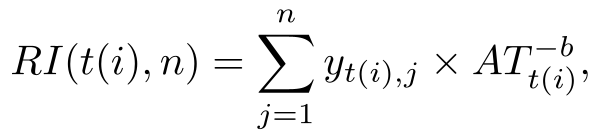
2. Group Interest Aggregation
The "Group Interest" for a user is the summation of the top interests of everyone in their -person social circle. If an interest appears in both the user's and their friends' top lists, it receives a higher weight.
3. Linked Data Integration
The system utilizes RDF (Resource Description Framework) to bridge two disparate data universes:
- The Social Graph: Who knows whom (e.g., FOAF:knows).
- The Knowledge Base: The actual content (e.g., SwetoDBLP).
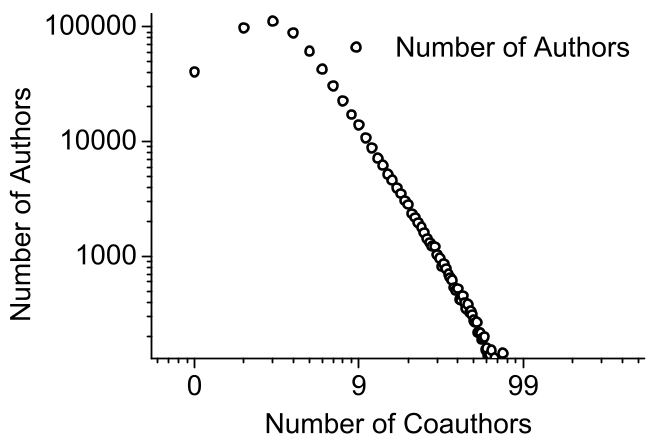 Figure 1: The power-law distribution of co-authors confirms that social networks are sparse, making them computationally scalable for search refinement.
Experiments & Results: Do Friends Really Know Best?
The authors tested their DBLP Search Support Engine (DBLP-SSE) with real researchers.
Key Findings:
- High Overlap: There is a 59.3% to 66.7% overlap between an individual’s interests and their group’s interests. This confirms that "birds of a feather flock together" in academia.
- Refinement Quality: In a query for "Intelligence," the unrefined search returned generic music books. The social-refined search successfully prioritized "Web Mining" and "Search Engines" because those were the interests of the user's social circle (e.g., Ricardo A. Baeza-Yates).
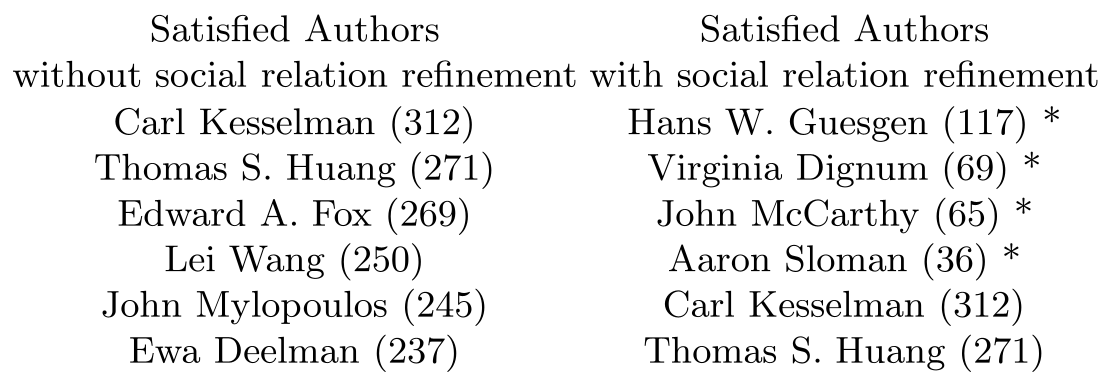 Table 1: Comparison showing how social relation refinement brings "familiar" and relevant experts to the top of the list.
Critical Analysis & Conclusion
Takeaway
The beauty of this approach is its scalability. By focusing on a small subset of "socially relevant" results, the system avoids the need to rank the entire Web for every query. It also provides a solution to the "cold start" problem: if we don't know you, we can look at your friends to guess your needs.
Limitations & Future Work
- Semantic Nuance: The current model treats words like "OWL" and "Ontology" as distinct terms. The authors acknowledge that integrating Google Similarity Distance or semantic embeddings would further improve accuracy.
- Privacy: While not discussed in the paper, using social relations for search refinement in a non-academic (e.g., private social media) context would require careful privacy safeguards.
In conclusion, this work proves that Social Context is a first-class citizen in Retrieval. By linking social graphs with semantic knowledge bases, we can transform a "Web of Strings" into a "Web of Relevant Meanings."