
Social Relations vs. Near Neighbours: Boosting Recommenders with Limited Social Data
Social Relations versus Near Neighbours: Reliable Recommenders in Limited Information Social Network Collaborative Filtering for Online Advertising
The paper proposes a hybrid recommendation algorithm that integrates limited Collaborative Filtering (CF) data with basic Social Network (SN) relations to enhance item rating predictions. By combining classic Pearson Correlation with social ties (friendship or trust), the method achieves significant improvements in both prediction accuracy and coverage across multiple benchmark datasets, including Epinions and Ciao.
TL;DR
This research tackles the "information desert" in recommendation systems—where neither deep user profiles nor dense rating histories are available. The authors propose a weighted hybrid algorithm that blends basic Collaborative Filtering (CF) with simple Social Network (SN) ties (trust/friendship). The result? A significant boost in prediction coverage (up to 32.5%) and accuracy (up to 3.25% MAE reduction) across five real-world datasets, proving that even minimal social data can outperform complex CF neighbors in dense networks.
The "Missing Link" in Online Advertising
Modern online advertising relies heavily on Recommender Systems (RS) to predict what users like. However, CF systems face a persistent wall: the Cold Start problem. If a user hasn't rated many items, the system can't find "similar neighbors."
While many advanced models try to fix this using rich metadata (demographics, location, item price), this information is often restricted or unavailable. The authors ask a critical question: Can we improve recommendations using only the bare minimum—user-item ratings and simple "who is friends with whom" links?
Methodology: The Weighted Synergy
The core innovation lies in the way the algorithm treats two different types of "neighbors":
- CF_NNs (Collaborative Filtering Nearest Neighbors): Users who liked the same things you liked (calculated via Pearson Correlation Coefficient).
- SN_NNs (Social Network Neighbors): Users you actually know or trust in a social context.
The Prediction Formula
The algorithm calculates a "mean-centered" rating from both groups. When a prediction is needed for User on Item , the system evaluates:
- If only CF data exists: Use CF_NNs.
- If only Social data exists: Use SN_NNs (increasing coverage).
- If both exist: Apply a weighted average based on parameters and .
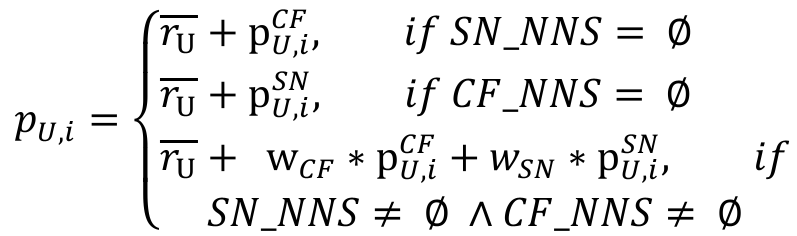
The physical intuition here is reliability balancing. In a dense social network (like Dianping or Epinions), your friends' opinions might actually be more indicative of your tastes than a random stranger who happened to rate three movies the same way you did.
Experimental Results: Breaking the Sparsity Barrier
The authors tested their approach against five diverse datasets (Ciao, FilmTrust, Epinions, LibraryThing, and Dianping).
1. Accuracy Gains
The study found a clear correlation between SN density and prediction quality. In the "Epinions" dataset, which features a high number of social relations per user (9.9), the MAE dropped significantly.
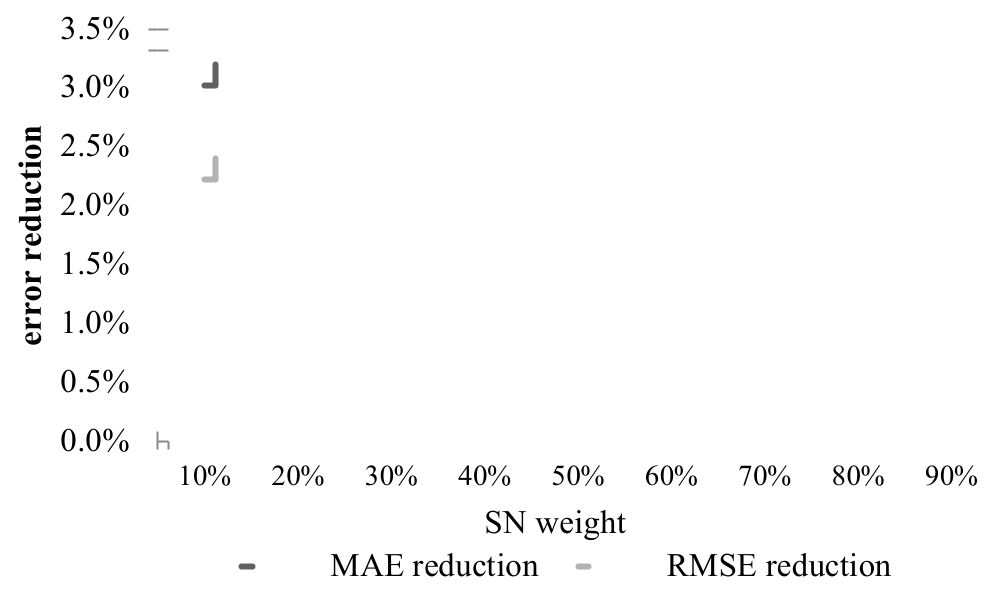 Fig 1: Accuracy improvement on the Epinions dataset as the social weight () increases.
2. Coverage Expansion
"Coverage" is how many items the system can actually recommend. By using social links as a fallback, the system could provide recommendations to users who were previously "invisible" to traditional CF systems. The Epinions dataset saw a 32.5% increase in the number of users who could receive personalized predictions.
| Dataset | Avg. Social Relations | Coverage Increase |
|---|---|---|
| Epinions | 9.9 | 32.5% |
| Dianping | 17.0 | 5.6% (Low due to high base coverage) |
| Ciao | 1.3 | 4.1% |
Critical Analysis: When do Friends Matter More?
A fascinating takeaway from the research is the "threshold of trust."
- In Sparse Social Networks: (e.g., Ciao, LibraryThing), the optimal is 30-40%. Here, your rating history is still the king.
- In Dense Social Networks: (e.g., Epinions, Dianping), the optimal hits 50-60%. In these environments, social relations become more reliable recommenders than CF neighbors.
Limitations
The current model uses a static weight (). In a real-world production environment, this would ideally be dynamic—automatically adjusting for each user based on their specific social activity versus their rating history.
Conclusion
This paper serves as a vital reminder for engineers in the online advertising space: you don't always need complex "Deep Learning" or invasive data mining to beat the SOTA. By intelligently blending basic social graphs with traditional collaborative filtering, you can solve the coverage problem and improve accuracy simultaneously, even with "limited information."
Future Outlook: The next frontier involves unsupervised weight adjustment and incorporating "tie strength" (how close the friendship is) to further refine these neighborhood-based predictions.