
SREP: Bridging Human Mobility and Social Status for Efficient Opportunistic Routing
Social Relationship Enhanced Predicable Routing in Opportunistic Network
This paper introduces Social Relationship Enhanced Predictable routing (SREP), a single-copy routing protocol for opportunistic networks. It uniquely combines a semi-deterministic Markov model for node mobility with a customized PageRank (SocialRank) algorithm to identify optimal relay nodes in a social-aware manner.
TL;DR
SREP (Social Relationship Enhanced Predictable routing) is a sophisticated routing protocol designed for "store-carry-and-forward" networks. By modeling how humans move between physical "communities" (using Markov Chains) and calculating their social influence (using a PageRank-inspired "SocialRank"), it identifies the most "popular" and "mobile" nodes to serve as the perfect data couriers.
Background: The Chaos of Opportunistic Networks
In an opportunistic network, a stable end-to-end path between a source and destination almost never exists. Data moves like a relay race: a node carries a packet until it bumps into someone else who is "better" at delivering it. The million-dollar question has always been: Who is the "better" relay?
Earlier protocols relied on brute-force flooding (Epidemic) or simple history-based probability (PRoPHET). However, they missed a critical insight: Humans don't move randomly. We follow schedules and occupy social hierarchies.
The Core Insight: Roles and Regularity
The authors of SREP argue that a node's utility is defined by two factors:
- Spatial Regularity: We move between specific locations—labs, dorms, cafeterias—which can be modeled as a semi-Markov process.
- Social Popularity: In a gym, a coach is more "connected" than a casual visitor. In a lab, a lead researcher is the social hub. SREP quantifies this using SocialRank.
Methodology: How SREP Works
1. Modeling Mobility with Markov Chains
Each node maintains a transition probability matrix. If you are currently in "Community A," what is the likelihood you'll move to "Community B"? Over time, the node learns its own roaming patterns, allowing the network to "predict" where a carrier will be in the next time slot.
2. SocialRank: The "PageRank" for People
SREP adapts Google’s PageRank algorithm. If a node (person) frequently encounters many other "important" nodes within a community, its SocialRank increases.
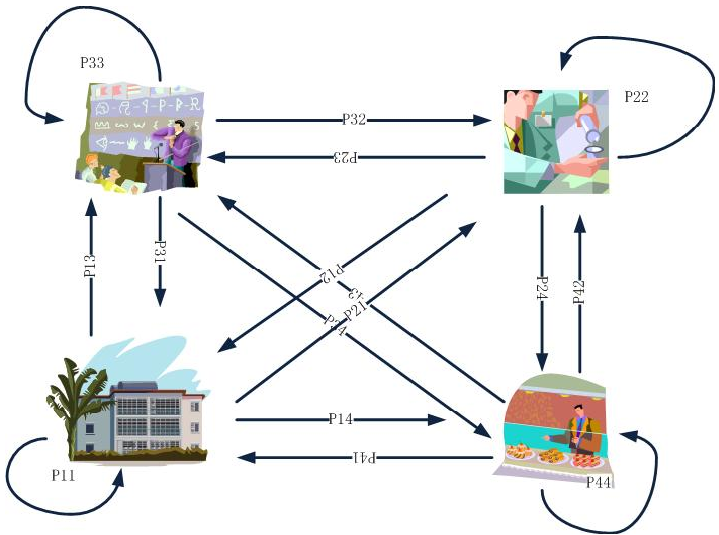 Figure: The Markov model illustrating node transitions between physical communities.
3. Relay Selection: The Weighted Decision
When two nodes meet, the one holding the message calculates a Prediction Correction of Social Degree. It doesn't just look at who is popular now, but who is likely to be in a high-status position in the next community they visit.
The decision formula essentially weights the SocialRank by the transition probability:
Experimental Performance
The researchers tested SREP against heavyweights like Epidemic and Spray-and-Wait using the ONE simulator.
Key Findings:
- Resilience to "Noise": SREP performs best when node movement has some level of predictability (low deviation).
- Efficiency: As TTL (Time-to-Live) increases, SREP’s delivery ratio climbs faster than its competitors while keeping latency significantly lower.
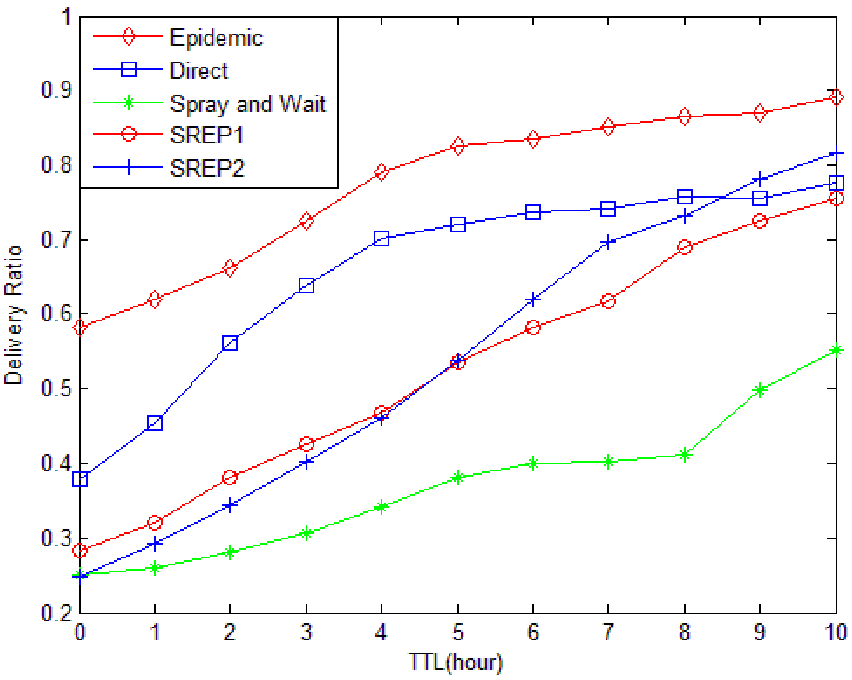 Figure: Delivery ratio comparison across different motion deviations.
Critical Analysis & Takeaways
SREP succeeds because it moves away from "blind" social metrics. By anchoring social status to specific physical communities, it recognizes that a node's value isn't global—it's contextual.
Limitations:
- The protocol assumes nodes are honest about their SocialRank and transition matrices.
- It requires a "warm-up" period (simulation suggests ~1.5 hours) to build accurate matrices.
Future Outlook: This work lays the groundwork for integrating more complex social dynamics (like "tie strength" or "temporal communities") into routing. For 5G/6G device-to-device (D2D) communication in crowded areas like campuses or stadiums, SREP-like logic will be essential for offloading traffic.
Conclusion
By treating humans not as random particles, but as socially-indexed travelers, SREP turns the unpredictability of opportunistic networks into a structured, predictable system for data delivery.