
Beyond Pixels: Leveraging Social Content Power for Smarter Image Retrieval
Social Relevance Feedback Based on Multimedia Content Power
This paper introduces a novel Social Relevance Feedback (RF) algorithm that integrates Multimedia Content Power (MCP) with visual feature similarity to improve image retrieval in social media environments. By combining recursive learning for similarity measures and crowd-sourced influence metrics (likes, shares, comments), the system achieves significantly higher user satisfaction compared to traditional content-based methods.
TL;DR
Purely visual search is often "blind" to what people actually care about. This paper introduces a Social Relevance Feedback (RF) mechanism that doesn't just look at colors and shapes, but measures Multimedia Content Power (MCP)—the social "gravity" of an image based on likes, shares, and comments. By blending social influence with visual similarity, the authors created a system that users significantly prefer over state-of-the-art mathematical models.
The "Blind Spot" in Traditional Retrieval
Most Image Retrieval systems operate on a simple premise: if Image A looks like Image B (mathematically), it must be relevant. However, this ignores the Semantic Gap and Conformity Theory. In the real world, as social beings, we are naturally drawn to content that our peers have validated.
Current search engines often focus on where an image is hosted (domain authority) rather than how the community interacts with it. This paper argues that an image with 2,000 likes is fundamentally more "relevant" to a social media user than a visually identical one with zero engagement.
Methodology: The Fusion of Social & Visual
The authors' core contribution is a two-pronged strategy to bridge the perception gap.
1. Recursive Nonlinear Similarity
Instead of using a fixed Euclidean distance, the system treats the similarity measure as a dynamic function. Using sigmoid functional components, the algorithm learns the user's "style" of searching through recursive updates.
2. Multimedia Content Power (MCP)
This is the "secret sauce." The algorithm calculates influence using two vectors:
- DMCP (Direct Power): How many times an image was originally posted.
- IMCP (Indirect Power): A weighted sum of Likes, Shares, and Comments from both friends and the wider network.
The final ranking formula weighs the visual distance against this MCP score, ensuring that "influential" images rise to the top of the search results.
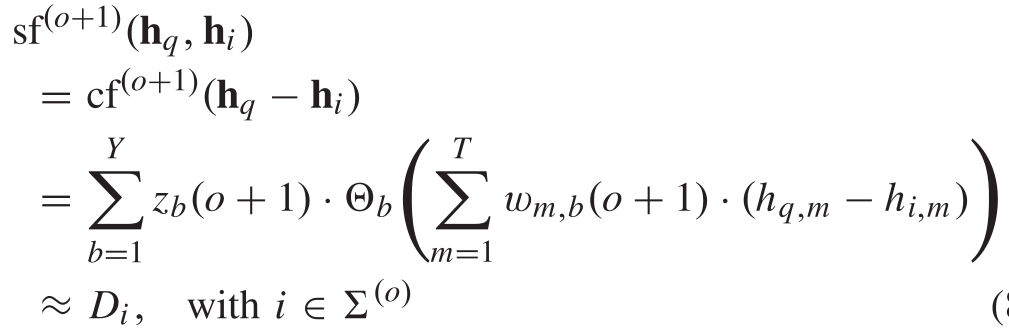 The recursive formula used to update similarity parameters based on user feedback and MCP.
Putting it to the Test: Facebook Data
The researchers tracked 120 users over 90 days, collecting 19,414 unique images. They compared their method against the Query-Sample Scaling (QSS) strategy, a recognized benchmark in the field.
The Quantitative vs. Qualitative Paradox
The results revealed a fascinating split:
- Quantitative metrics (Precision-Recall and ANMRR) favored the traditional QSS method. This makes sense—QSS is optimized for mathematical matching.
- Subjective User Preference, however, told a different story. In 3,500 evaluation sessions, users overwhelmingly preferred the Social RF results (Setup P2) over QSS.
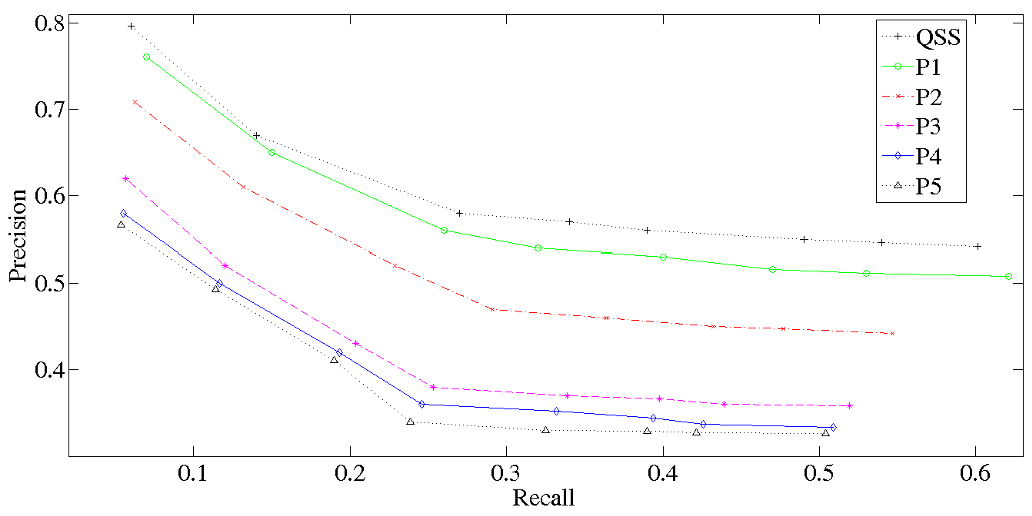 Experimental comparison showing how different weights of MCP (P1-P5) affect retrieval accuracy compared to QSS.
Why the Discrepancy?
Users found that the social-aware setups (P1 and P2) returned "interesting" content. Even if an image wasn't a perfect visual match, if it was trending and visually similar, it satisfied the user's intent better than a boring but mathematically "perfect" match.
Critical Insights & Future Outlook
The primary takeaway is clear: Context is King. Social signals are not just "metadata"—they are a proxy for human emotion and importance.
Limitations:
- The study primarily focused on a younger demographic (students aged 18-26), whose social behavior might be more "conformity-driven" than older populations.
- The calculation of "Original Posts" is difficult because users often copy-paste instead of using official "Share" buttons.
Future Work: The next frontier lies in Long-term User Habit Learning. By understanding not just what the crowd likes, but what you specifically interact with over months, retrieval systems could move from "Social Search" to truly "Predictive Search."
Conclusion
This paper serves as a vital reminder that in the age of Big Data, the "Big" is less important than the "Human." By integrating Multimedia Content Power, the authors have provided a roadmap for making our digital tools feel a lot more like us.