
Social Resistance: Why Common Friends Make Us "Closer" in Northern Algebra
Social Resistance
This paper explores the application of "Resistance Distance" as a metric for measuring proximity in social and traffic networks. It proposes using rank-one Cholesky updates and the Sherman-Morrison-Woodbury formula to efficiently recompute distances as network topologies evolve, achieving significant computational speedups over full matrix factorization.
TL;DR
This case study redefines how we measure "distance" in a social or traffic network. Instead of just counting the steps in a shortest path, it uses Resistance Distance—a concept borrowed from electrical engineering—to account for the strength and redundancy of connections. Most importantly, it provides a high-performance numerical recipe (Cholesky updates) to keep these distances updated in real-time as the network grows.
The "Jane and Felix" Problem: Why Shortest Paths Fail
In standard graph theory, the distance between two people is the shortest path. But consider this: If Jane and Felix have 10 common friends, aren't they "closer" than if they only had one?
Shortest path algorithms are "blind" to this redundancy. As shown in the paper's motivational example:
- Intuition: More common friends = closer relationship.
- Prior Work: Shortest path ignores common neighbors.
- Insight: By treating every friendship as a resistor in an electrical circuit, we can calculate the "effective resistance" between two nodes. The more parallel paths (friends) there are, the lower the resistance (distance).
Methodology: The Linear Algebra of Closeness
The core of the approach lies in the Graph Laplacian (), defined as: where is the adjacency matrix and is the degree vector.
The resistance distance is calculated using the weighted 2-norm:
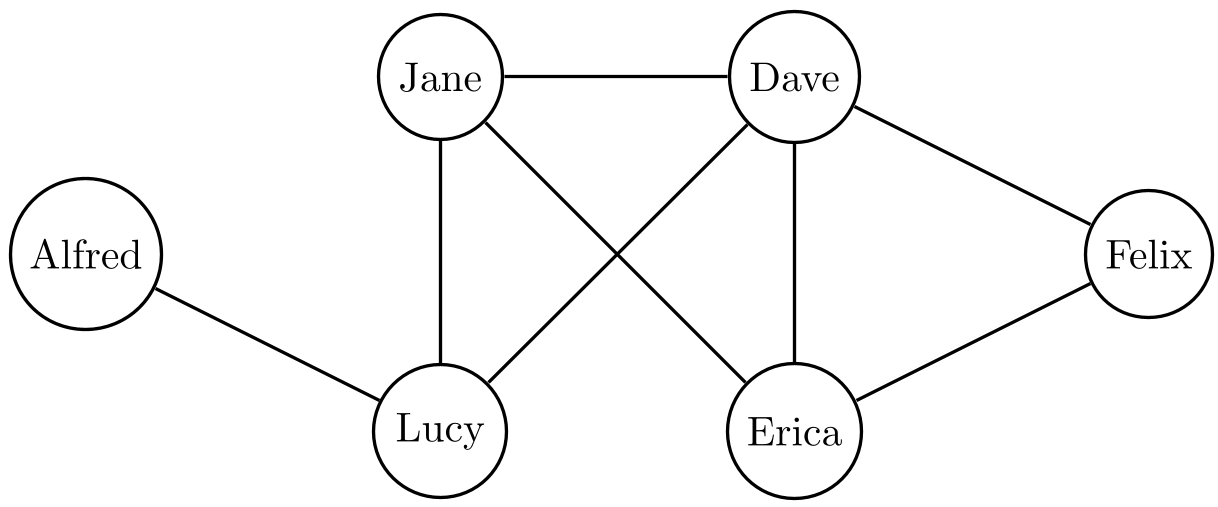 Figure: A social network of 6 individuals used to demonstrate how resistance distance captures connectivity better than shortest path.
Computational Efficiency: Rank-One Updates
Computing the inverse of a matrix or a Cholesky factorization is , which is disastrous for large networks. However, adding a single edge to a graph is mathematically a rank-one update.
The authors show that instead of re-calculating the entire factorization, we can use Givens Rotations to update the existing Cholesky factor in only time.
The Update Mechanism:
- New connection added represented as a vector .
- Use the Cholesky factor of the original .
- Apply a sequence of Givens matrices to "zero out" the new row in the augmented matrix:
Experiments: arXiv and Traffic Networks
The authors applied these techniques to a General Relativity collaboration network and a subset of the California road network.
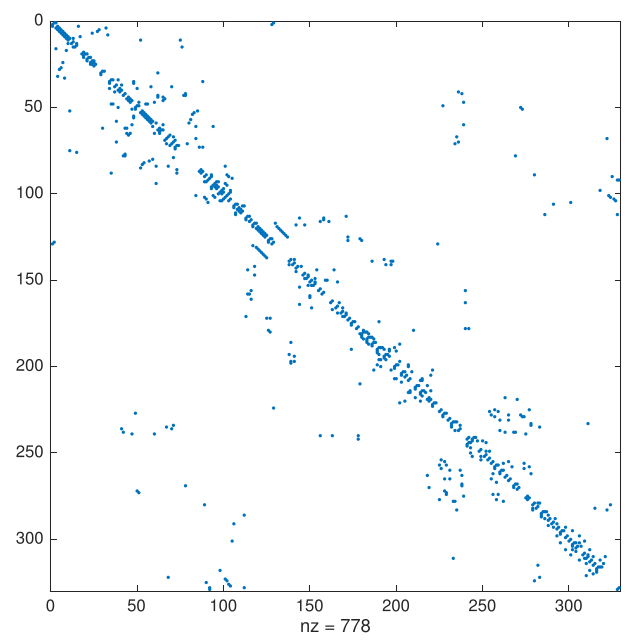 Figure: The arXiv collaboration network (left) and California traffic network (right) used for scaling tests.
Key Results:
- Connectivity Impact: As you add "roads" between nodes with the highest resistance distance, the average system-wide resistance drops significantly—more effectively than random additions.
- Performance: The Rank-One update method is orders of magnitude faster than full re-factorization, enabling dynamic analysis of the traffic grid.
- Stability: While the Sherman-Morrison-Woodbury (SMW) formula is also , the Cholesky update is generally more numerically stable for certain classes of matrices.
Critical Analysis & Conclusion
Takeaway
Social Resistance is a powerful metric that aligns mathematical distance with human intuition. By leveraging optimized numerical linear algebra (rank-one updates), we can compute these sophisticated metrics on dynamic, evolving graphs.
Limitations
- Density: The study primarily uses dense-matrix techniques. In the real world (e.g., Facebook-scale), matrices are extremely sparse.
- Scale: For networks with billions of nodes, even is too slow; future work must focus on Sparse Cholesky updates and iterative solvers like Conjugate Gradient.
Future Outlook
This work provides a bridge between electrical circuit theory and social science. As we move toward more real-time recommendations (e.g., "People you may know"), the ability to update proximity metrics on-the-fly will be a critical engineering requirement.