
Xavier: The Social Robot that Masters the Art of Waiting in Line
A social robot that stands in line
This paper introduces a social navigation system that enables the mobile robot "Xavier" to recognize and join human queues. By modeling a line as a chain of "personal spaces" and utilizing a custom stereo-vision-based human detection algorithm, the robot can autonomously perform social tasks like purchasing coffee in a peopled environment.
TL;DR
Researchers have developed a mobile robot, Xavier, capable of understanding and participating in one of the most fundamental human social structures: the queue. By leveraging the cognitive concept of Personal Space and a robust Stereo-Vision detection system, the robot can detect a line of people, join the back of it, and advance toward a service counter (like a coffee shop) without the "social awkwardness" typical of early autonomous agents.
Context: Beyond Obstacle Avoidance
In the early days of mobile robotics, humans were often modeled as mere "cylindrical obstacles." However, as robots move into service roles (hospitals, museums, offices), this simplified view fails. If a robot is sent to buy coffee but doesn't understand the "social rule" of queuing, it might accidentally cut in line or treat waiting customers as barriers to be bypassed.
The core insight of this paper is that Social Behavior is a prerequisite for Service Success. To coexist with us, robots must respect our psychological boundaries.
The Science of Personal Space
The authors utilize the theory of Proxemics—specifically the notion of "Personal Space." In a queue, humans maintain a specific distance:
- Too close: Causes discomfort (intrusion of personal space).
- Too far: Invites others to cut in line.
Through experiments with human subjects, the authors mapped this space as an oval, wider toward the front of the person. By modeling a queue as a "chain of personal spaces," the robot calculates where it "belongs" in the sequence.
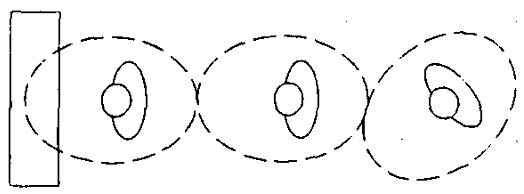 Figure: Modeling a line as a chain of overlapping or connected personal spaces.
Methodology: How Xavier "Sees" a Queue
Detecting people in a queue is challenging because the robot often sees people from the side or back, rendering frontal face detection useless.
1. Stereo-Vision & 3D Clustering
Xavier uses stereo cameras to create a disparity image, providing depth data. It clusters these data points to isolate individual objects, filtering out noise like furniture.
2. The Modified Hough Transform
To determine a person's orientation, the robot fits an ellipse to the 3D data at chest height and a circle at head height. Using a 3D Hough Transform (searching across ), the robot finds the most likely center and orientation () of each human body.
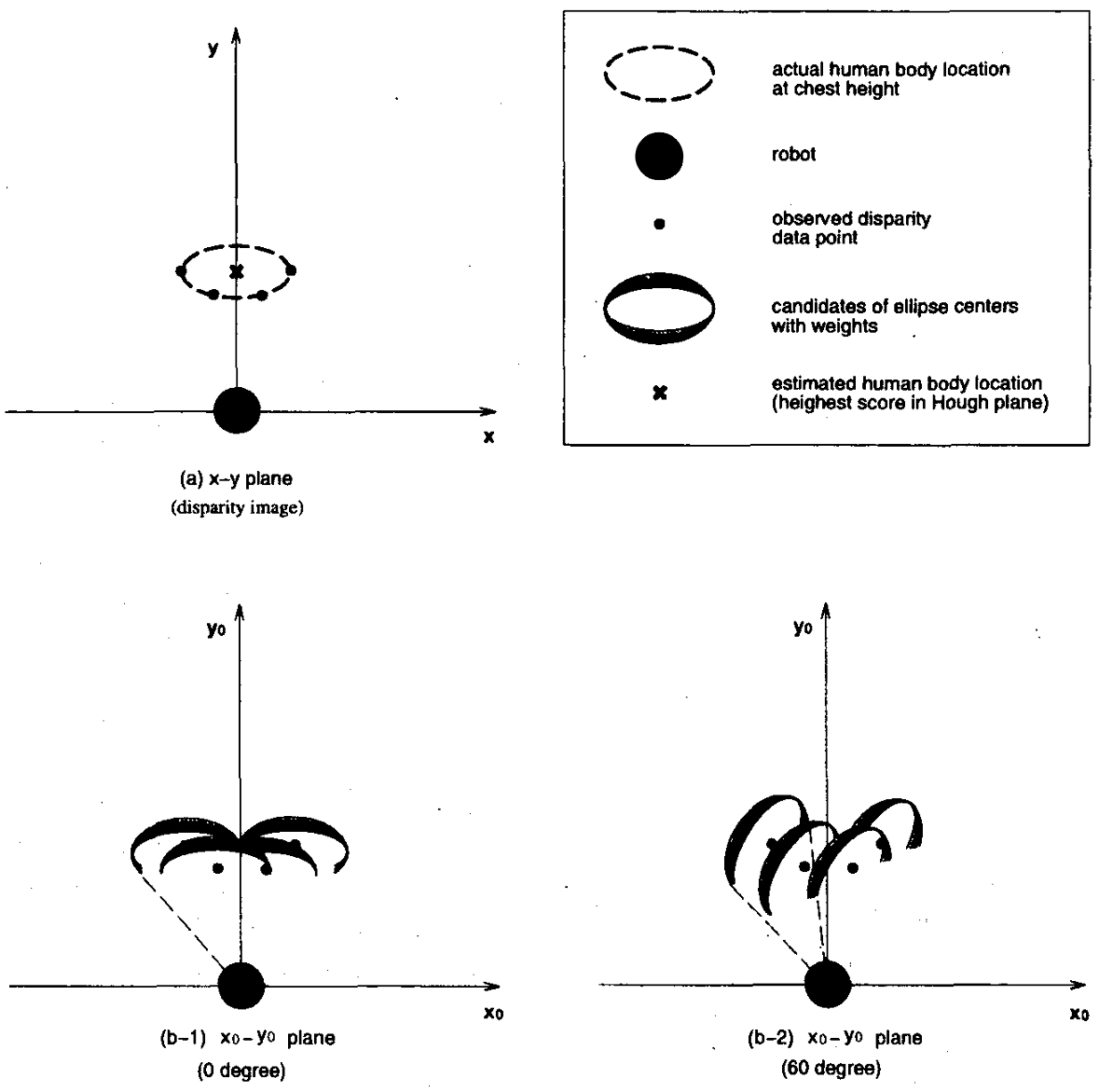 Figure: The modified Hough Transform methodology used to estimate human position and orientation.
Experimental Results: The Coffee Test
The robot was tasked with navigating to a kiosk, joining the line, and purchasing coffee.
- Success Rate: 70% in real-world trials.
- Human Reaction: Most impressively, human customers actually queued behind the robot. This implies that the robot's physical positioning was "readable" enough that humans accepted it as a social participant in the queue.
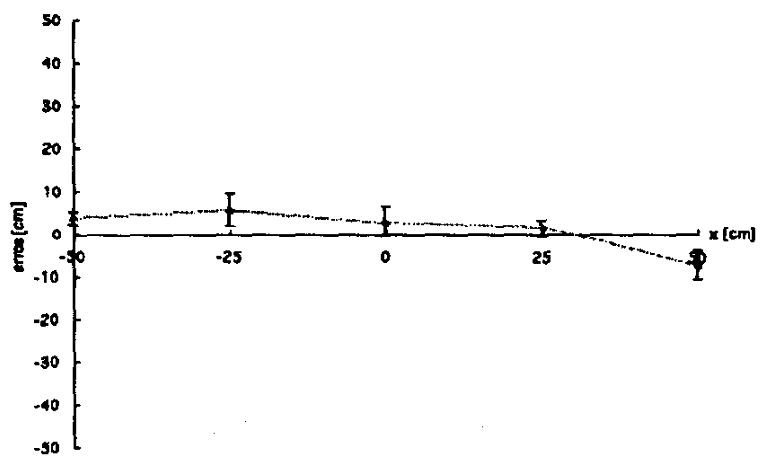 Figure: Analysis of detection errors in horizontal and depth directions.
Critical Analysis & Conclusion
While a 70% success rate leaves room for improvement, this work is a seminal step in Socially Aware Navigation.
Limitations:
- Texture Dependence: The vision system struggles when humans wear low-texture clothing or when viewed from the back (where contrast is lower).
- Static Environment: The model assumes a relatively orderly line; chaotic or highly crowded spaces might still confuse the geometry-based detection.
Future Outlook: This research proves that "social intelligence" can be engineered through geometric and psychological modeling. As we move toward more advanced AI, integrating these "Personal Space" constraints into Reinforcement Learning (RL) navigation policies will be the next frontier for seamless human-robot interaction.