
We Don’t Need No Stinkin’ Badges: The Limits of Top-Down Gamification in Online News Communities
We don't need no stinkin' badges: examining the social role of badges in the Huffington Post
This study investigates the social impact of gamified "badges" on user engagement within The Huffington Post's commenting community. Using social role and network theories, the authors examine whether organizationally-imposed badges effectively identify or create "discussion catalysts."
TL;DR
Does a digital badge make you a leader? This study examines The Huffington Post's attempt to gamify its comment section. Contrary to organizational expectations, badges (Networker, Superuser, Moderator) performed poorly as predictors of thread engagement. In fact, some of the most influential users—those with thousands of "fans"—explicitly lacked or ignored these corporate-bestowed symbols, suggesting that in organic communities, content and peer recognition still trump "stinkin' badges."
Background: The Rise of the Artificial Social Role
In the early 2010s, news organizations shifted from being passive hosts of comments to active managers of social spaces. The Huffington Post introduced badges to incentivize specific behaviors: frequent sharing, popularity, and moderation.
From an academic perspective, this creates a tension between:
- Organic Social Roles: Roles like "Discussion Catalysts" or "Answer People" that emerge through repeated patterns of behavior.
- Hierarchical Control: Symbolic markers (badges) defined and awarded by the organization to steer community behavior.
The authors set out to see if these badges actually identified the "rich" in the network (Preferential Attachment) or if they were merely superficial icons.
Methodology: Analyzing the Thread Dynamics
The researchers analyzed three distinct types of stories related to the Tucson shootings:
- Breaking News: The initial report.
- Political Controversy: Reactionary pieces (e.g., Sarah Palin's comments).
- General News: Human interest/rehabilitation updates.
They tracked two primary dependent variables: Thread Length (level of engagement) and Unique Badge Owners (the "rich get richer" effect).
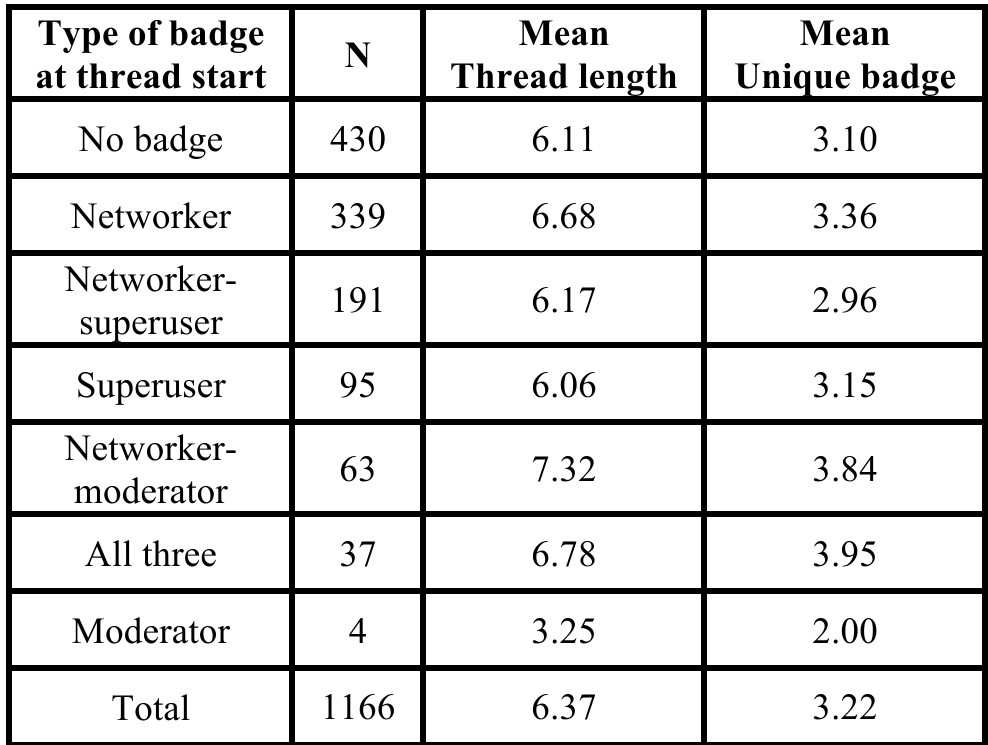 Table 1: Comparison of engagement levels based on the badge status of the thread starter.
Key Findings: Content is King, Badges are Peasants
The results provided a reality check for gamification enthusiasts:
- No Badge Advantage: Threads started by badge owners were not significantly longer than those started by regular users.
- Content Over Icons: The type of news story was a significant predictor of engagement. General news stories actually led to longer, more sustained threads than breaking news, regardless of who started them.
- The Elite Outsiders: When identifying the "top 21" commenters, the researchers found that non-badge owners often had significantly higher fan counts (averaging 1,065 fans) than badge owners (715 fans). The most fanned individual (2,423 fans) operated entirely without a badge.
Critical Insight: The "Cop" vs. The "Networker"
One of the most nuanced findings involves the Community Moderator badge. Users who only held the moderator badge (achieved by flagging "uncivil" content) were virtually ignored, starting the shortest threads. However, "Networker-Moderators"—those who were both popular and acted as moderators—saw the highest engagement. This suggests that moderation is only respected when it comes from a place of established social capital.
Conclusion & Future Outlook
This paper serves as a seminal warning: You cannot manufacture social status with an algorithm.
The Huffington Post's community, largely progressive and skeptical of corporate structures, seemed to develop a "counter-normative" structure where badges were potentially viewed as symbols of "selling out" or unnecessary corporate interference.
Limitations
- Single Snapshot: The data was limited to a specific two-week news cycle (the Tucson shootings).
- Platform Specificity: The results might differ on platforms like Reddit or StackOverflow, where badges (flair/reputation) are more deeply integrated into the functional utility of the site.
Takeaway for Product Designers
If you are building a community platform, focus on surfacing content value and peer-to-peer recognition (fans/follows) rather than arbitrary achievement markers. As the authors suggest, the most valuable members of your community might just decide they "don't need no stinkin' badges."