
Social Role Clustering: Deciphering the Hidden Patterns of Social Media through Topic Modeling
Social role clustering with topic model
The paper proposes a "Bag-of-Users" (BoU) schema based on Latent Dirichlet Allocation (LDA) to cluster social roles in heterogeneous networks. By treating discussion subjects as "documents" and users as "words," the model effectively identifies hidden social groups and official accounts within massive social media datasets.
TL;DR
This study introduces a novel paradigm for social network mining by reapplying the classical Latent Dirichlet Allocation (LDA) model in a counter-intuitive way. Instead of clustering words in documents, the authors propose the Bag-of-Users (BoU) schema, where users are clustered based on the "subjects" they discuss. This approach successfully identifies specialized social roles—from official media outlets to niche interest groups—within millions of Sina Weibo records.
Problem & Motivation: Beyond the Graph
Most traditional social network analysis (SNA) treats a network as a simple graph of nodes and edges. While this captures connectivity, it ignores the "What" and "Why" of human behavior.
Existing SOTA methods for social role discovery often suffer from two major flaws:
- Content-Structure Gap: They either focus purely on text or purely on link topology.
- Scalability & Noise: In platforms like Weibo or Twitter, the sheer volume of data and the presence of "inactive" users make it hard for traditional ranking-based algorithms to find meaningful clusters without a strong prior on behavior.
The authors' insight is simple yet profound: If you care about the same things and behave the same way across different discussions, you likely share a social role.
Methodology: The Bag-of-Users (BoU) Logic
The core innovation lies in the transformation of a heterogeneous network into a format that LDA can ingest.
1. From Graph to Bipartite Structure
The researchers first construct a subject-user network. If a user posts about a specific sensitive subject, an edge is created with a weight representing their posting frequency.
2. The BoU Transformation
In standard NLP, a document is a bag of words. Here, a Subject is treated as a "Document," and a User is treated as a "Word."
- Classical LDA: Documents Topics Words
- BoU-LDA: Subjects Social Roles Users
 Figure 1: The workflow from raw social media data to the final BoU-LDA social role clusters.
By using this inverted schema, the LDA model naturally finds "latent clusters" of users who tend to co-occur across various subjects, effectively grouping them by their functional roles in the social ecosystem.
Experiments & Results
The model was tested on a massive dataset of 14 million Weibo tweets (filtered to 7 million for quality).
SOTA Comparison: BoU-LDA vs. NetClus
The researchers compared their approach against NetClus, a ranking-based clustering algorithm for heterogeneous networks. The results (Table 1) showed that BoU-LDA was significantly better at identifying specialized roles:
- Specific Clusters: BoU-LDA identified "Public Opinion Monitoring Centers" and "IT & Data Analysis" groups that NetClus completely missed.
- Structure Diversity: When mapped to a visualization, BoU-LDA groups showed a more natural, distributed structure, whereas NetClus tended to force a "central group" bottleneck.
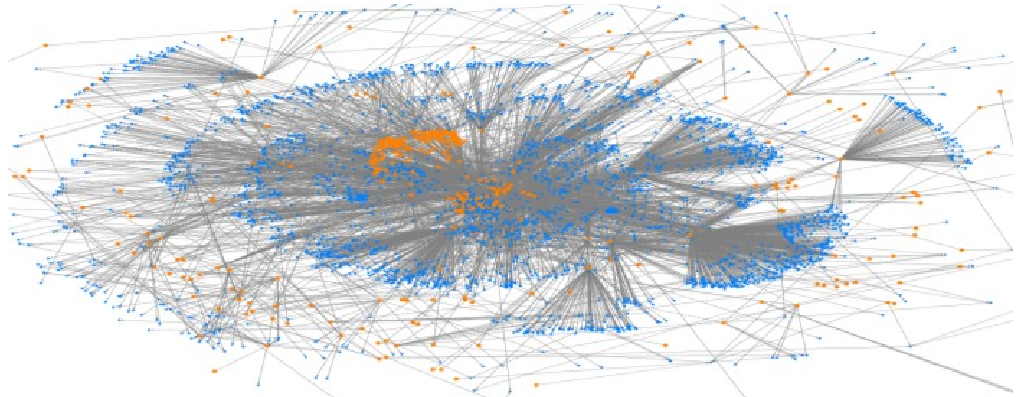 Figure 2: The complex subject-user heterogeneous network after filtering and processing.
Visualizing Social Diversity
The visualization in Figure 4 (in the paper) reveals that BoU-LDA results in fewer "black nodes" (unclassified users) and captures more meaningful inter-group interactions. This suggests the model is more robust to the noise and data imbalance typical of real-world social media.
Critical Analysis & Conclusion
Takeaway: The BoU-LDA approach proves that the "topic modeling" metaphor is highly extensible. By shifting the unit of analysis from text segments to user-behavioral patterns, we can uncover the "hidden community" structure necessary for security and market analysis.
Limitations:
- The current model is static. Social roles evolve, and a temporal version of BoU-LDA (perhaps utilizing Dynamic Topic Models) would be a logical next step.
- It relies on manually or keyword-defined "subjects." Future iterations could benefit from an end-to-end approach where subjects and roles are learned simultaneously.
This research serves as a primitive building block for modern security tasks, providing a scalable way to recognize "Important Persons" and hidden communities in the increasingly complex digital landscape.