
Hierarchical Social Role Support: Accelerating Consensus in the Digital Age
Analyzing Social Roles Based on a Hierarchical Model and Data Mining for Collective Decision-Making Support
The paper proposes a hierarchical social role analysis framework to improve collective decision-making in Social Networking Services (SNS). By identifying dynamic user roles across content, profile, and relation layers, the authors develop an enhanced mechanism that outperforms the traditional Delphi method in reaching consensus.
TL;DR
Reaching a group consensus in online communities is often plagued by "too many voices" and "too much noise." This paper introduces a Three-Layer Hierarchical Model that mines user data to identify social roles (like "Opinion Leaders" or "Active Users"). By assigning dynamic voting weights based on these roles, the researchers achieved consensus nearly 50% faster than traditional methods like the Delphi technique.
The Problem: The Noise of Equality
Collective decision-making—where a group tries to find a common solution—is the backbone of modern collaboration. However, in digital Social Networking Services (SNS), two problems arise:
- Vocal Minorities: The most active users often don't represent the majority opinion.
- Context Fluidity: A user's influence changes depending on the topic (e.g., a student's opinion matters more for course offerings, while a teacher's matters more for curriculum design).
Traditional models fail because they often treat every vote as equal or use static seniority, ignoring the complex interplay between a person's real-world identity and their online behavior.
Methodology: The Three-Layer Social Role Model
The authors argue that a user's role isn't mono-dimensional. They propose a hierarchical structure to capture the "physics" of social influence:
- Content Layer: Focuses on actions and history. (e.g., Is this user an "information initiator"?)
- Individual Profile Layer: Focuses on attributes like gender, experience, or occupation.
- Relation Layer: Focuses on the network. (e.g., Is this user a "Hub" connecting different groups?)
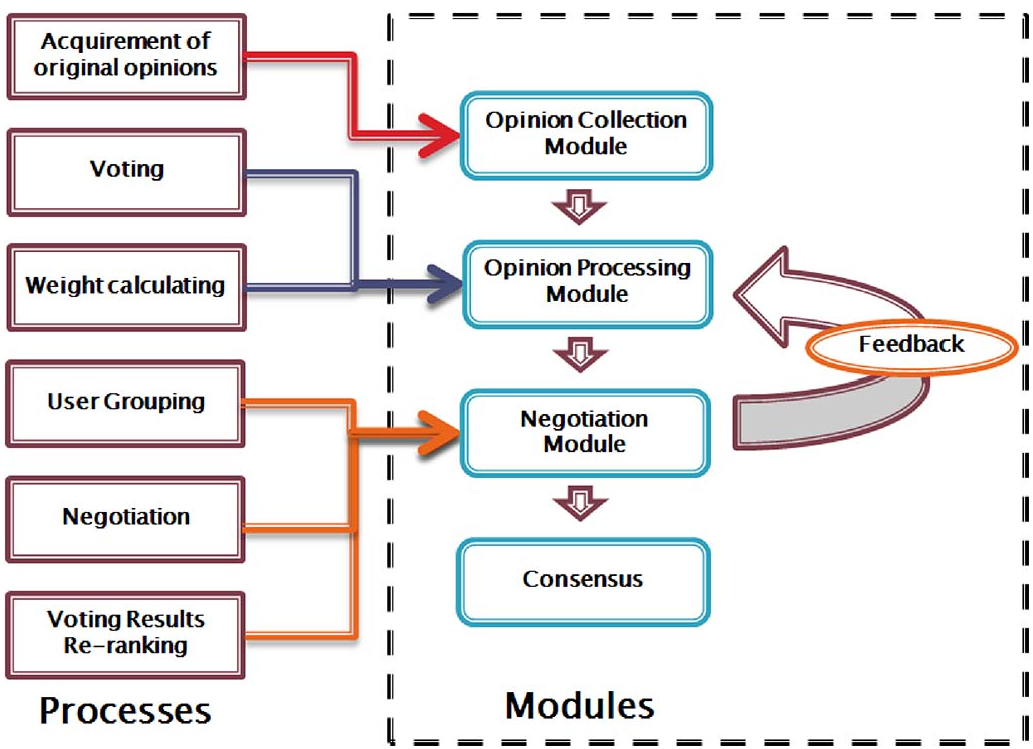
Moving from Voting to "Weighted Influence"
The core innovation is the integration of these roles into the Delphi Method. Instead of simple averaging, the system calculates a social role influence parameter ().
- Round 1: Decisions are weighted by Content and Profile roles ().
- Negotiation: Results are fed back to the group.
- Round 2+: Weights pivot to emphasize Relation-based roles (), such as opinion leaders who can bridge gaps between disagreeing factions.
Experimental Results: Faster, Smarter Consensus
The researchers tested their theory using NetLogo, simulating a Course-Offering Determination (COD) system. They compared their role-based method against the standard Delphi method across different group sizes and consensus strictness.
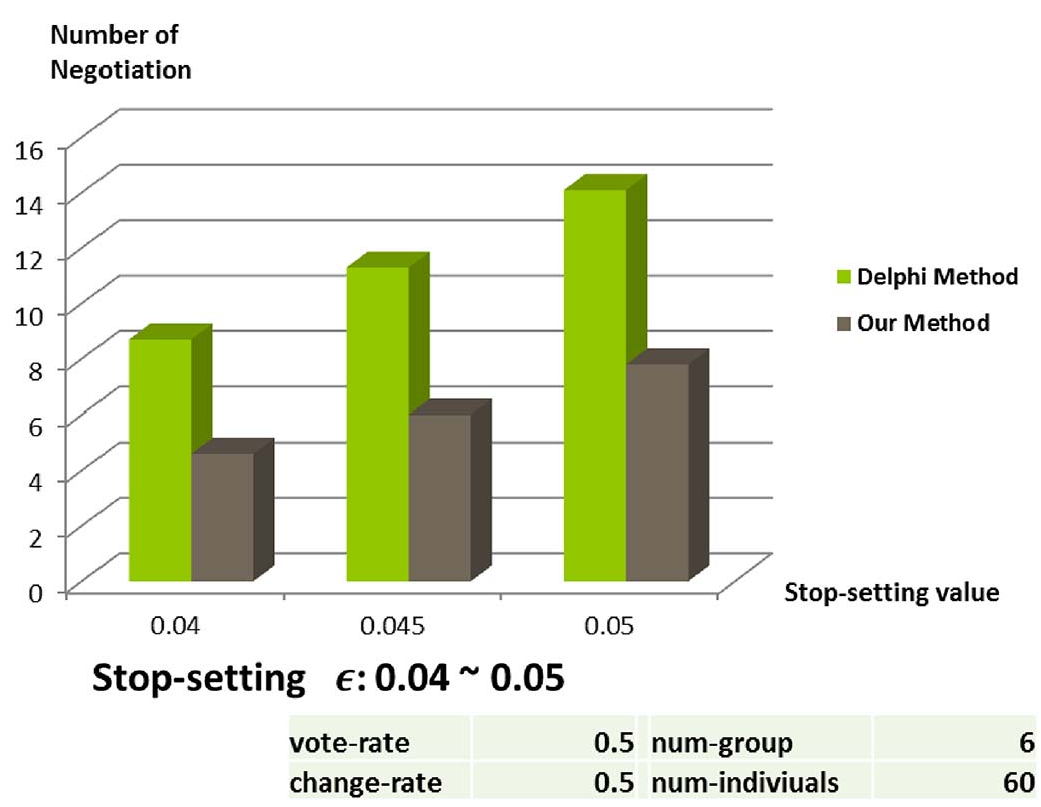
Key findings included:
- Efficiency: The proposed method reached the "stop-setting" (consensus threshold) in roughly half the iterations required by traditional approaches.
- Scalability: The advantage was most pronounced when there were many users but a limited number of "plan groups" (options), effectively filtering the noise of a large crowd.
- Strictness Benefit: Interestingly, the stricter the consensus requirement (lower variance threshold), the more the role-based weightings outperformed simple voting.
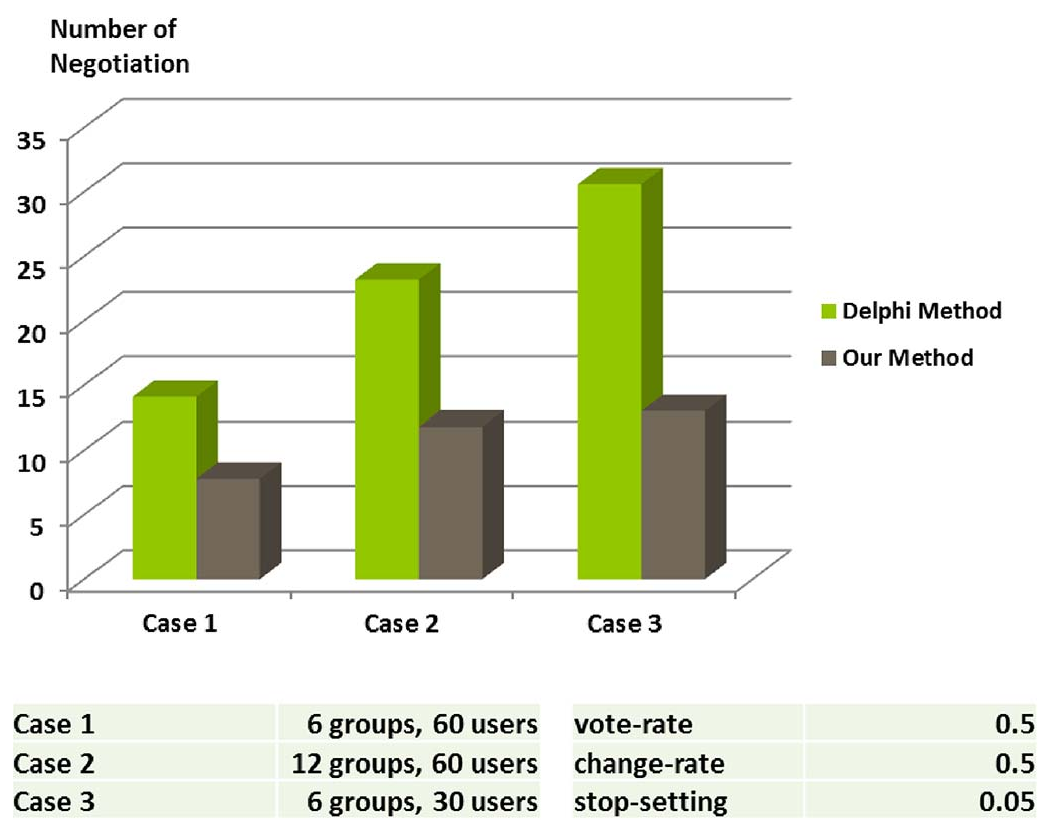
Deep Insights & Future Outlook
This work highlights a critical truth for the future of digital governance: Not all data points are created equal. By bridging the gap between real-world credentials and cyber-world activity, the authors provide a blueprint for more resilient decision-making systems.
Limitations: While efficient, the model relies on the availability of personal "profiling data." In an era of increasing privacy regulations (like GDPR), mining such deep personal streams may face implementation hurdles.
Future Work: The next frontier lies in Automated Role Discovery. Rather than pre-defining layers, can AI dynamically determine which social features are most relevant to a specific decision in real-time?
Conclusion
By treating social roles as dynamic, multi-layered entities, we can transform chaotic online debates into structured, efficient consensus-building machines. This research is a vital step toward smarter social groupware and organizational decision-support tools.