
RSSR: Leveraging Social Roles to Revolutionize Social Recommendation Efficiency
Recommendation With Social Roles
The paper introduces the Role Specific Social Recommender (RSSR), a matrix factorization framework that simultaneously infers social influence networks and user preferences by incorporating "social roles." It utilizes an incremental clustering algorithm to handle dynamic role changes in social networks.
TL;DR
The paper "Recommendation With Social Roles" introduces RSSR, a framework that moves beyond simple peer-to-peer relationships. By identifying latent social roles (like "Advisor" or "Student") and modeling influence through these roles, the researchers achieved a significant boost in accuracy—slashing MAE by 40% in some cases—while reducing the computational complexity of the social network from to .
Contextual Background
In the world of Social Recommender Systems (SRS), the "word of mouth" effect is king. However, most SOTA models assume that if you are connected to a friend, their influence on you is either a constant weight or a learned parameter across every unique pair. This is both computationally expensive for large graphs and sociologically naive. The authors argue that influence is rooted in expectations tied to social positions—roles—rather than just the existence of a link.
The Problem: The Peer-to-Peer Bottleneck
Previous works like SoRec or SocialMF face two primary hurdles:
- Complexity: Learning weights for every possible edge in a network of users is .
- Statics vs. Dynamics: Social roles evolve. A Ph.D. student eventually becomes a professor, and their influence profile changes accordingly. Most models treat these roles as static or ignore them entirely.
Methodology: The "Skeleton Network" and Incremental Clustering
1. Dynamic Role Detection
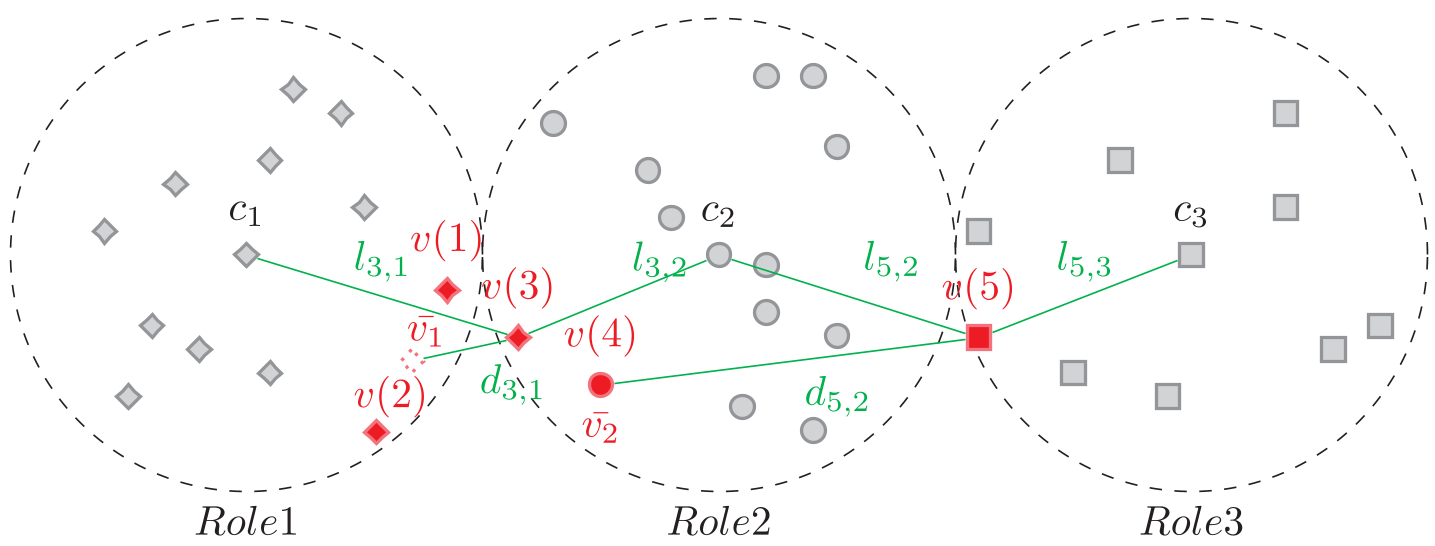
The authors propose an Incremental Role Clustering algorithm. Instead of a standard K-means which might jump erratically, this version uses a distance threshold to ensure role transitions are smooth. If a user’s behavior deviates significantly from their "user-specific centroid," only then is a role change registered.
2. The RSSR Framework
The core innovation is the matrix factorization objective function. It combines a user's own preference (latent vector ) with the influence of their neighbors, weighted by the roles those neighbors play:
Here, represents the influence of role on the user's current role . This creates a "Skeleton Network" of role-to-role interactions, which is far smaller than the original user-to-user graph.
Experimental Breakthroughs
The authors validated RSSR using the DBLP academic dataset, focusing on keywords in Data Mining (DM) and Graphics (GR).
SOTA Comparison
RSSR showed a dominant performance over benchmarks like TrustMF and SocialMF. In the dm2006 dataset, the MAE dropped from ~0.09 to 0.048.
Efficiency and Scalability
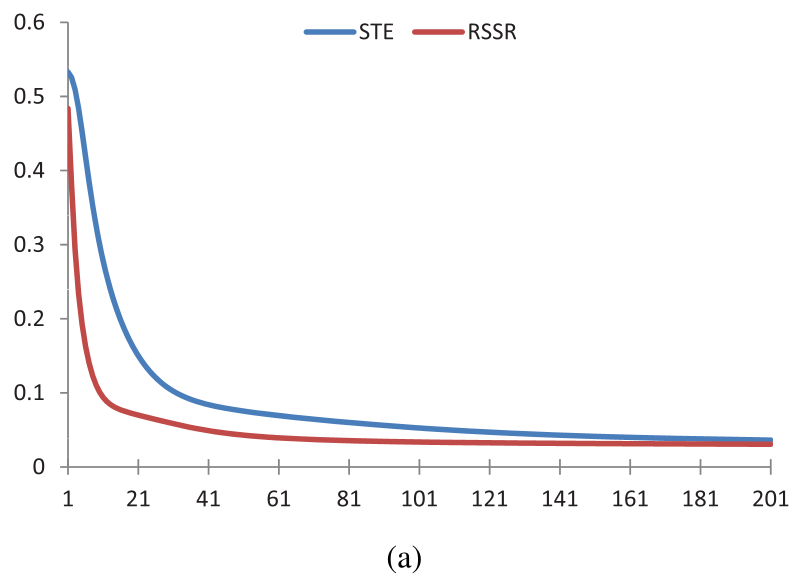
Because the model learns role-level weights () instead of peer-level weights (), convergence is significantly faster. As the dataset size increases, RSSR’s iteration requirements scale linearly, whereas traditional Social Trust Ensembles (STE) scale exponentially.
Critical Insight & Conclusion
The true power of this paper lies in its structural abstraction. By acknowledging that users might only occupy distinct functional "roles," the model filters out the noise of individual variations and focuses on the underlying "social physics" of how influence flows.
Takeaway: If you are building recommenders for massive social graphs, stop trying to model every edge. Model the roles that define the edges. This "Skeleton" approach is not just more efficient—it is more accurate because it captures the sociological truth of human interaction.
Future Work: The authors suggest exploring multi-role modeling (where one person holds multiple roles simultaneously), which could further enhance the granularity of academic and social predictions.