
Beyond the Screen: How AFAS is Decoding the Human Soul
Social Sciences
This paper explores the transformative role of Automated Facial Image Analysis and Synthesis (AFAS) in behavioral science. By leveraging Active Appearance Models (AAMs) and SVM classifiers, the author demonstrates SOTA performance in detecting Action Units (AUs) and complex behavioral states like pain and depression across diverse, naturalistic datasets.
TL;DR
Facial expressions are the "windows to the soul," yet for decades, behavioral scientists were trapped either in subjective manual coding or intrusive sensors. This paper highlights how Automated Facial Image Analysis and Synthesis (AFAS)—powered by Active Appearance Models (AAM)—replaces manual labor with machine precision. It successfully detects depression, pain, and social synchrony while introducing the revolutionary ability to synthesize real-time avatars to test social hypotheses.
Background Positioning: This is a seminal overview that bridges the gap between Computer Vision (AAMs/SVMs) and Clinical Psychology/Behavioral Science.
The Bottleneck: Why Manual Coding is Failing Research
Prior work in behavioral science heavily relied on the Facial Action Coding System (FACS). While comprehensive, FACS is:
- Inherently Subjective: Reliant on the coder's perception.
- Labor Intensive: Often taking hours to code minutes of video.
- Static-Dependent: Struggling to account for the "flow" and timing of expressions (onsets/offsets).
The author argues that the future lies in AFAS, which treats the face as a dynamic, statistical manifold rather than a set of static snapshots.
Methodology: The Power of Active Appearance Models (AAM)
The core innovation lies in the use of AAMs to represent facial structure. An AAM is a statistical model that describes both shape (the "mesh") and appearance (the "texture").
The Foundation of Shape
The shape of an AAM is defined by a base shape plus a linear combination of shape vectors :
This mathematical formulation allows the system to filter out rigid head motion (rotation and translation) while precisely capturing non-rigid deformations—the actual muscle movements of a smile or a wince.
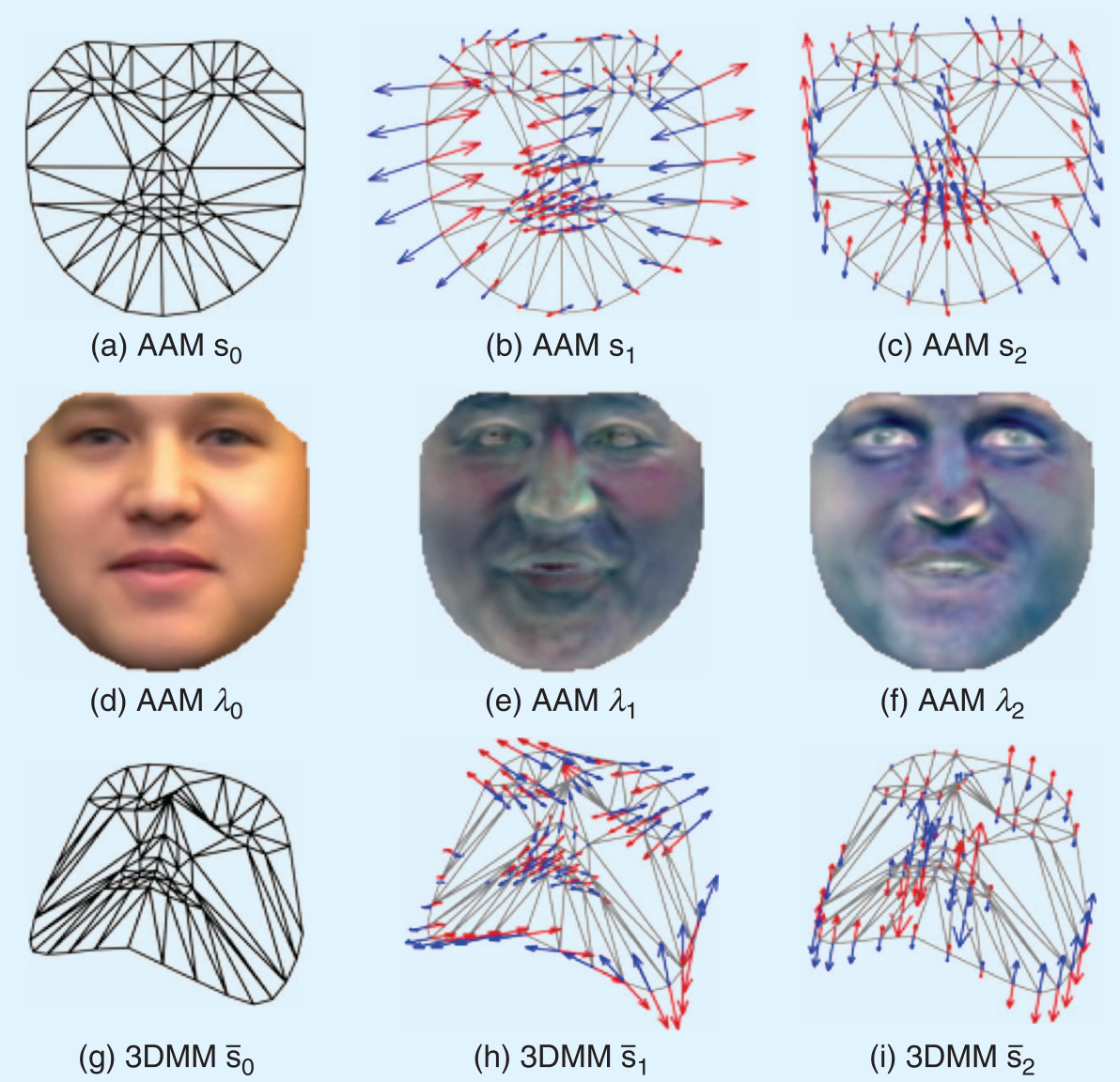 Figure 1: Illustration of shape and appearance basis eigenvectors. (a)-(c) show 2D shape modes, while (d)-(f) show synthesized appearance.
Experiments: Validating Clinical Utility
The paper doesn't just present a model; it proves its efficacy in high-stakes environments:
- Depression Detection: The system achieved 79% accuracy in distinguishing clinical depression from remission, identifying that lowered head pitch and vocal turn-taking are key markers.
- Pain Measurement: AFAS replicated expert ratings of pain by monitoring specific AUs (e.g., brow lowering, orbital tightening). Crucially, it found that pain could be detected from "coarse" ground truth, making it viable for rapid biomedical testing.
- Social Synchrony: By analyzing mother-infant interactions, the system mapped the temporal "coupling" of smiles, proving that the Duchenne smile is a temporally integrated event across social partners.
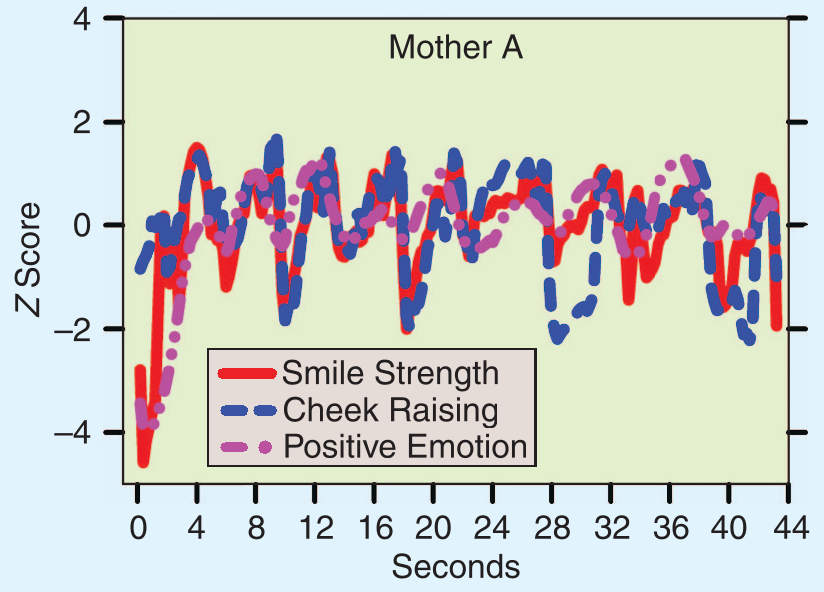 Figure 2: Time-series analysis showing the synchrony between mother and infant facial actions and perceived emotion.
Synthesis: Experimental Control via Avatars
Perhaps the most "future-tech" aspect of the work is the use of Communication Avatars. By using AAMs to extract motion parameters from one person and "driving" the face of another (cross-identity synthesis), researchers can now answer: "Do we react to who someone is (identity) or what they do (behavior)?"
The study found a fascinating Perceptual Stream Dissociation: head movements respond to the dynamics of the conversation, whereas judgments of sex are tied strictly to appearance.
 Figure 3: The video-conference paradigm where a live confederate is replaced by a synthesized avatar in real-time.
Critical Insight & Conclusion
The transition from person-specific models (requiring 3% manual annotation) to generic, person-independent trackers (like Constrained Local Models or CLMs) is the next frontier. While person-specific AAMs are more precise, the introduction of Registration Invariant Representations (e.g., Gabor magnitudes) allows AFAS to work "out of the box" without losing feature quality.
Final Takeaway: AFAS is no longer a "lab toy"—it is a robust clinical tool that can reduce human labor by 50% while revealing social cues that the human eye often misses.
Limitations
- Still struggles with extreme occlusion or "spontaneous" non-frontal poses in less controlled settings.
- Generic models currently track less precisely than person-specific models.