
Beyond Six Degrees: Why the Social World is "Lumpier" Than We Thought
Social search in "Small-World" experiments
This paper investigates the "algorithmic small-world hypothesis"—the ability of individuals to navigate social networks to find short paths—using data from two large-scale experiments involving over 160,000 message chains. The authors introduce a novel, provably unbiased estimator based on importance sampling to account for high attrition rates and individual-level heterogeneity.
TL;DR
Is everyone really connected by six degrees of separation? This paper re-examines the "Small-World" experiment with 162,328 email chains and a sophisticated statistical lens. The verdict: While the median person is just 6-7 steps away, the average distance is much longer and the paths are harder to find than previously believed. The "Small-World" is a reality for the socially privileged, but a myth for many others.
The "Algorithmic" vs. "Topological" Gap
Most of us are familiar with the Topological Small-World: if you look at a map of 180 million IM users, the math shows they are separated by roughly 6.6 steps. However, that doesn't mean you could actually find a specific person in that crowd using only your friends.
This paper focuses on the Algorithmic Small-World Hypothesis: can ordinary individuals, using only local knowledge, actually navigate these paths? The authors argue that previous experiments by Milgram and others were flawed because they ignored chain attrition. If 99% of people quit the game before the message reaches the target, the 1% who finish usually represent "best-case scenarios," not the average experience.
Methodology: Modeling the "Human" in the Network
Instead of assuming people quit at random, the authors tracked the attributes of those who stayed in the game versus those who didn't.
1. The Attrition Model
Using multilevel logistic regression, they analyzed how factors like income, education, and age affected "next-step continuance." They found that:
- Social Capital Matters: Individuals with graduate degrees and high incomes were significantly more likely to continue the chain.
- Relational Strength: "Extremely close" friends were more reliable carriers than casual acquaintances.
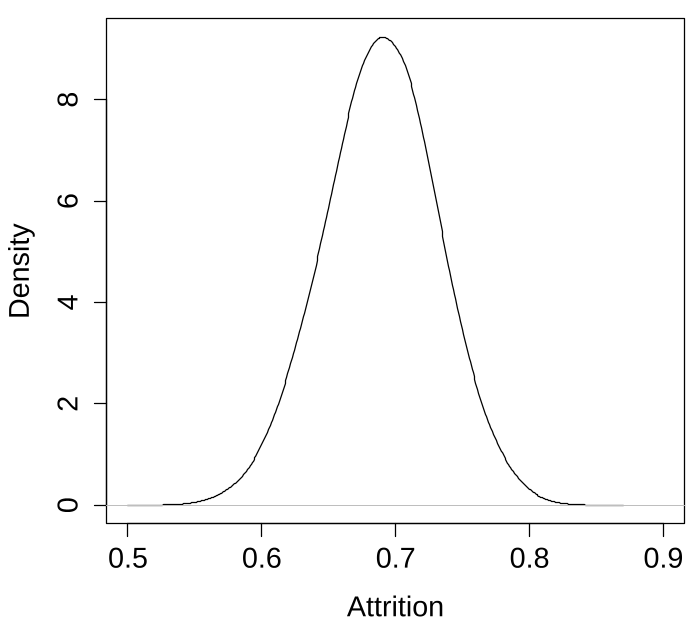 Above: The distribution of attrition rates across participants, showing a peak around 0.7 (70% chance of quitting).
2. Importance Sampling: Correcting the Bias
To find the "true" path length, the authors used Importance Sampling. If a long chain (say 10 steps) has a very low probability of surviving, any 10-step chain that does finish must be given a massive weight in the final calculation to represent the thousands of similar chains that failed.
The Reality Check: Results
The findings provide a "mixed" support for the small-world theory.
- The Median is Stable: Regardless of the model used, the median remains at 6 or 7 steps. This confirms that for about half the population, the "Six Degrees" rule holds.
- The Mean is a Mess: The mean path length jumped from the observed 6 steps to an estimated 22 or even 49 steps once attrition and heterogeneity were factored in.
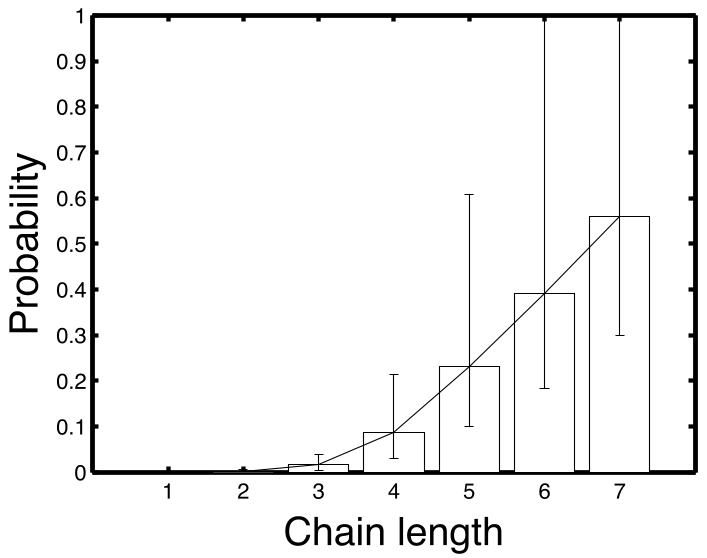 Above: The Cumulative Distribution Function (CDF) shows that while many chains are short, the "tail" of the distribution is long and uncertain.
Deep Insight: A "Bowl of Lumpy Oatmeal"
The authors conclude that our social reality is less like a perfectly connected grid and more like a "bowl of lumpy oatmeal." There are clusters of high-status, highly-educated individuals who can find each other with ease (the "Small Worlds"). However, these clusters are loosely—or perhaps not at all—connected to others.
Key Takeaways for Researchers:
- Search != Topology: Just because a path exists mathematically doesn't mean a human can find it.
- Attrition is Information: The fact that people quit is not "noise"; it's a signal of social distance and lack of motivation/connectivity.
- Heterogeneity is Crucial: Assuming everyone in a network behaves the same leads to massive underestimates of how difficult it is to "network" across social boundaries.
Conclusion
This paper serves as a critical warning for anyone building social search algorithms or viral marketing campaigns: the "average" distance in a social network is a deceptive metric. The world is small for some, but for others, the target might as well be on another planet.