
Decoding the Digital Dialogue: Social and Semantic Network Analysis of Chat Logs
Social and semantic network analysis of chat logs
This paper introduces a dual-methodological framework for analyzing chat logs in Multi-User Virtual Environments (MUVEs), utilizing Social Network Analysis (SNA) for structural patterns and Semantic Network Analysis for content themes. The core contribution is a temporal proximity algorithm that reconstructs interactional ties from non-threaded Internet Relay Chat (IRC) data to evaluate learning communities.
TL;DR
In the sprawling chat logs of Multi-User Virtual Environments (MUVEs), finding "who is learning what" is like looking for a needle in a haystack. This paper presents a specialized framework that combines Social Network Analysis (SNA) and Semantic Network Analysis to map the structural and thematic landscape of IRC interaction. By moving away from simple message sequence and focusing on temporal proximity, the authors reveal the hidden "bridges" and "cliques" that define a learning community.
Problem & Motivation: The Chaos of Semi-Synchronous Chat
In traditional face-to-face interaction, we follow "adjacency relevance"—if I speak after you, I am likely speaking to you. In Internet Relay Chat (IRC), this rule breaks. Multiple threads happen simultaneously, responses arrive out of order, and the sheer volume of data makes manual coding impossible.
The authors identify a critical gap: researchers need a way to quantify the social structure (who is influential?) and the semantic content (what is being learned?) without being misled by the non-threaded nature of chat logs.
Methodology: Mining Structure from Time
The researchers propose a dual-track approach:
1. The Proximity Algorithm (Social)
Since we cannot assume adjacent messages are related, the authors treat communication as a "temporal window." If User A posts and User B posts within 120 seconds, a relational tie is formed. This bypasses the chaos of out-of-order messages.
2. Neural Semantic Mapping (Content)
Using the CATPAC engine, they apply a neural network to extract word co-occurrence patterns. This transforms raw text into a multi-dimensional map where the distance between words represents their conceptual relationship in the minds of the participants.

Experiments & Critical Results: Finding the "Hidden" Leaders
The authors applied their methods to the Tapped-In community, a virtual space for education professionals. By analyzing a one-hour session with 62 participants, they uncovered:
- Information Brokers: While some users were highly active (Degree Centrality), others acted as "bridges" (High Betweenness Centrality). Users like User 7 and User 44 were critical; without them, the network would fragment into isolated clusters.
- Decentralized Learning: A low centralization score (approx. 5%) proved that the learning session was democratic rather than dominated by a single "sage on the stage."
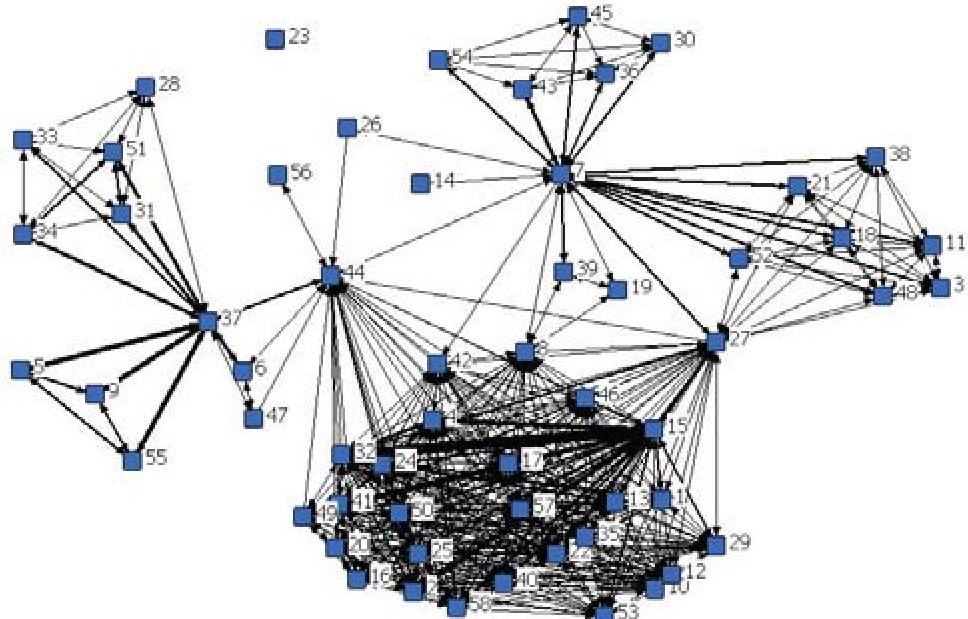 Figure 1: Sociogram of user interaction. Thick lines indicate strong ties; arrows show the flow of information.
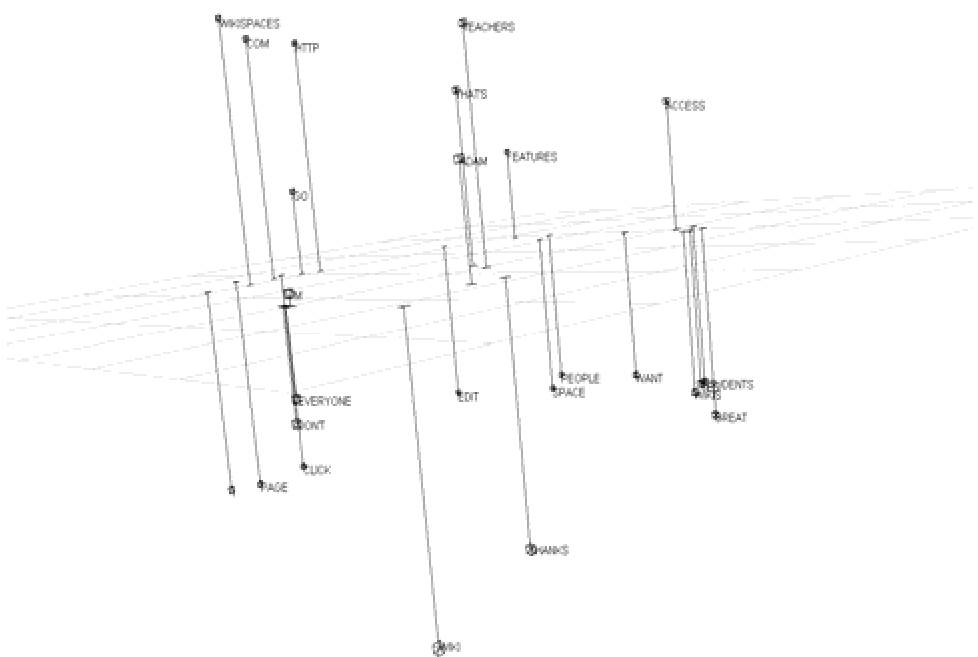 Figure 2: Multi-dimensional plot showing how terms like "classroom," "wiki," and "students" cluster together conceptually.
Critical Analysis & Conclusion
Takeaway: This paper is a pioneering work in Learning Analytics. It proves that social roles in virtual spaces are not just about how much you talk, but where you sit in the information flow.
Limitations: The "temporal window" approach is a clever proxy, but it is still an abstraction. It might capture two people talking "past" each other if they happen to post at the same time about different topics.
Future Outlook: In the age of AI, this framework could be supercharged. Imagine integrating Large Language Models (LLMs) to verify the intent of the proximity-based ties, creating a "Smart Learning Analytics" dashboard that monitors community health in real-time.