
Social Sensing: Transforming Taps and Tweets into a Real-Time Bus "Time Ruler"
Social Sensing Enhanced Time Ruler for Real-Time Bus Service
The paper introduces a "Social Sensing Enhanced Time Ruler," a real-time bus service framework that integrates traditional bus schedules with real-time social media data (e.g., Twitter/Microblog) to predict bus arrival times. It employs an ANN-based prediction model that fuses historical APC data with dynamic social events to provide more accurate "macro rulers" for urban transit.
Executive Summary
TL;DR: This paper presents a novel framework that turns social media into a distributed sensor network to solve the "unreliable bus schedule" problem. By combining historical transit data with real-time "social events" analyzed via Artificial Neural Networks (ANN), the system creates a dynamic "Time Ruler" that predicts bus arrivals with far greater accuracy than traditional GPS-only methods.
In the academic landscape, this work sits at the intersection of Cyber-Physical-Social Systems (CPSS) and Intelligent Transportation Systems (ITS). It transitions from mere data collection to "Social Sensing," where human observations become critical inputs for machine learning models.
The "Blind Spot" of Current Transit Systems
Despite GPS and electronic schedules, commuters still face the "anxiety of the unknown." Why?
- Event Lag: Traditional systems are reactive; they detect a slowdown after a bus hits traffic.
- Qualitative Blindness: Current apps tell you where the bus is, but not how it is (Is it overcrowded? Is the AC broken? Is the driver reckless?).
- Static Logic: Most models ignore the "physical intuition" of a road—how a school zone or a T-junction behaves differently during specific hours.
Methodology: The Science of Social Sensing
The authors categorize the "Time Ruler" into two distinct sensing streams:
1. Perceived Service Quality (PEA)
This handles the "How." Using web crawlers and an SVM-based classifier, the system extracts sentiments regarding comfort, safety, and convenience.
- Innovation: They use KF-IDF-DF (Keyword Frequency-Inverse Document Frequency-Domain Frequency) to weigh terms like "driver skill" or "overcrowded" specifically within the transit domain.
2. Physical Road Conditions (PRCA)
This handles the "When." The system identifies events like "students leaving school" or "traffic floods" and converts them into time-delay variables.
3. The ANN Prediction Model
The core engine is a Back-Propagation ANN. It takes three primary inputs:
- Temporal Context: (e.g., Monday Morning Peak).
- Social Event Vectors: (e.g., A PRCA event detected within the last 30 minutes).
- Spatial Data: Historical records from Automatic Passenger Counters (APC).
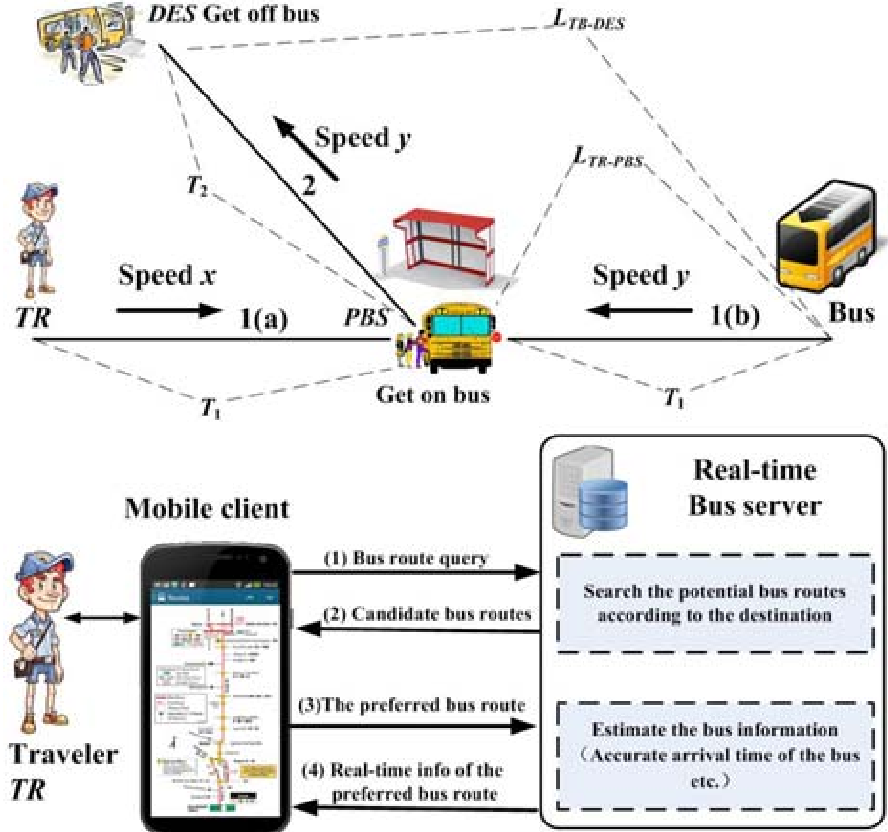 Fig 1: The interaction between the Traveler, Mobile Client, and the Social Sensing Server.
Experiments: Precision in the Real World
The study focused on road sections in Wuhan, China. By dividing the route into road sections (), the model calculates a "Macro Ruler" by summing local delays.
Key Results:
- Error Analysis: The model achieved an average MSE of ~12.2 to 21.3 seconds across different road types.
- Fusing Variables: In a test case for Bus 577, the system integrated a "student crowd" event () and a "traffic flood" () to predict a arrival time delay of precisely 28 minutes and 54 seconds for the total journey.
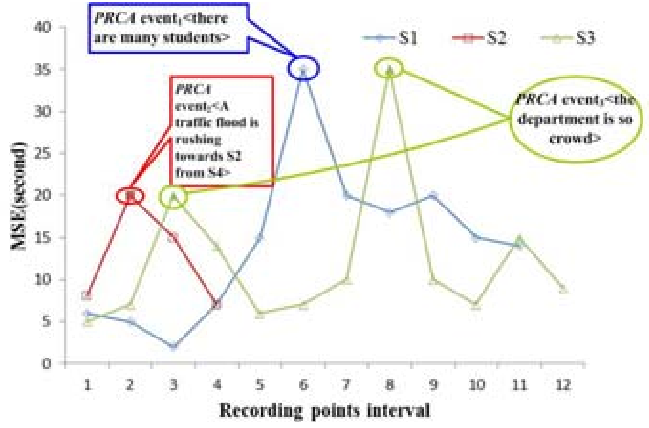 Fig 2: Error distribution for arrival time prediction on different road sections.
Critical Insight: Why This Works
The "magic" isn't just the ANN; it's the Temporal Decay of information. The authors highlight that a tweet from 30 minutes ago is significantly more valuable than one from 3 hours ago for PRCA. They apply a weight to ensure the prediction "lives in the now."
Conclusion & Limitations
Takeaway: This paper successfully argues that public transport isn't just a physical system but a social one. Bridging these two vastly improves the "Time Ruler" accuracy.
Limitations:
- Data Density: The system relies on a high volume of social media "sensors." In cities with low social media activity, the model might revert to baseline historical averages.
- Verification: Distinguishing between "fake" traffic reports and real ones remains a challenge for text-based SVMs.
Future Outlook: Integrating visual social sensing (extracting data from street-level photos/videos) could be the next frontier for this Time Ruler.