
Serendipity: Engineering Spontaneous Social Connections via Mobile Bluetooth
10224_Social serendipity mobilizing social software.
The paper introduces Serendipity, a mobile social software system that leverages Bluetooth proximity detection and a centralized profile database to facilitate real-time, face-to-face interactions. By using the BlueAware application on mobile phones, the system identifies nearby users with shared interests and triggers professional or social introductions in immediate physical contexts.
TL;DR
Serendipity is a pioneering mobile system from the MIT Media Lab that transforms the "passive" Bluetooth signals in our pockets into active social catalysts. By matching real-time proximity data with online user profiles, it cues face-to-face introductions between strangers who share common interests, effectively untethering social software from the desktop and embedding it into the physical world.
Background: Beyond the Desktop
In 2004, while the world viewed mobile phones primarily as communication tools for people already acquainted, Nathan Eagle and Alex Pentland saw them as sophisticated sensors for "Reality Mining." At the time, social networking was synonymous with websites like Friendster or LinkedIn—platforms that required a PC and were disconnected from a user's immediate physical surroundings. The motivation behind Serendipity was to fix this "social software that isn't social" by creating a system that recognizes potential collaborators or friends standing just five meters away.
Methodology: The Architecture of Social Scanning
The system relies on two primary components for proximity detection:
- BlueAware: A background application (MIDP 2.0) that scans for unique Bluetooth Identifiers (BTIDs). To balance rich data collection with battery life, the authors optimized the scan refresh rate to once every five minutes, extending standby time to 36 hours.
- BlueDar: A fixed hardware beacon for social settings (like bars or lounges) that uses a high-power Class 1 Bluetooth chipset to detect all discoverable devices within a 30-meter radius.
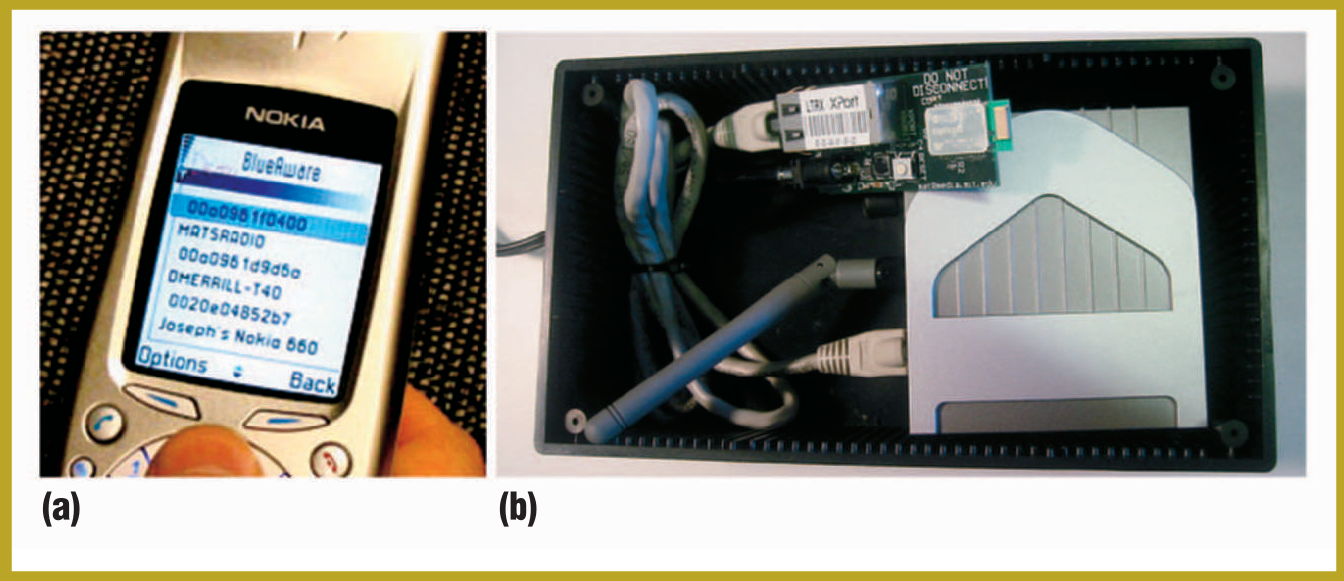 Figure 1. (a) BlueAware on a Nokia Series 60; (b) The BlueDar scanning bridge.
When a match is found based on user-defined weights (e.g., "Business Networking" vs. "Bar Hopping"), the centralized server calculates a Similarity Score. If the score exceeds both users' privacy thresholds, the system pushes an alert containing the other person's photo, shared interests, and suggested "talking points."
Relationship Inference: The Math of Friendship
A standout technical insight of this paper is the move from simple proximity sensing to Relationship Inference. By collecting longitudinal data (cell tower transitions and Bluetooth logs), the authors trained a Gaussian Mixture Model (GMM) to recognize patterns.
They discovered a "common-sense phenomenon" with mathematical precision: office acquaintances are seen frequently during 9-to-5 hours in specific locations, while true friends show a distinct signature of proximity outside of work hours and across varying cell towers.
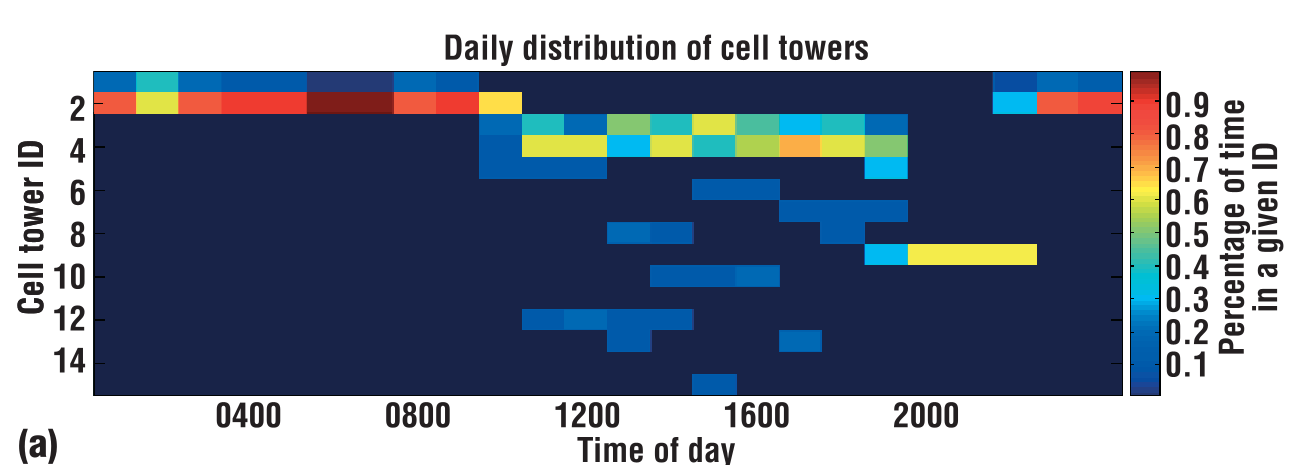 Figure 2. Visualizing a user's day: The "midday hot spot" represents office time, while outlying detections indicate social interactions.
Experiments & User Insights
The system was stress-tested at a high-level executive conference. Key findings included:
- The "Context" Problem: Users in an auditorium during a talk don't want to be matched. The authors solved this by placing "Blocker" Bluetooth beacons in the hall to pause the app.
- Social Overload: In crowded reception areas, users felt overwhelmed by too many alerts. This led to the implementation of a "Hidden Mode" and a "Cool-down" period of 10 minutes between introductions.
- Commercial Interest: There was significant enthusiasm for "Enterprise Serendipity"—connecting employees in large corporations who are working on similar projects but have never met.
Critical Analysis: Privacy and Friction
While the technical achievement is significant, the paper acknowledges major hurdles:
- Privacy: Sharing names and photos with nearby strangers is high-risk. The authors proposed "Anonymous SMS" and "Friends-of-Friends" filters to mitigate this.
- The Visibility Trap: Bluetooth discovery must be turned "on," which many users disable for security or battery reasons.
- Legacy: Looking back, this work laid the foundation for modern proximity-based features like Apple's AirDrop or the "People Nearby" functions in apps like WeChat and Telegram.
Conclusion
Serendipity was a visionary leap towards the Internet of People. It recognized that the most valuable data we carry isn't just our contact list, but our physical movement and proximity patterns. As we move into an era of AR and even more sophisticated wearables, the principles of context-aware, weighted matching proposed by Eagle and Pentland remain more relevant than ever.