
Beyond Venting: How Online Social Networks Replicate the Deep Mechanics of Human Emotion
The social sharing of emotion (SSE) in online social networks: A case study in Live Journal
This study investigates the Social Sharing of Emotion (SSE) within the Live Journal blog network, employing content analysis of 540 posts. It identifies a three-phased communication structure (Initiation, Feedback, and Repost) and confirms that online emotional exchanges largely replicate the pro-social, beneficial patterns found in face-to-face interactions.
TL;DR
Is expressing your feelings on a blog just "shouting into the void," or does it actually help you heal? A case study of Live Journal reveals that online emotional sharing is far from superficial. By analyzing 540 blog posts, researchers found that users engage in a sophisticated three-phase cycle of emotional sharing that closely mirrors face-to-face psychology, providing a vital pro-social function for emotional recovery.
Background: The Digital "Venting" Myth
For years, critics have dismissed online emotional expression as mere "venting"—a superficial outburst of feeling that lacks the depth of real-world interaction. In the academic coordinate system, this paper sits at the intersection of Computer-Mediated Communication (CMC) and Social Psychology. It challenges the cynical view of SNS behavior, arguing that platforms like Live Journal serve as digital sanctuaries for a process known as the Social Sharing of Emotion (SSE).
The Human Urge: Why We Share
The core insight of the authors is that emotions are inherently interpersonal. When a goal is blocked (negative emotion) or achieved (positive emotion), humans feel an instinctive urge to affiliate. SSE theory suggests that for this to be beneficial, it must involve:
- A Narrative: Describing the situation and the feeling (not just "I'm sad").
- A Recipient: Someone to provide feedback.
- A Loop: An exchange that leads to emotional regulation.
Methodology: The Three-Phased Model
The researchers mapped the interaction on Live Journal into a specific cycle:
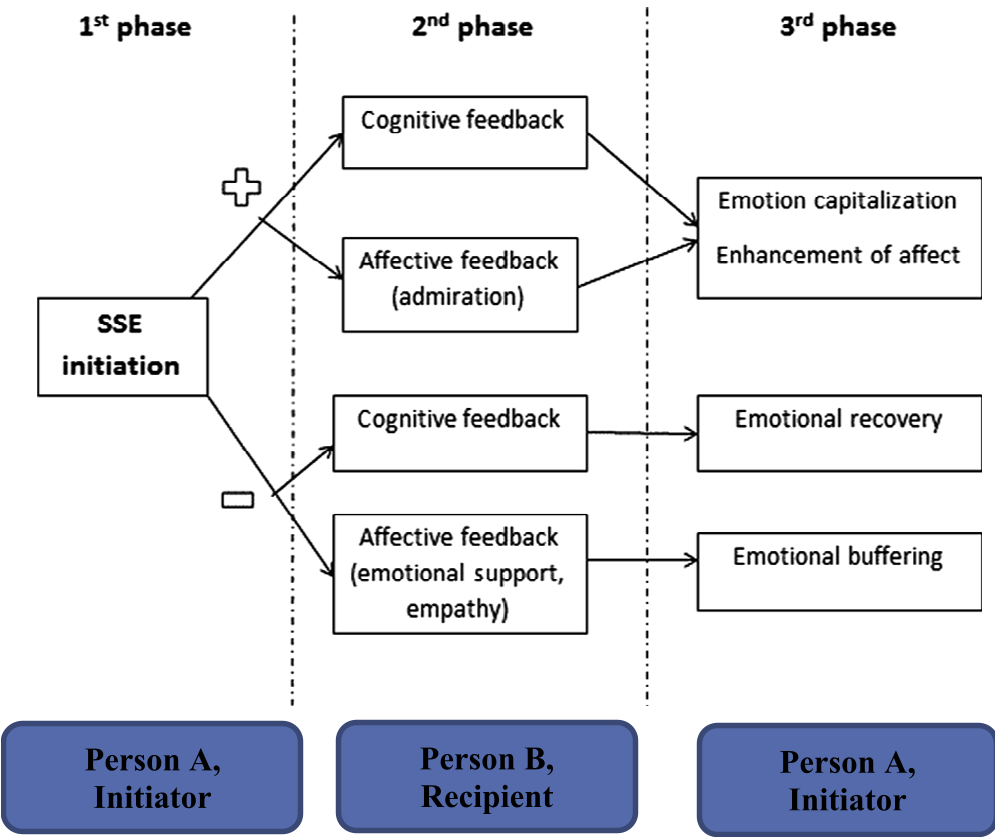
- Phase 1: Initiation: Users post about their Day. The study found that "Full SSE" (stating both the event and the feeling) was the dominant mode.
- Phase 2: Feedback: The audience responds. The study examined Affective Feedback (comfort/empathy) vs. Cognitive Feedback (rational reframing/advice).
- Phase 3: Repost: The original author responds to the comments, potentially signaling emotional recovery.
Key Findings: The Power of Negative Valence
Contrary to the "highlight reel" culture of Instagram or Facebook, Live Journal users showed a higher propensity for sharing negative emotions.
1. SOTA Performance in Empathy
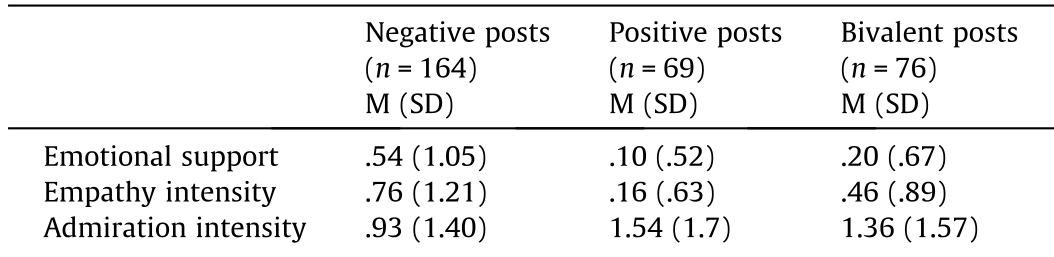
The data showed that feedback providers are highly "attuned" to the needs of the initiator. When a post was negative, the intensity of empathy and emotional support spiked significantly.
2. Affective Over Cognitive
Consistent with face-to-face communication, Affective Feedback (33.7%) outperformed Cognitive Feedback (20.9%). This suggests that when people share online, they are primarily looking for a "buffer"—a sense of being heard and validated—rather than a logical solution to their problems.
3. The "Full Account" Preference
73.5% of emotional posts were "Full SSE." Users aren't just saying "I'm shocked!"; they are explaining why (e.g., "I saw a car accident, and now I feel shocked"). This narrative structure is the key indicator that the user is seeking meaningful social interaction, not just an emotional outburst.
Critical Analysis & Conclusion
This work provides a robust defense of online communities. It proves that the Inductive Bias of these platforms allows for a replication of deep-seated human social needs.
Limitations: The study focuses on Live Journal, which has a specific "diary-like" culture and higher anonymity. These results might shift on platforms like LinkedIn, where professional impression management might suppress negative SSE.
Takeaway: For researchers and product designers, the message is clear: Social platforms are at their best when they facilitate the full narrative of an emotion. By providing a space where users feel safe to share the "Why" and the "How" of their feelings, we can foster genuine well-being and digital social capital.