
Leveling Up the Brain: Why Social Sharing is the Secret Sauce for Cognitive Training
The Effect of Social Sharing Games and Game Performance on Motivation to Play Brain Games
This study investigates the impact of gamification feedback mechanisms on user engagement in "brain games." Specifically, it compares performance-based feedback (scores) versus completion-based feedback (badges) across private and socially shared contexts, finding that socially shared performance feedback significantly boosts intrinsic motivation.
TL;DR
Training your brain is often as repetitive as a gym workout, making long-term adherence a major hurdle. This study reveals that how we receive feedback matters: sharing your performance (scores) on social networks significantly boosts intrinsic motivation and enjoyment compared to keeping those achievements private. The "Social Score" is the gold standard for keeping players engaged in brain-training tasks.
The Motivation Gap: From Art to Science
Psychologists have long used standardized tasks to improve attention and memory. However, while the content is scientifically sound, the motivation is often lacking. Most users find these tasks "dull" or "repetitive." Gamification—adding points, badges, and levels—aims to fix this, but the research is divided. Does a badge make you feel competent, or does it feel like a "controlling" external reward that kills your natural interest?
The authors of this paper argue that the missing link is the Social Environment. Brain games are typically solitary experiences, but by shifting them into Social Network Games (SNGs), we can tap into human needs for connection and social comparison.
Methodology: The 2x2 Factorial Design
To isolate what truly drives motivation, the researchers recruited 202 participants and assigned them to four distinct scenarios during a visual attention task:
- Private Badge: "You finished the task! (Only you see this)"
- Private Score: "You scored 8/10! (Only you see this)"
- Social Badge: "You finished the task! (Posted to Facebook)"
- Social Score: "You scored 8/10! (Posted to Facebook)"
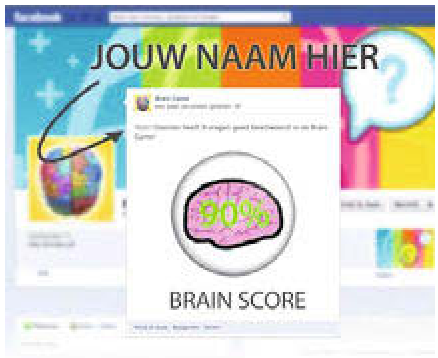 Above: An example of the "Social Badge" interface used in the study to simulate social sharing.
Key Findings: The Power of the "Social Score"
The results were clear: Publicity matters.
- Motivation & Interest: There was a significant main effect for social sharing. Those who knew their results would be shared were much more likely to want to play again.
- The Winning Combo: The "Social Score" condition (Performance-based + Shared) outperformed all others. It wasn't just about finishing (badges); it was about showing how well you did.
- The Competition Paradox: Interestingly, the participants didn't report feeling more "competitive." This suggests that social sharing might be satisfying a need for competence or relatedness (social signaling) rather than just a raw desire to beat others.
Note: The study found a distinct spike in motivation when performance-based feedback was combined with social sharing.
Deep Insight: Competing without Competition?
One of the most fascinating takeaways is the disconnect between motivation and perceived competition. Even though players in the "Social Score" group were the most motivated, they didn't necessarily feel they were in a "contest."
This suggests that in the context of health and brain training:
- Social Signaling is powerful: Proving you are "smart" or "persistent" to your network is a reward in itself.
- Competence over Completion: Simple badges (completion) are less motivating than scores (competence) because scores provide a more nuanced "signal" of one's ability.
Critical Analysis & Future Outlook
The study provides a strong blueprint for health-tech developers: Stop building solitary apps. To keep users coming back to cognitive exercises:
- Shift from Private to Public: Create "opt-in" social loops.
- Prioritize Skill-Based Feedback: Use granular scores rather than binary "Task Complete" badges.
Limitations: The study used a one-time experiment. The "novelty effect" of sharing a score might wear off over weeks of daily training. Furthermore, the participants were already active social media users, meaning these findings might specifically apply to "Socializers" rather than all personality types.
Conclusion: By situating "boring" cognitive tasks within the vibrant ecosystem of social networks, we can transform mental maintenance from a chore into a socially rewarded achievement.