
Beyond Words: Boosting Social Signal Detection with Deep LSTM and Clustering
Classification of Social Signals Using Deep LSTM-based Recurrent Neural Networks
This paper presents a Deep LSTM-based framework for the frame-wise classification of non-verbal social signals, specifically laughter and filler vocalizations. By utilizing the SSPNet Vocalization Corpus, the authors introduce a novel feature engineering approach that integrates k-means cluster information with standard MFCCs to enhance classification accuracy.
TL;DR
Communication is more than just vocabulary; it's about the "how"—the laughter, the "umms" (fillers), and the pauses. This paper tackles the challenge of identifying these social signals by using Deep LSTM networks and a clever feature engineering trick: using k-means clustering to provide the model with a "map" of the acoustic space. The result? A significant jump in accuracy over traditional machine learning methods.
Background & Motivation: The Silence Between the Words
Over 60% of human communication is non-verbal. While Automatic Speech Recognition (ASR) has mastered "what" we say, Computational Paralinguistics focuses on the non-linguistic fillers and vocalizations.
The authors argue that previous SOTA methods—like HMMs and GMMs—are fundamentally flawed for this task because they assume audio frames are somewhat independent. In reality, a laugh or a filler is a temporal journey. To capture this, we need a model with a "memory," making Long Short-Term Memory (LSTM) networks the perfect candidate.
Methodology: The Core Innovation
The research moves beyond simple MFCC (Mel-frequency cepstrum coefficients) extraction.
1. The Architecture
The team utilized Deep LSTMs, which use input, forget, and output gates to manage information flow. By stacking these layers, the model learns increasingly complex representations of the audio signal.
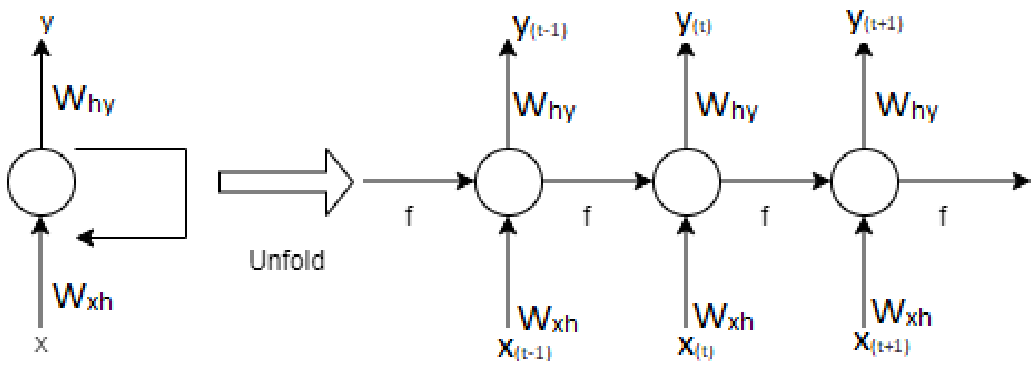 Fig 1: The Recurrent Neural Network structure used to capture temporal speech dynamics.
2. Clustering as a Feature
The "Aha!" moment of the paper is the integration of k-means clustering.
- The Logic: If we group similar audio frames together into clusters, the cluster ID acts as a high-level "summary" of the acoustic state.
- The Implementation: By setting (found via an elbow-method style loss analysis), the input vector expands from 20 (MFCCs) to 21 (MFCCs + Cluster ID).
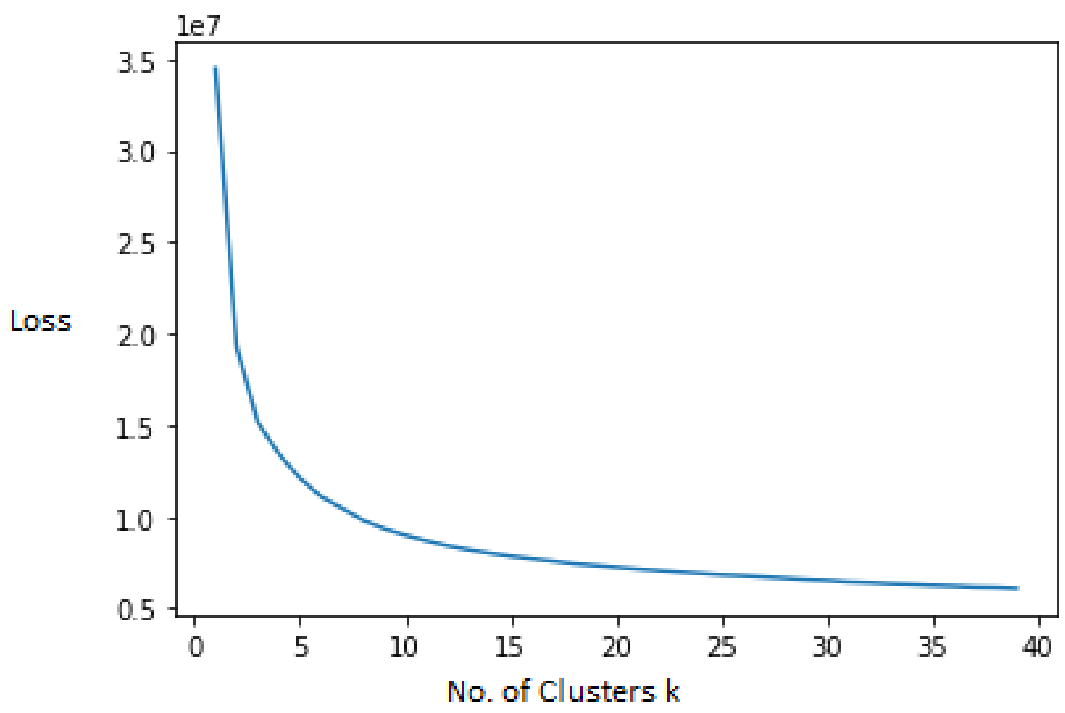 Fig 2: Determining the optimal number of clusters (k=14) to maximize feature information.
Experiments and Benchmarking
The researchers tested their approach on the SSPNet Vocalization Corpus. They conducted an ablation study comparing LSTMs with and without the clustering feature.
Key Findings:
- Standard LSTM: Max Testing Accuracy of 88.18%.
- LSTM + Clustering (Proposed): Max Testing Accuracy of 89.15%.
- Deep Stacking: Interestingly, while stacking LSTMs helped in regular setups, it didn't provide a significant boost when the clustering feature was already present, suggesting that the cluster information might already be providing the "high-level" abstraction that a second layer would normally seek.
The Competitive Landscape
When compared to traditional classifiers, the LSTM's ability to handle temporal sequences gave it a clear edge:
| Model | Accuracy |
|---|---|
| Decision Tree | 78.5% |
| Naive Bayes | 79.9% |
| Random Forest | 85.5% |
| LSTM (Proposed) | 89.1% |
Critical Insights & Conclusion
This work highlights a crucial trend in signal processing: Recurrent architectures are essential for paralinguistics.
However, the most valuable takeaway is the success of the hybrid approach. By combining unsupervised learning (k-means) with supervised learning (LSTM), the model gains a better understanding of the data distribution before it even begins the classification task.
Future Outlook: While LSTMs are powerful, the next frontier for this research would likely involve Transformers or State Space Models (SSMs) like Mamba, which could handle even longer temporal dependencies in conversational audio with better computational efficiency.
Paper Reference: Joshi, H., Verma, A., & Mishra, A. "Classification of Social Signals Using Deep LSTM-based Recurrent Neural Networks."