
TIBIAS: Reimagining TCP for the Social Era of Ad-hoc Networks
7904_Social-Similarity-Aware TCP With Collision Avoidan
TIBIAS is a socially-aware TCP congestion avoidance protocol designed for Ad-hoc Social Networks (ASNETs). It integrates social similarity matching into the transport layer to optimize bandwidth allocation and differentiate between congestion-based and wireless-related packet losses, achieving significant throughput improvements over standard TCP Reno and Veno.
TL;DR
The paper introduces TIBIAS, a novel TCP variant that injects social intelligence into the transport layer. By recognizing how much "similarity" exists between mobile nodes in an Ad-hoc Social Network (ASNET), TIBIAS effectively differentiates between random wireless loss and true congestion, boosting throughput by up to 94% compared to traditional TCP Reno.
Background: When Networks Become Social
Ad-hoc Social Networks (ASNETs) are a unique subset of the Internet of Things (IoT) where devices interact based on human social patterns. However, traditional transport protocols are "socially blind"—they treat every connection the same, leading to poor link utilization in environments where intermediate nodes might prefer to relay data for users with shared interests (e.g., sports fans or colleagues).
The Pain Point: The "Congestion Confusion"
Standard TCP has a fatal flaw in wireless social networks:
- Loss Misinterpretation: It assumes every lost packet is a sign of congestion, leading to a drastic reduction in the congestion window (cwnd) even if the loss was just a momentary wireless glitch.
- Resource Scarcity: It doesn't know how to prioritize bandwidth in a multi-user environment where "social similarity" could be a key metric for allocation.
Methodology: The TIBIAS Architecture
The core of TIBIAS is the Socially-aware Congestion Avoidance and Differentiation Module (SCADM). Unlike standard TCP, which follows a linear increase/decrease path, TIBIAS uses a two-pronged approach:
1. Socially-aware Congestion Avoidance (SCAS)
Instead of just reacting to RTT, TIBIAS calculates a Similarity Interest Rate (SIR).
- If the current window is smaller than the SIR-calculated "ideal" rate, it increases the window more aggressively.
- It ensures that nodes with high similarity scores get a "high-priority" slice of the available bandwidth.
2. Socially-aware Differentiation (SDS)
When a packet is lost (indicated by triple duplicate ACKs), TIBIAS doesn't panic. It checks the relationship between the current window and the SIR:
- Wireless Loss: If the window is already below the similarity-based threshold, TIBIAS identifies this as a random link error and retransmits without slashing the window.
- Congestion Loss: Only if the window exceeds the similarity-based rate does it trigger traditional congestion control.
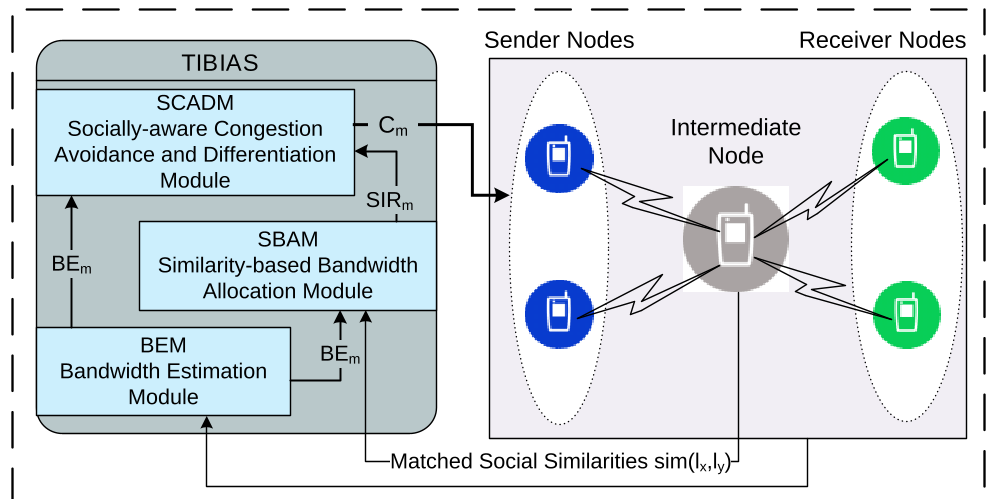 Figure: The structural flow of TIBIAS, showing the integration of Bandwidth Estimation and Similarity Allocation.
Experimental Validation
Using OPNET simulations, the authors compared TIBIAS against heavyweights like TCP Veno, TCP-CERL, and ESTCP.
- Throughput Gains: TIBIAS maintained much higher throughput as the number of connections increased, outperforming Reno by over 90%.
- Link Utilization: Even at high packet loss rates (10^-2), TIBIAS maintained superior link utilization because it resisted the urge to unnecessarily shrink its window during random losses.
- Retransmission Efficiency: By proactively managing congestion through "social" cues, TIBIAS achieved the lowest retransmission ratio among all tested protocols.
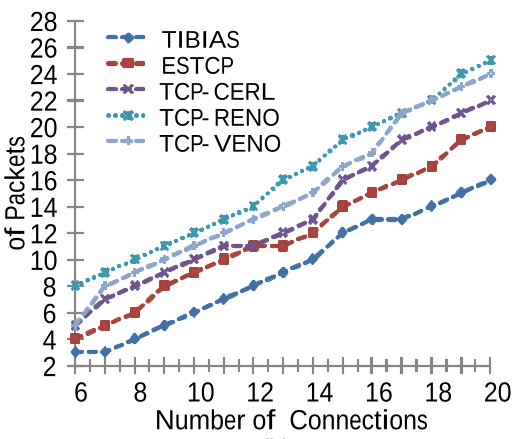 Figure: Impact of packet loss on link utilization—TIBIAS shows significantly higher resilience to error.
Critical Insight & Conclusion
The genius of TIBIAS lies in its sender-side-only modification. It requires no changes to the receiver or the underlying network layers, making it highly deployable. By utilizing "Similarity Matching" (calculated through ontology-based profile comparisons), TIBIAS transforms the transport layer from a math-driven pipe into a context-aware communicator.
Future Outlook: While TIBIAS excels in similarity-based scenarios, future work must address "socially selfish" behaviors where nodes might refuse to relay for anyone without similarity. Balancing social priority with global fairness remains the next frontier for ASNET research.