
Decoding 17 Years of Social Simulation: From Cellular Automata to Complex Networks
Which models are used in social simulation to generate social networks? a review of 17 years of publications in JASSS
This paper presents a systematic review of 17 years of social network models used in the Journal of Artificial Societies and Social Simulation (JASSS). It identifies and classifies the predominant network generation techniques—ranging from regular lattices to scale-free networks—while evaluating their evolution toward more data-driven and realistic synthetic population approaches.
TL;DR
How do we connect digital citizens in an Agent-Based Model (ABM)? This paper reviews nearly two decades of research in the Journal of Artificial Societies and Social Simulation (JASSS), uncovering a community-wide transformation. While the field began with rigid grids, it has evolved into a sophisticated landscape of Scale-Free and Small-World structures, though it still struggles with the "realism gap."
The Modeler's Dilemma: Accuracy vs. Abstraction
When building a simulation—say, an epidemic model in Vietnam—a researcher can easily generate synthetic agents with the right ages and incomes. But how do they know who talks to whom?
Social network data is notoriously hard to acquire due to privacy and complexity. Historically, modellers have reached for abstract mathematical "handles" (like Random Graphs), but these often fail to capture the nuances of human behavior, such as homophily (associating with similar people) or spatial constraints.
Methodology: The JASSS Survey
The authors Meta-analyzed 628 articles to see which "skeletons" researchers use to connect their agents. They identified nine primary categories:
- Regular Lattices: The heritage of Cellular Automata.
- Random Networks (Erdös-Rényi): Simple, average connectivity focused.
- Small-World (Watts-Strogatz): High clustering with short paths.
- Scale-Free (Barabási-Albert): Power-law distributions (the "rich get richer").
- Spatial Networks: Connections based on physical distance.
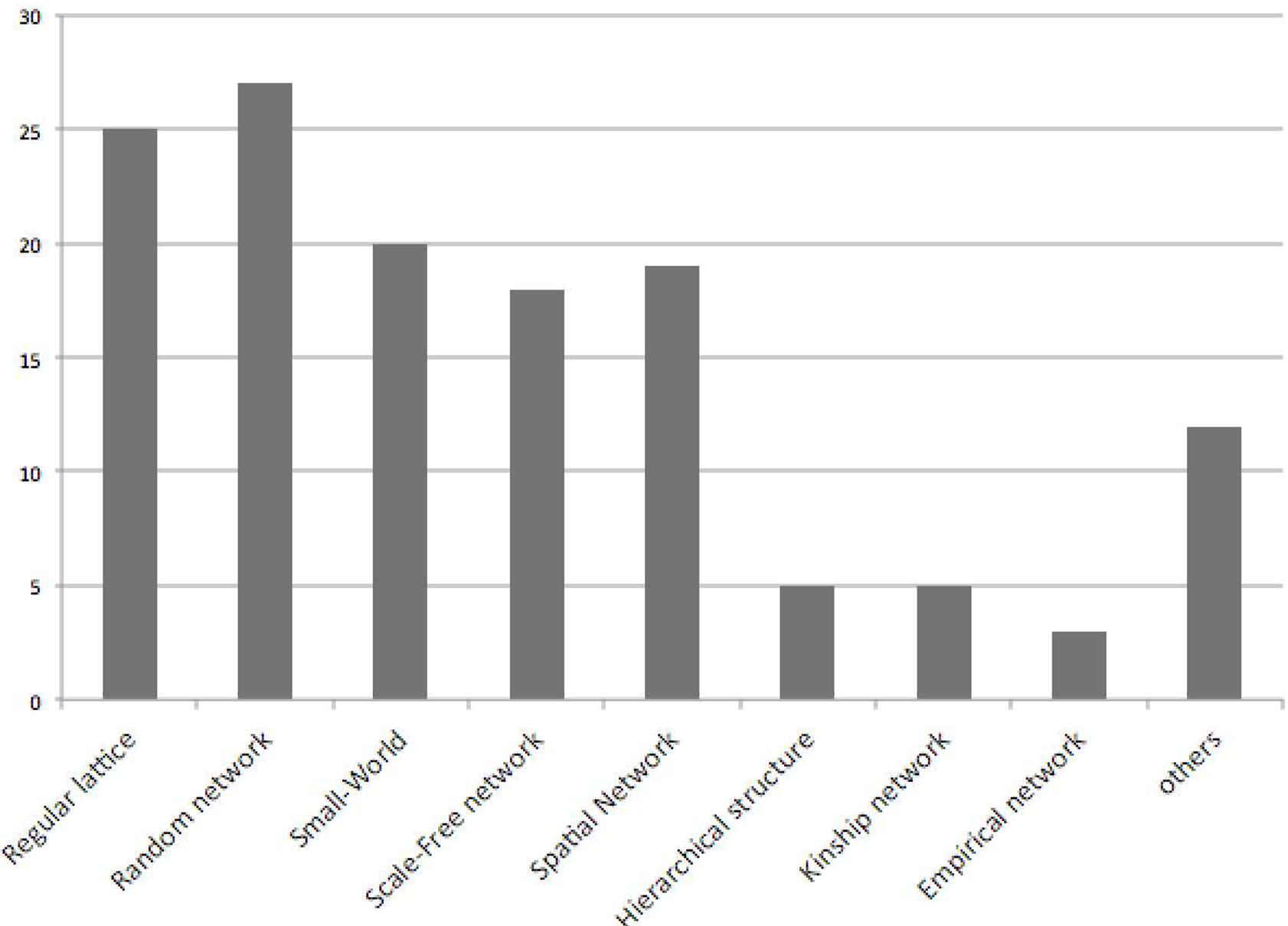 Figure 1: Distribution of model types across the JASSS corpus. Note the dominance of abstract models (ER, SW, SFN).
Strategic Evolution: The Bifurcation
The paper highlights a fascinating "fork in the road" that occurred as the community grew away from its Cellular Automata roots:
- The Spatial Path: The grid was interpreted as geographical space. This led to models where distance dictates connection (e.g., the "Social Circles" model).
- The Structural Path: The grid was interpreted as a pure interaction topology. This led to the adoption of Erdös-Rényi, Small-World, and Scale-Free models to test how different "shapes" of society change the results of an experiment (the "Network Effect").
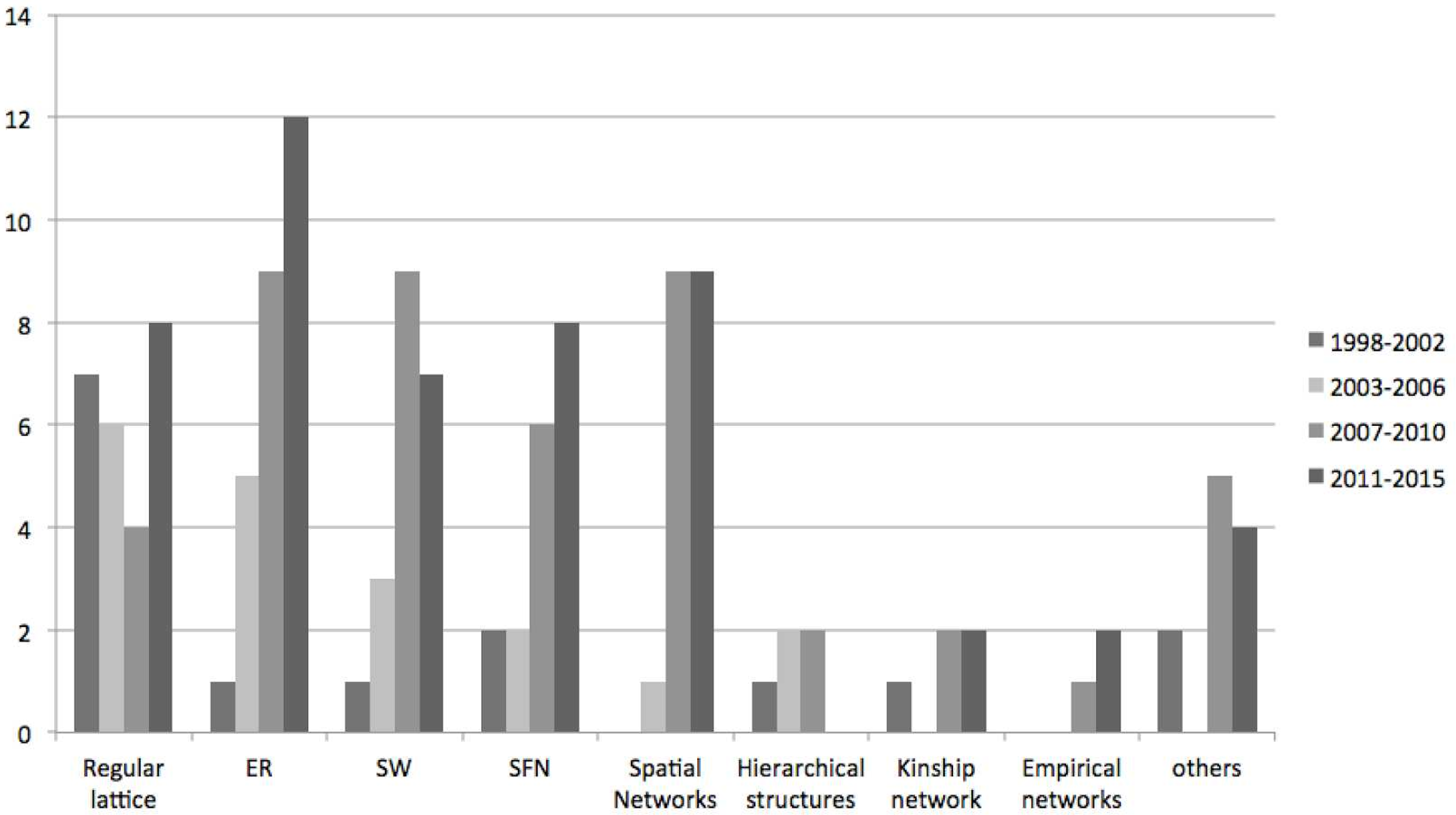 Figure 2: Usage of models across five-year segments. We see a clear rise and stabilization of Small-World (SW) and Scale-Free (SFN) models after the year 2000.
Beyond the Basics: The Future of Synthetic Societies
The authors argue that "abstract" models, while useful for sensitivity analysis, are reaching their limits. They point toward three promising frontiers:
- Exponential Random Graph Models (ERGM): Statistical models that can replicate the local patterns (like triangles or stars) observed in real human networks.
- Kronecker Graphs: A mathematical way to "scale up" a small, observed network pattern into a massive population.
- Rule-Based Linking (YANG): Instead of a formula, use logic. If Agent A and Agent B share a workplace and are the same age, the probability of a link increases. This creates "informed" networks rather than "random" ones.
Critical Insight: The "Network Effect"
The most profound takeaway is that modern modellers now use multiple network types simultaneously. By running the same simulation on a Random Graph and a Scale-Free network, researchers can prove that their findings aren't just a byproduct of the network's shape.
Conclusion & Limitations
While the community has become more rigorous, the paper identifies a lack of empirical validation. Most simulations still don't use real-world network data because it is "expensive" and "scarce." However, with the rise of RFID tracking, social media APIs, and big data, the next 17 years of JASSS are likely to be defined by hyper-realistic, data-driven synthetic populations.
Takeaway for Practitioners: Don't settle for a default network. Test your agents on multiple topologies to ensure your simulation's emergent phenomena are robust.