
The Social Smart Grid: Scaling Decentralized Energy Through Community Coordination
The social smart grid: Dealing with constrained energy resources through social coordination
The paper introduces the "Social Smart Grid," a framework that integrates social network models and Service-Oriented Architecture (SOA) into power grids. It enables community-driven energy sharing and coordination, achieving stable decentralized operations and energy savings of 7%–9% through a credit-based marketplace.
TL;DR
The energy crisis isn't just a production problem—it's a coordination problem. This paper proposes the Social Smart Grid, an overlay that uses social network logic and Service-Oriented Architecture (SOA) to allow households to trade energy directly. By forming "energy alliances," prosumers can smooth the grid's load, effectively achieving 7-9% energy savings without massive central batteries.
Background: The Storage Paradox
The fundamental weakness of our current power grid is that electricity must be consumed the instant it’s produced. While the "Smart Grid" transition introduced remote meters and renewables, it hasn't solved the peak load problem. Centralized utilities still struggle to predict when you'll turn on your heater or charge your EV.
The author's core insight is that Social Coordination can act as a "virtual battery." If users coordinate their habits within a trusted community, the aggregate demand becomes thousands of times smoother and more predictable.
Methodology: Weaving Social Fabric into the Grid
The framework operates on three layers, with the Social Overlay Network being the innovative heart.
1. The Mathematical Engine of Community
Instead of a top-down control system, the paper adopts the Jackson-Wolinsky Model from economic sciences. Every node (household) calculates its own utility () by balancing the payoff of energy shared by neighbors against the technical cost of maintaining those connections:
eq i} \delta_j^{t(ij)} - \sum_{j: ij \in g} c_j$$ * **$\delta_j$**: The energy "payoff" or reliability a neighbor provides. * **$c_j$**: The "overhead" of managing a contract with that neighbor. ### 2. SOA and SLAs: The Technical Interface For a community to trade energy, it needs a "legal" and technical framework. The paper uses **Web Services (SOA)** to allow users to "publish" their energy offers like blog posts. These are governed by **WSLA (Web Service Level Agreements)**, which automatically monitor if a neighbor actually delivered the 5kWh they promised at 2 PM. 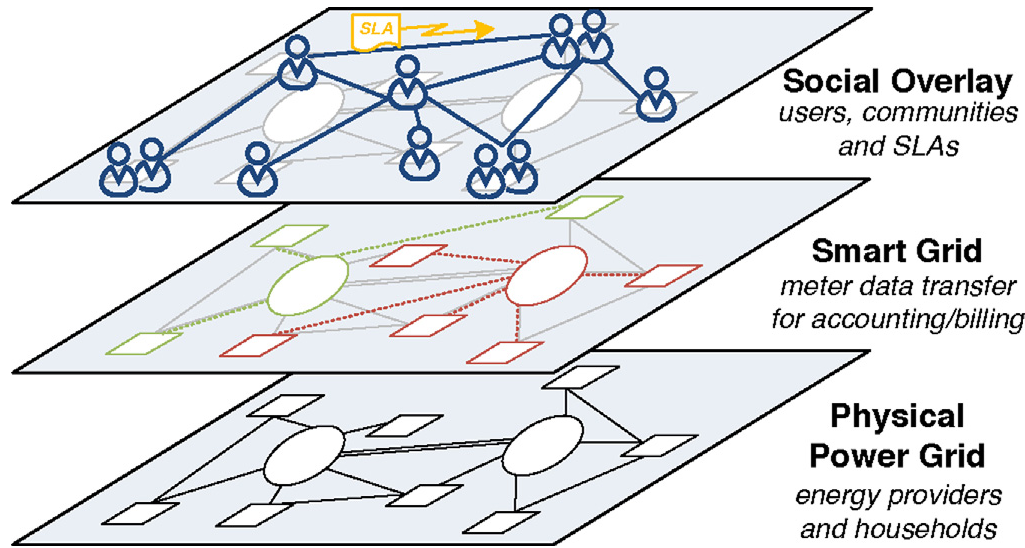 *Figure 1: Conceptual layers of the Social Smart Grid, highlighting the social overlay above the physical infrastructure.* ## Simulation: Can It Actually Scale? The author tested the theory using an agent-based simulation of 767 households, categorized into groups like "Single Adults" (who produce solar energy during the day while at work) and "Pensioners" (who consume more during the day but can share wind energy at night). ### Key Findings: * **Dynamic Stability**: Communities didn't just form; they evolved. Agents cut ties with unreliable neighbors and formed "triangles" of trust. * **The 7% Advantage**: By trading energy locally, the community reduced its reliance on industrial power plants by ~7%. * **Oscillating Utility**: Global utility peaked in the afternoon when solar production was high and different social groups (pensioners vs. workers) could complement each other's needs. 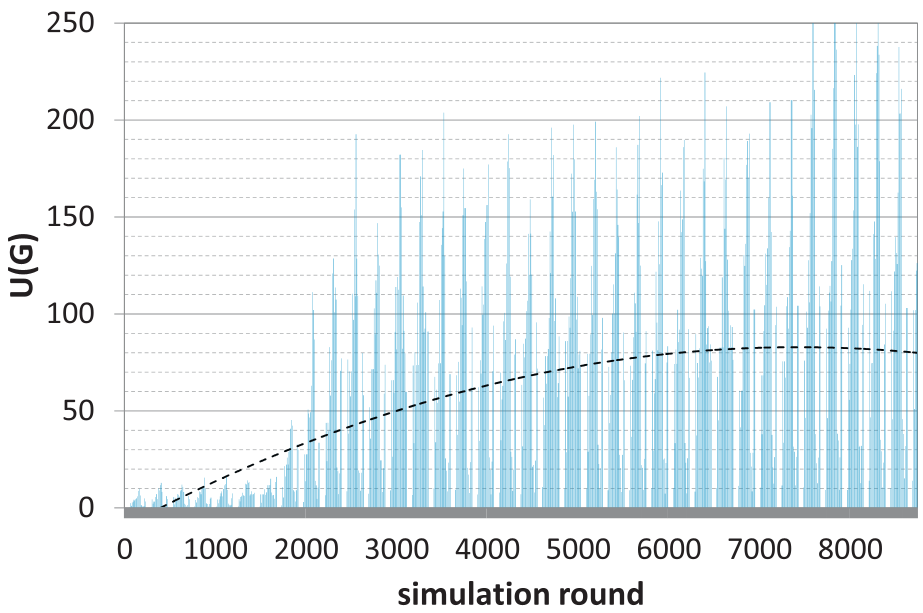 *Figure 2: The evolution of global network utility over time, showing the "warm-up" period where agents find optimal partners.* ## Critical Insight: Why This Matters The most profound takeaway here is **"Transitive Payoff Propagation."** In a social grid, you don't just benefit from your neighbor; you benefit from your *neighbor's neighbors*. If my friend is connected to a huge solar farm, I get a more stable supply through them. This "Social Capital" translates directly into "Energy Security." By using the **Web of Trust** (PGP-style signatures) on FOAF profiles, the system ensures that your energy consumption data remains private within your circle of trust while still allowing for decentralized commerce. ## Conclusion & Limitations While the simulation is promising, the **"Hyperdynamics"** of a real grid—where voltage can fluctuate in milliseconds—presents a higher technical bar than a 1-hour round simulation. However, as EV batteries become ubiquitous, the Social Smart Grid provides the essential **human coordination layer** that is currently missing from our "smart" but "antisocial" energy infrastructure. **Future Outlook**: The next step is moving from simulations to real-world micro-grids, where pseudonymization will be key to protecting user privacy while they trade their "sunlight" for "credits."