
Bridging the Digital Divide: The University of Glamorgan’s Framework for Social Software in Learning
Social Software for Learning – The Institutional Policy of the University of Glamorgan
This paper presents the University of Glamorgan's institutional policy for integrating Social Software (Web 2.0) into higher education. It establishes a formal framework and seven "Good Practice Guidance" points to reconcile the benefits of collaborative learning with the risks of external platform usage.
TL;DR
This paper details the University of Glamorgan's strategic policy for embedding Social Software (Web 2.0) into the academic curriculum. It moves past the "wild west" era of social media by introducing 7 core "Good Practice" guidelines that address the friction between private social lives and formal education, focusing on privacy, reliability, and pedagogical value.
Problem & Motivation: The "Get Out of MySpace" Dilemma
In the late 2000s and early 2010s, a paradox emerged: while students were hyper-connected socially, they often resisted using those same tools for study. The authors identify five critical barriers:
- Psychological Separation: Students often view social software as a space for life, not learning.
- Academic Luddism: Staff were frequently not "up-to-date" and lacked the confidence to moderate digital spaces.
- Legal Quagmires: Concerns over Data Protection (GDPR precursors) and Copyright often led to institutional paralysis.
- Sustainability: The fear that a third-party service (like Flickr or Google Docs) might disappear, taking student work with it.
Methodology: The Glamorgan Core Principles
The university’s approach is not to force adoption ("blanket approach") but to provide a secure scaffold. They define social software through a specific lens of participation and collaboration.
The Categorization of Tools
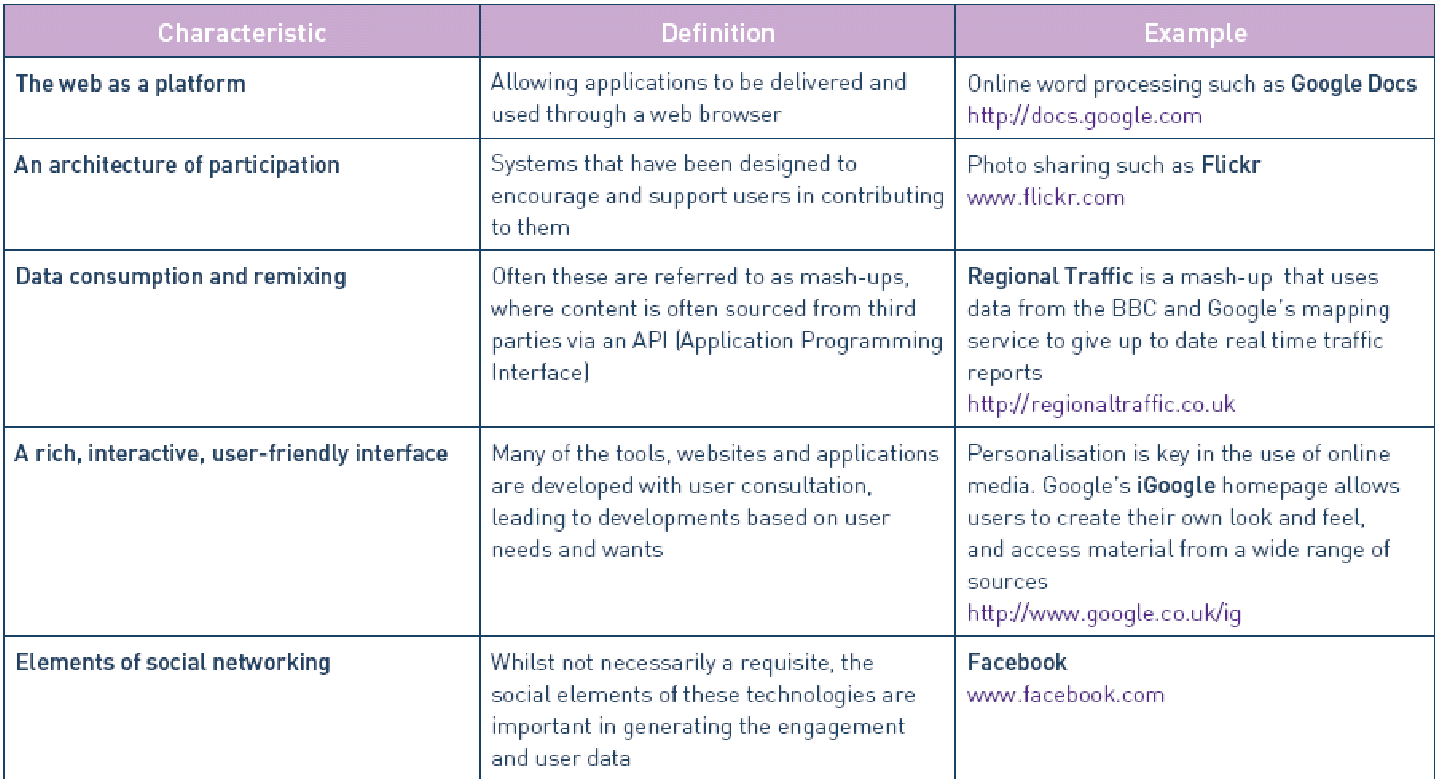
The paper categorizes tools based on four characteristics:
- The Web as a Platform: e.g., Google Docs for collaborative writing.
- Architecture of Participation: e.g., Flickr for peer photo-sharing.
- Data Remixing (Mash-ups): Combining APIs for real-world context.
- Social Networking: e.g., Facebook for community building.
The Seven Good Practice Guidelines
The core of the methodology is a set of actionable instructions for academics:
- Login Transparency: Inform students that university credentials won't work on external sites.
- Risk Awareness: Explicitly warn students about security during contributions.
- The Backup Mandate: Use tools like ScrapBook or built-in restore functions to prevent data loss.
- Support Boundaries: Clarify that the University IT helpdesk does not fix external third-party software.
- Provider Disclaimer: Ensuring students know their data relationship is with the service provider, not the university.
- T&C Auditing: Staff must check "Terms and Conditions" for content ownership.
- Copyright Integrity: Verification that uploaded materials do not infringe on IP rights.
Experiments & Results: Perceived Benefits vs. Institutional Control
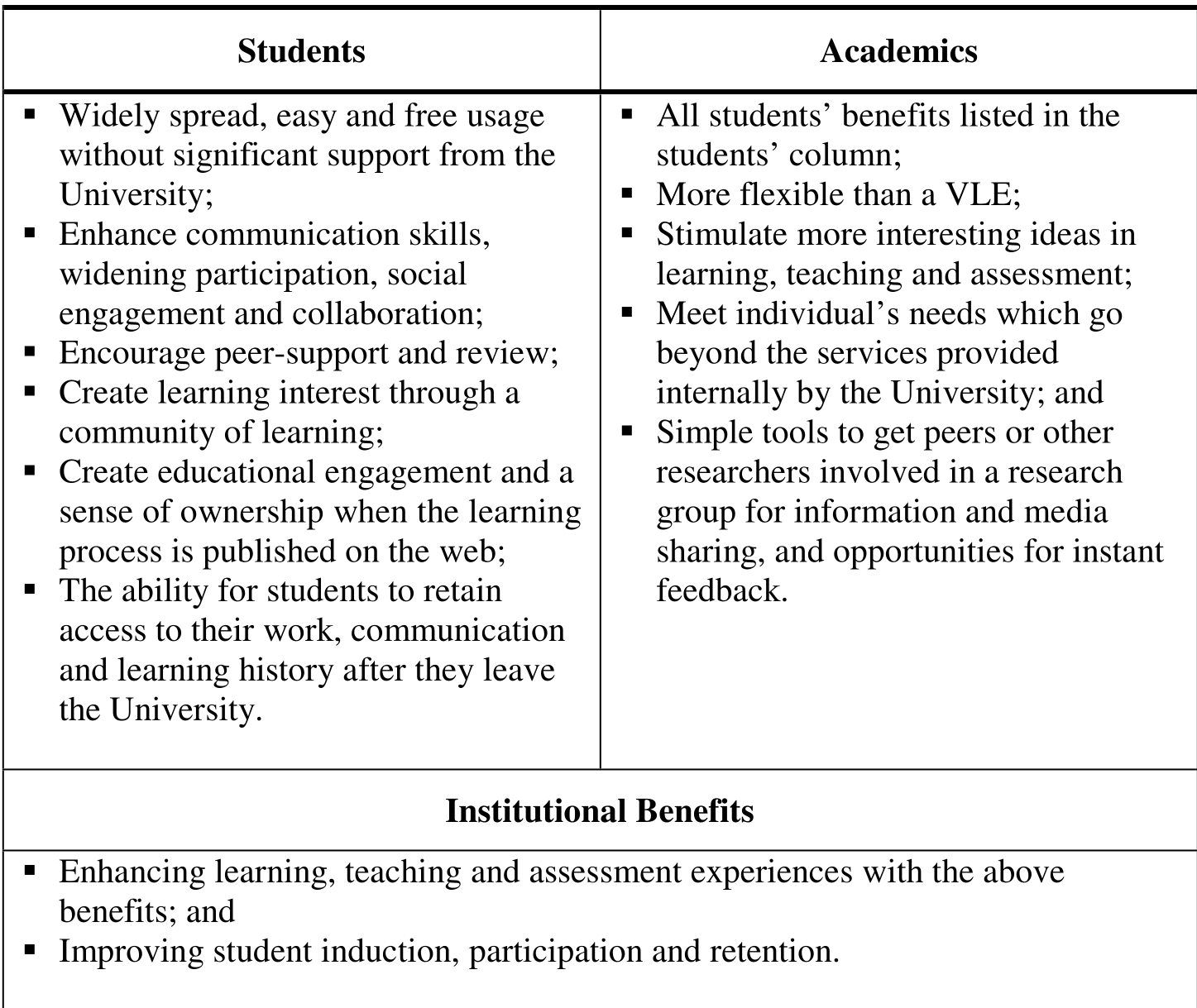
The researchers found that when these guidelines are met, the benefits are multi-dimensional:
- For Students: Increased ownership of work, easy peer-to-peer review, and the ability to retain their "learning history" after graduation (unlike closed VLE systems).
- For Academics: Greater flexibility than standard Blackboard environments and instant feedback loops.
- Institutional Outcome: Enhanced student induction and retention rates by fostering a "Community of Inquiry."
Critical Analysis & Conclusion
Takeaway
The University of Glamorgan's policy was ahead of its time by recognizing that technology is social, but education is institutional. The success of Web 2.0 in learning depends not on the tool itself, but on the clarity of the "Terms of Engagement."
Limitations & Future Outlook
The paper concludes with a vital observation on global accessibility. While these tools work in the UK, many (like YouTube or Facebook) are blocked in major international markets like China. This "Digital Border" remains a significant challenge for modern global universities. Future work must bridge the gap between regional internet policies and universal collaborative learning tools.
Final Thought
If you are an academic today, the question isn't "Should I use social software?" but "Do I have a backup and a privacy disclaimer?"